Surely it would be tough for any drinker to suddenly stop, but what about physically dependent alcoholics? How did they cope and get through withdrawals? Or did they?
It wasn't exactly like alcohol was hard to come by, even during prohibition. There were still illegal bars, smugglers and bootleggers, moon-shining, gangsters and even prescriptions. Yes, doctors used to prescribe alcohol as medication back in the day - even during prohibition. Many doctors made a hefty penny prescribing alcohol to thirsty pasients.
So I guess that alcohol-dependent people still had some ways to get alcohol, both legally and illegally, during prohibition.
They drank.
Getting alcohol during prohibition was not hard, it was available in small towns and big cities.
One option was making moonshine or distilling gin or other spirits in secret. If you didn't do it yourself a neighbor might be and for a price you could have some.
Bootleggers were across the U.S. selling their product, often "cut" bottles. One former bootlegger telling his story in [The New Yorker wrote] (http://newyorker.com/magazine/1926/09/25/a-bootleggers-story-i-how-i-started) :
I bought my bottles from a firm in the Middle West, in lots of ten thousand, perfect imitations of real Scotch bottles. The liquor was made up from Scotch malt that was landed on the Jersey shore. I got hold of one hundred barrels and cut it into fifteen thousand cases of liquor, using the malt for a base, for flavor and so on, and filling out the body with government alcohol redistilled and water.
There was also [prescription alcohol] (http://smithsonianmag.com/history/during-prohibition-your-doctor-could-write-you-prescription-booze-180947940/) available legally to anyone willing to pay.
During Prohibition, the U.S. Treasury Department authorized physicians to write prescriptions for medicinal alcohol.
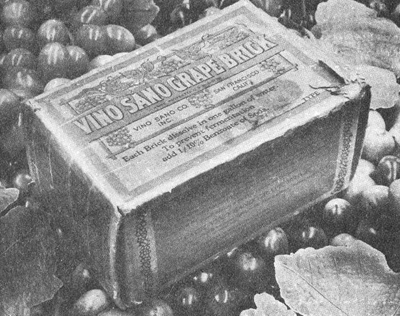
Probably one of the most creative ways alcohol was available across the country was as carefully worded grape juice. This spin on homemade alcohol relied on the fact the grape juice remained completely legal, and why wouldn't it be legal, it is just juice.
Vintners made what became known as "wine bricks," officially called grape bricks, which were just [blocks of concentrated grape juice] (https://vinepair.com/wp-content/uploads/2015/08/vino-santo-grape-brick.jpg). Growing grapes for the purposes of making wine was against the law and the "law abiding" vintners wanted to ensure that they were obeying the law and that their concentrated grape juice could not be used to make wine.
To stay on the right side of the law grape juice makers included [two warnings] (http://smithsonianmag.com/smart-news/ingenious-brick-helped-wine-industry-survive-prohibition-180956412/) to anyone who purchased the grape brick.
The first warning told buyers not to dissolve the brick in a gallon or water. The second warning told buyers that they should not leave the dissolved product in a cool cabinet for 21 days because doing so would turn the product into wine.