Ben Franklin has this infamous quote regarding German immigrants not being able to assimilate to US culture. I guess the Italians and Spaniards part makes sense but I thought Swedes and Germans are some of the whitest people on the planet at that time. Is he talking about a "cultural swarthiness"?
[W]hy should the Palatine Boors be suffered to swarm into our Settlements, and by herding together establish their Language and Manners to the Exclusion of ours? Why should Pennsylvania, founded by the English, become a Colony of Aliens, who will shortly be so numerous as to Germanize us instead of our Anglifying them, and will never adopt our Language or Customs, any more than they can acquire our Complexion.
Which leads me to add one Remark: That the Number of purely white People in the World is proportionably very small. All Africa is black or tawny. Asia chiefly tawny. America (exclusive of the new Comers) wholly so. And in Europe, the Spaniards, Italians, French, Russians and Swedes, are generally of what we call a swarthy Complexion; as are the Germans also, the Saxons only excepted, who with the English, make the principal Body of White People on the Face of the Earth. I could wish their Numbers were increased. And while we are, as I may call it, Scouring our Planet, by clearing America of Woods, and so making this Side of our Globe reflect a brighter Light to the Eyes of Inhabitants in Mars or Venus, why should we in the Sight of Superior Beings, darken its People? why increase the Sons of Africa, by Planting them in America, where we have so fair an Opportunity, by excluding all Blacks and Tawneys, of increasing the lovely White and Red? But perhaps I am partial to the Complexion of my Country, for such Kind of Partiality is natural to Mankind.
Benjamin Franklin is the most important person in American history to never hold the office of President of the United States. He was an intellectual or -- as the French would sometimes refer to him -- un philosophe whose ideas, thoughts and words were flexible and open to change as new opportunities or challenges presented themselves. Franklin was such a prolific writer that you can scan his entire body of work and find some quote to justify any sort of position, but cherrypicking his work is an intellectually dishonest exercise when robbed of context. I've seen this quote floating around quite a bit to lazily justify some sort of strand of anti-immigrant fervor in the United States, typically with a political agenda behind it. But before we go too deep into such a tangential topic, let's first talk a little bit about colonization and then address the question of "What is a German?", which will hopefully answer the concept of swarthy-ness in a concise fashion.
Colonial settlement in North America generally spread from north to south in an effort to pioneer lands with a limited Spanish presence. Early ventures such as the Lost Colony at Roanoke were often abysmal failures, although the English and Scottish were the first to make a strong go of it with colonies in what are now the Atlantic Provinces of Canada, Massachusetts Bay and Virginia. As colonialism began to sweep Northern Europe in an effort to capture some of the wealth of Spain and Portugal, other nations threw their hat into the ring. The Dutch created factories in Albany and Manhattan. The Swedes sent a fairly successful colony to Delaware. The real push for settlement would come, however, from civil disruptions in Europe that acted as a "push factor" from the British Isles to North America. Americans will be innately familiar with at least some element of John Winthrop's Pilgrims who sought to turn Boston into a "beacon upon a hill", but not as much with the less romantic and more practical Dutch, Swedish and German migrations to the 13 Colonies.
By 1664, the nascent Dutch and Swedish ventures had all but come to an end as English domination of North America became more apparent. The demise of New Netherland and New Sweden was in part due to fighting between the Dutch and the Swedes, but also in part due to the fact that life in the Netherlands and Sweden was relatively good and willing immigrants hard to find. The early Dutch and Swedish colonies had never been comprised of an entirely homogeneous or, indeed, monolingual group of settlers but were instead a diverse bunch who had different push factors leading them to North America. At the same time, there was a large influx of Britons and Irishmen seeking to escape the English Civil War (bad for Protestants), the Commonwealth (bad for Catholics) and, finally, the Restoration (bad for anyone who didn't like the king) under Charles II. At the conclusion of the Restoration, several so-called regicides who signed the death warrant of Charles I even managed to escape execution by fleeing to New York. So, as you can see, immigration to the 13 Colonies was a somewhat undesirable option -- something had to have gone rather dramatically wrong for you to want to pick up and leave.
So where precisely do the Germans fit into this?
The Mennonites were an Anabaptist sect formed in response to a radical refutation of Roman Catholicism during the Reformation. On top of eschewing mandatory church membership and infant baptism, they were also perceived to be a particularly dangerous sect of religious zealots by standards of the day. As a result, they were unwelcome in almost every major state of the Holy Roman Empire. Although the Mennonites were clustered throughout Germany, one of the largest concentrations of the "Pennsylvania Dutch" were located in the fervently Roman Catholic Electorate of the Palatinate. The early Pennsylvania Dutch were almost uniformly Mennonites or Anabaptists, but these first settlers opened up the doors for immigrants from across the Holy Roman Empire.
This might seem like a rather insignificant event since, after all, the Pilgrims came to the United States in a rather similar fashion. However, the Pilgrims didn't come in the same numbers and all at the same time. Seeing opportunity to increase the number of immigrants, several colonial bodies either sold or granted vast tracts of land to tens of thousands of Germans of many different religious creeds, but a significant number of new immigrants were dissenting Anabaptist families that sought to not only preserve their German identity, but also to shun those who did not. In the course of 30 years, Pennsylvania went from a somewhat diverse but English-dominated colony to a colony that was at least a third to a half German. While many immigrants integrated well, a large number of the Anabaptists did not. They had no desire to learn English, which was not a problem in it of itself, but they also had misgivings about trading or even interacting with the English, which was anathema for a proto-capitalist like Franklin. The more liberal Anabaptists continued to grate many English colonists in other important ways, including their refusal to take any oath, to participate in any sort of violence even in self-defense against Indian raids and several other cultural grievances both real and imagined.
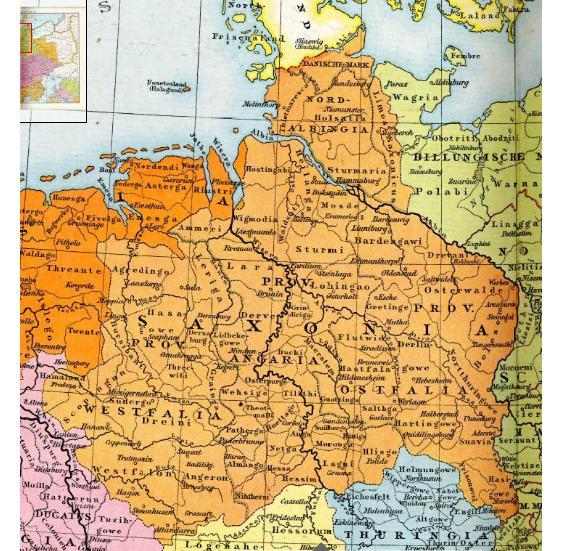
Franklin therefore isn't addressing Germans as a whole in the above paragraph, but is instead using Germans as a short-hand to discuss the Anabaptist Pennsylvania Dutch. He even prefaces his discussion of the Amish by calling them "Palatine Boors", which contrasts with other German immigrants such as the Crowninshield Family of Boston that integrated seamlessly into the fabric of colonial Massachusetts. Crucially, families such as the Crowninshields were considered "Saxons", which doesn't refer to the Electorate of Saxony, the Saxon Ernestine Duchies or any sort of polity -- he is instead referring to Old Saxony, a vast territory that encompasses all of northern and central Germany. Even then, unpacking Franklin's statement about the matter opens a bevy of sociological issues and biases that would have been apparent to an Anglophone reader of Franklin's tracts in the 1750s, but would have been lost without context today.
In addition to being frustrated with the failure of the Mennonites to integrate, Franklin is also prone to 18th century English biases against "swarthy" Catholic Europe, lumping southern Germany with Switzerland, Italy, Spain and Portugal. There is a bit of xenophobia here mixed in with some prejudice and fear, but Franklin is ultimately writing in 1751 on the verge of the French and Indian War. He would go on to have mixed feelings about the Pennsylvania Dutch in particular, but bore no particular ill-feeling to ethnic Germans as a whole: he even suggested adding the heraldic shield of the Kingdom of Prussia to an early proposed design for the Great Seal of the United States.
Where in his writings is this quote? Are we sure it is real?
Why do we think he considers "Red" lovely? Was Franklin a believer in concepts of noble savagery? How much do we know about his feelings on native Americans in general?
I'm guessing that in the nascent days of the United States, many of our founding fathers thought this way, but was the statement seen as controversial at the time? The above post mentioned "infamous," but does modern historical perspective regard Ben Franklin as some sort of racist or proto-white supremacist, a la the slave-owning Andrew Jackson? Do white supremacists cite Franklin in defense of their cause?