I've often heard that, even after the Revolutionary War, people in the US first and foremost thought of themselves as a citizen of their state (e.g. "I'm a New Yorker first, American second"). When did this flip and people viewed themselves as Americans first?
The major turning point was the Civil War and reconstruction. Before the war loyalties remained with states as evidenced by Robert E. Lee's loyalty to Virginia, not the United States.
You even see this shift in the language used by people during that time. Before the war the plural "United States are" was used, after the war "United States" shifted to used as a singular noun and people would say "the United States is." Using the plural allowed people to identify strongly with their state whereas the singular United States created and cemented a national identity.
[Evidence] (http://itre.cis.upenn.edu/~myl/languagelog/archives/002663.html) for this transition goes back to the 1880s.
The plural United States is still occasionally heard. [ At least once] (https://www.theatlantic.com/politics/archive/2013/05/these-united-states-how-obamas-vocal-tic-reveals-a-polarized-america/275739/), and possibly more than once, President Obama used the plural referring to "these United States."
Instead of asking God to bless the United States at the end of his speech, as Obama commonly does, he asked God to bless "these United States."
It is easy to say that the Civil War caused this change, and it played a large role in shifting from state-based identities to identifying as an American, but other factors influenced the change.
At this same time the U.S. was becoming more connected. Railroads crisscrossed the country including the transcontinental railroad completed in 1869. Telegraph lines also went up, often near railroad tracks, and connected distant parts of the country. The 1861 [transcontinental telegraph] (https://en.m.wikipedia.org/wiki/First_transcontinental_telegraph) provided communication in almost real-time between the east and west coasts. Twenty years earlier it took over three months for news to travel across the country.
The Civil War played an outsized role in the development and deployment of both railroads and the telegraph. Both sides, although the Union to a much greater extent, constructed telegraph networks and built railroads for military purposes. After the war the South was left with little of either; and both had to be rebuilt since transportation and supply lines, railroad, and communications, the telegraph, were targeted and destroyed during the war as military objectives.
While /u/NYSenseOfHumor has a pretty good answer here, I wanted to point out some evidence that some Americans held a stronger national feeling before the Civil War than is commonly acknowledged.
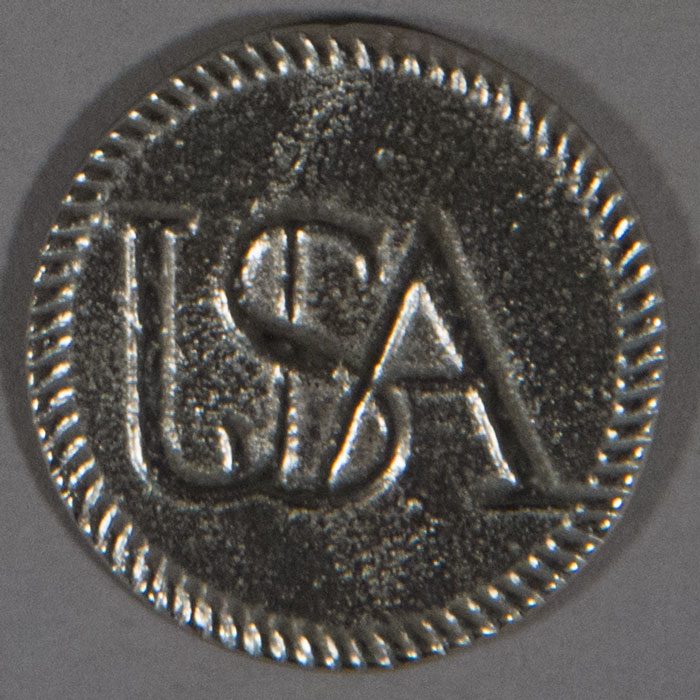
The very existence of an organization called the United States points to a national impulse, and the conduct of the War of American Independence required cooperation between the citizens of the several states. Alan Taylor points to the creation of shared American identity - of free English consumers in an Atlantic marketplace being constrained and harassed by the imperial government - as the basis for the incredible leap of faith that the colonists took in jumping into revolution together. When it could get the supplies it wanted, Continental Army officers ordered buttons and other accouterments with national symbols emblazoned on them. The running of the army was also distinctly national in character: Congress very purposely selected a Virginian to lead the army of New Englanders besieging Boston at the start of the war. By war's end, one of the Massachusetts brigades was commanded by a North Carolinian, another by a general Connecticut, and the New York/New Jersey/New Hampshire brigade by a New Englander (I think. Let me double check that one).
Westward expansion was also more of a national project that a state one. The several states gave up their land claims in the West after the Revolution, giving everything between Ohio and the Mississippi over the control of the central government. Colonists from every state flooded into this area even as the borders defining territories remained fluid and porous; what united them was a sense of being American, not an affiliation to the states they had left behind.
As William Skelton pointed out in An American Profession of Arms, the officer corps of regular Army between the 1820s and the 1850s was proudly national in character, shunning the blatant sectionalism that had defined the 1812-era army (like that time Andrew Jackson had invaded Florida because some Southern planters asked him to). This army proudly, if joylessly, defended US national interests as defined by the federal government out in the West, where fraternity between Northern and Southern officers stood in stark contrast to the growing sectionalism dividing national politics. It's worth noting that the military remained fully functional right up to the point where states started seceding. And, while Lee famously turned his coat to side with his state, many other Southern officers honored their oaths and stayed in the army to fight the rebellion. Of these, none was more prominent that Lee's boss and mentor, Winfield Scott.
As an add-on, /u/freedmenspatrol wanted me to share this unholy mathematical creation that shows "the United States is" and "the United States are " were both used pretty interchangeably.