Disclaimer:
I posted this 10 days ago.
I had an answer from u/Valkine who said that they were in a visit and didn't have access to all their tools/info there and that I should repost this question 10 days later, so here I am.
From the first post however it's been said that it probably was actually used as a tool to build crossbows and not as a crossbow loader, which makes much more sense to me.
The following is a n exact paste of the original post, and here is a link to the original so you can see its answers.
pasted post
Hi everyone
A local newspaper made an article on two crossbow loaders that were found in a neighboring city. Aside from the fact I have a question about it, I think I should put it here as well because according to what's said in the article it's quite a good find and might interest some of you. (to clarify, it's not these small forked objects, it's a huge thing)
Here is the link to the article (no paywall), it is in French. Here's the pic of the loader without the article and bigger, I couldn't find ANY other picture on the internet of such a device
I will write down there a full translation of the digital article in case you're curious, just skip it otherwise, my question isn't answered by the article.
Beginning of article
Two crossbow loaders from 1353 found in Sion
image label: The object now exhibited in history museum allowed to load knight's crossbows
Middle Ages: recent studies allowed to shed light on pieces that were found in the Valère arsenal, crossbow loaders built in Winter 1353.
We thought these were catapults. Two pieces of wood were "sleeping" (kinda weak translation but whatever you get it) in the cantonal depots for quite a while. When the arsenal was inventoried, a hundred years ago, we had labelled them as simple catapults. Until the day where an archeologist and German historian, Fabian Brenker, turns his interest to it. According to him, it is not a catapult but a crossbow loader. "I knew of the existence of this object from the literature, but never, to my knowledge, had we found one in real life." Without waiting, he makes contact with the cantonal museums and goes to Sion. Thanks to his analyses, he manages to determinate the precise date of creation of the object. Winter 1353. The loader although imposing and difficulty transportable, was essential to the knight. Before every shot, this man had to reload his weapon. From shadow to light
the preservation of these objects is a miracle. "They could have been used to make a fire, says Fabian Baker. The fact they still do exist demonstrates of their value." Their identity found again, the most beautiful of the 2 pieces is today out of the shadow. She has made her entrance in the museum of history where it proudly sits at the entrance.
End of article
(The digital article is smaller than the paper one I have, but the only real difference is that it mentions that it was too heavy to carry around so was probably used for defense of static positions such as towns, the rest of the paper article is really not that interesting)
My questions :
Why did we need this ?
I mean from what I've always seen/read/heard on crossbows, I know they're a pain to reload but I thought that you could always do that with both your hands or with a crank for some. Isn't that ineffective to have to line up/move to the location of the loader and wait for your turn to reload this ? Or did there exist crossbows so powerful you couldn't actually reload them by hand ? Was it because it was too early to have cranks invented ? Because it's cheaper than cranks ? Because it's making it less hard on your body to sustain longs periods of using this weapon ? Because there's less risk of harm to yourself when you reload it this way ?
Googling around, I couldn't even find another picture or mention of static crossbow loaders, whether in French or English, looks like a really niche thing so I guess it was far from extremely useful ?
I appreciate you reading this far and hope you'll have useful answers :) (And it looks like knights where I used to live didn't care much about the whole "no range kills" thing, just noticing by the way)
Before I go on to talk about my thoughts on what this likely is, it’s worth spending some time talking about what we know of crossbow spanning devices, and how they don’t generally look like this. Multiple devices were developed over the course of the Middle Ages to help with the spanning (or drawing) of crossbows of varying strengths. While new, more complex machines were introduced in the Later Middle Ages, it shouldn’t be assumed that older devices were completely replaced by new technology. New devices could span far more powerful crossbows, but did so at the cost of being bulky and slow. Less powerful crossbows remained popular in the Later Middle Ages due to their ease of use, and greater rate of fire.
The most basic way of spanning a crossbow is also the most obvious: use your hands. The first innovation we know of to aid this process was the addition of a stirrup to the front of the crossbow. This allowed the weapon to be held firm by the archer’s foot while the crossbow string was pulled back into place. The chronology of early crossbow history is at best vague, and at worst completely unknown, so it’s hard to say exactly when the next innovation came onto the scene, but it was certainly present during the High Middle Ages. This device was the belt hook, and it was pretty much as it sounds: a hook that hung from the archer’s belt. This was attached to the string, the archer placed their foot in the stirrup, and then used the force of their legs/back to pull the string into place. This could be done either by balancing on one foot and pushing down with the other, or by kneeling and using a standing-up motion to pull the string into place. There’s a great illustration of the former in the 14th century Lutrell Psalter, which also shows how this device remained in use throughout the Middle Ages.
A device that was very similar in use to the belt hook, but much later in invention, was the Krihake or Samson Belt. This device also used a hook, but it was attached to a pully and placed on a piece of rope. This was tied around the archer’s waist, and used by securing the rope to a notch on the crossbow, and the hook onto the string. The archer would kneel to do this, and then use the act of standing to pull the string into place. The pulley allowed an archer to span a much more powerful crossbow than would have been possible with a belt hook. You can see examples of these being used in the foreground of Piero de Pollaiuolo’s Martyrdom of St. Sebastian from c.1475 : https://en.wikipedia.org/wiki/Martyrdom_of_Saint_Sebastian_(Piero_del_Pollaiolo)#/media/File:Antonio_Pollaiuolo_003.jpg. (Sorry for the open link, I can't remember how to embed a link that has brackets as part of its URL)
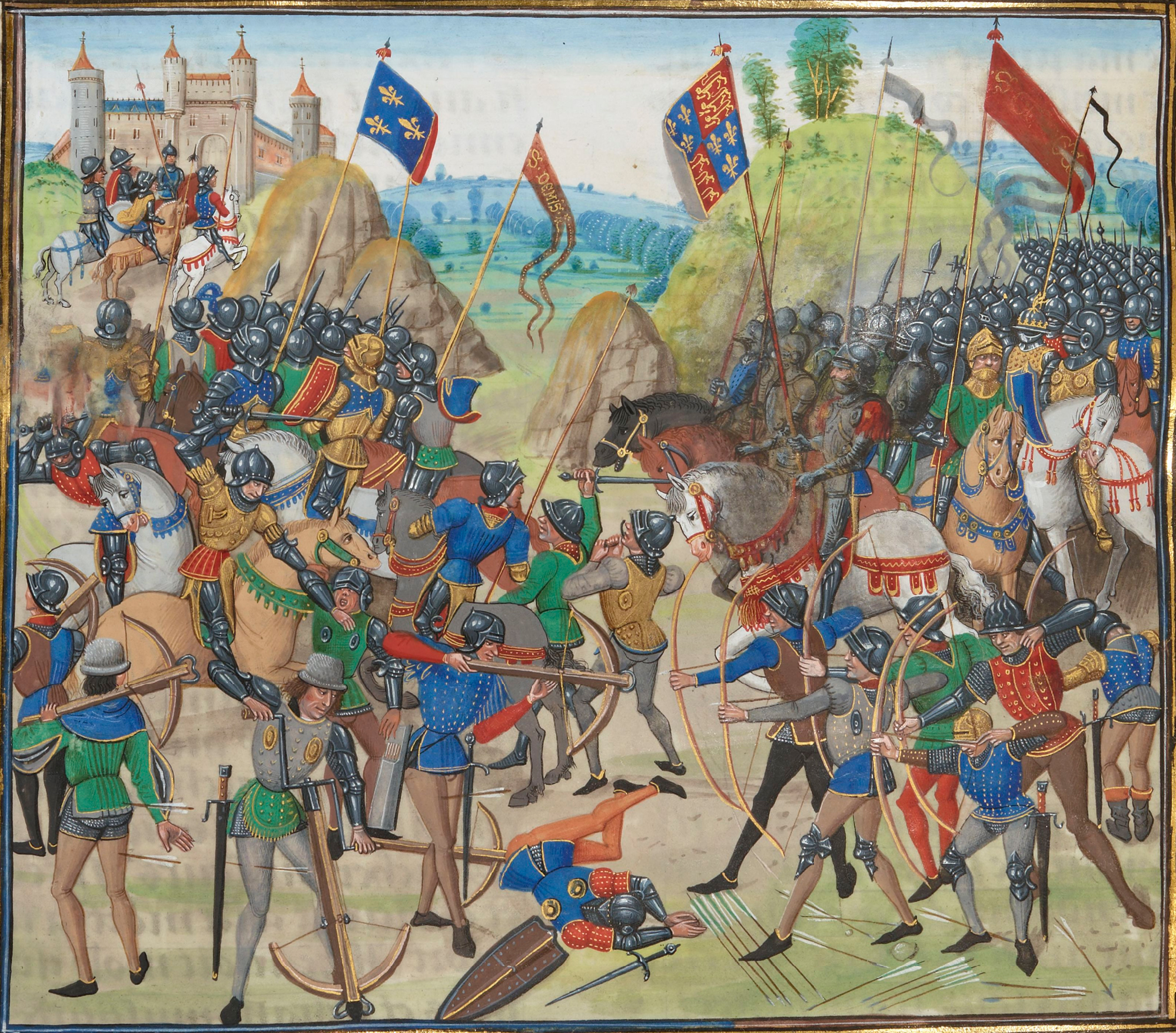
The two devices that were used to span the most powerful of crossbows were the cranequin and the windlass. The windlass is probably the older of the two technologies, there are reasonable arguments to date it to the early-13th or even late-12th centuries, but this hasn’t been conclusively proven. The windlass was a winch-based device which attached the butt of the crossbow. Hooks were applied to the string, and then a two-handled crank was used to pull the string back into place. It was certainly a slow device, but it could span a very powerful crossbow, and while cumbersome the device was relatively portable. There’s a great image of windlasses in use in this famous depiction of the Battle of Crecy from a copy of Froissart. The cranequin is a much harder device to describe. It was basically a gear box, with a bar that ran through a cranking device. On one end of the bar was a hook, which attached to the string, and the crank was then used to pull the string into place one gear notch at a time. There’s a good picture of this in use in Albrecht Durer’s Martyrdom of St. Sebastian from 1495. Cranequins also survive in significant numbers, and there are some great examples in places like The Wallace Collection.
The last device used to span crossbows in the Middle Ages was the Goats-Foot Lever. Again, this one is hard to describe, so I’m just going to point to this illustration by Ralph Payne-Gallwey showing how it was used. (ignore the weird shop branding someone has pasted onto it, it’s not part of the original). This device was one of the most portable and reliable spanning devices, and may have been used to span crossbows from horseback (a task primarily undertaken by hunters rather than fighters), and most even have a hook for hanging from a belt or saddle.
So that’s the general outline of medieval crossbow spanning devices, and in that list there isn’t really anything that resembles the device pictured above. For more on spanning devices, and crossbows in general, I recommend the following books:
Josef Alm, European Crossbows
Ralph Payne-Gallwey The Crossbow (This book is really old, like over 100 years old, and while it's got its problems, the illustrations of crossbow spanning devices in use are among the best around)
Dirk Breiding A Deadly Art: European Crossbows 1250-1850
If you read German there’s also Holger Richter’s Die Hornbogenarmbrust


#/media/File:Antonio_Pollaiuolo_003.jpg)