This week, ending in May 25 2017:
Today's thread is for open discussion of:
History in the academy
Historiographical disputes, debates and rivalries
Implications of historical theory both abstractly and in application
Philosophy of history
And so on
Regular participants in the Thursday threads should just keep doing what they've been doing; newcomers should take notice that this thread is meant for open discussion only of matters like those above, not just anything you like -- we'll have a thread on Friday for that, as usual.
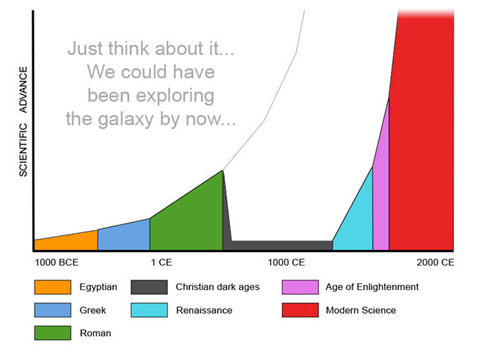
I've got a question about the history of science and technology. (It's a big one and it's difficult to put into words, so please bear with me.) It has to do with the popular view of scientific history as a continual upward movement, i.e. that awful graph.
I used to view history in that way, being influenced by Carl Sagan's Cosmos and similar programmes and books. One of the things that made me change my conception was a post on this forum explaining the development of writing.
I can't find it now, but IIRC the user described the conditions of societies without writing: hunter-gatherer societies consisting of a few hundred people. The user pointed out that in such small societies, developing a system of writing isn't worthwile, because the oral tradition is sufficient for transferring information - in other words, you can just talk to people. Writing means inventing an alphabet and using resources for writing material (clay, wax, papyrus), which is only worth the effort if you live in larger, agrarian society like a city, where records have to be kept.
This explanation rustled my jimmies,because I used to think of writing as something that 'people just hadn't thought of yet', but now I was told that the invention of writing was not a great breakthrough or a new step on the ladder of technological advancement, but simply a result of the conditions of the time and place.
My universalist conception of history was changed to a more 'localized' conception. (I'm sure there's a better word for it, but I hope you understand what I mean).
Now, my question is this: what merit does the universalist view have, if any? To what extent can the history of science and technology be understood as a series of upgrades in Age of Empires or Sid Meier's Civilization?
More concretely, do you know of any discoveries or inventions that could have been made earlier than they were, but they were made later, not because of circumstances, but because people just hadn't thought of it?
How well regarded are the writings of Joseph Campbell by historians?
I'm curious as to what posters think of H.W. Brands and his work. I'm very interested in reading more in-depth analysis of U.S. foreign policy during the Imperialist era of the late 19th/early 20th century and Brands looks to have produced quite a bit of work relating to that. However, he seems to have a ridiculously high level of output and much of his works look to be "life and times" type reads. How is he generally viewed in the academy?
Has anyone here ever attended the Center for Metahistory at the University of Groningen?