Well, Britain has seen activity from Palaeolithic times and you can see an example of the continuity at work here in Norman Davies' The Isles, which speaks of continuity in DNA from a Stone Age body to a living member of the town where the body was found.
In among this continuity however there is also considerable migration, a two-way stream. Hunter-gatherers in the Mesolithic would have come up from what was a refugia in Southwest France and Northern Iberia; farmers appear to have come from Brittany and the Low Countries via the Middle East, the Beaker people originated on the Continent and made there way here, and now DNA hints at a large-scale population replacement in the Bronze Age. Finally, Celtic expansion into the Isles from their homeland in modern Austria preceded the Romans.
So the Britons (and the Irish) are a melange of different peoples, with different origins. I'd suggest reading The Isles along with Britain Begins by Barry Cunliffe.
I’d like to correct some misconceptions in the question, and then expand a bit on what u/tbickle76 wrote.
Caledonians were indigenous peoples living in what is now Scotland. They were not of Roman origin. Tacitus records them fighting against, and being slaughtered by, the Roman general Agricola in 83 CE, after which they seem to have been absorbed by the Picts. The Scots, however, originated from neither Caledonians nor Picts, but rather from the Scotti, immigrants / invaders from Ireland.
Germania, from the Roman perspective, was the region of Europe east of the Rhine, which was outside the Roman Empire. During the time when Roman power was in decline, diverse groups of germanic speaking people migrated / invaded throughout the Empire, but during earlier times of Roman expansion, the character, culture, and influence of the Roman west was not Germanic. The Germanic origin of the English language is a result of post-Roman Anglo-Saxon migrations.
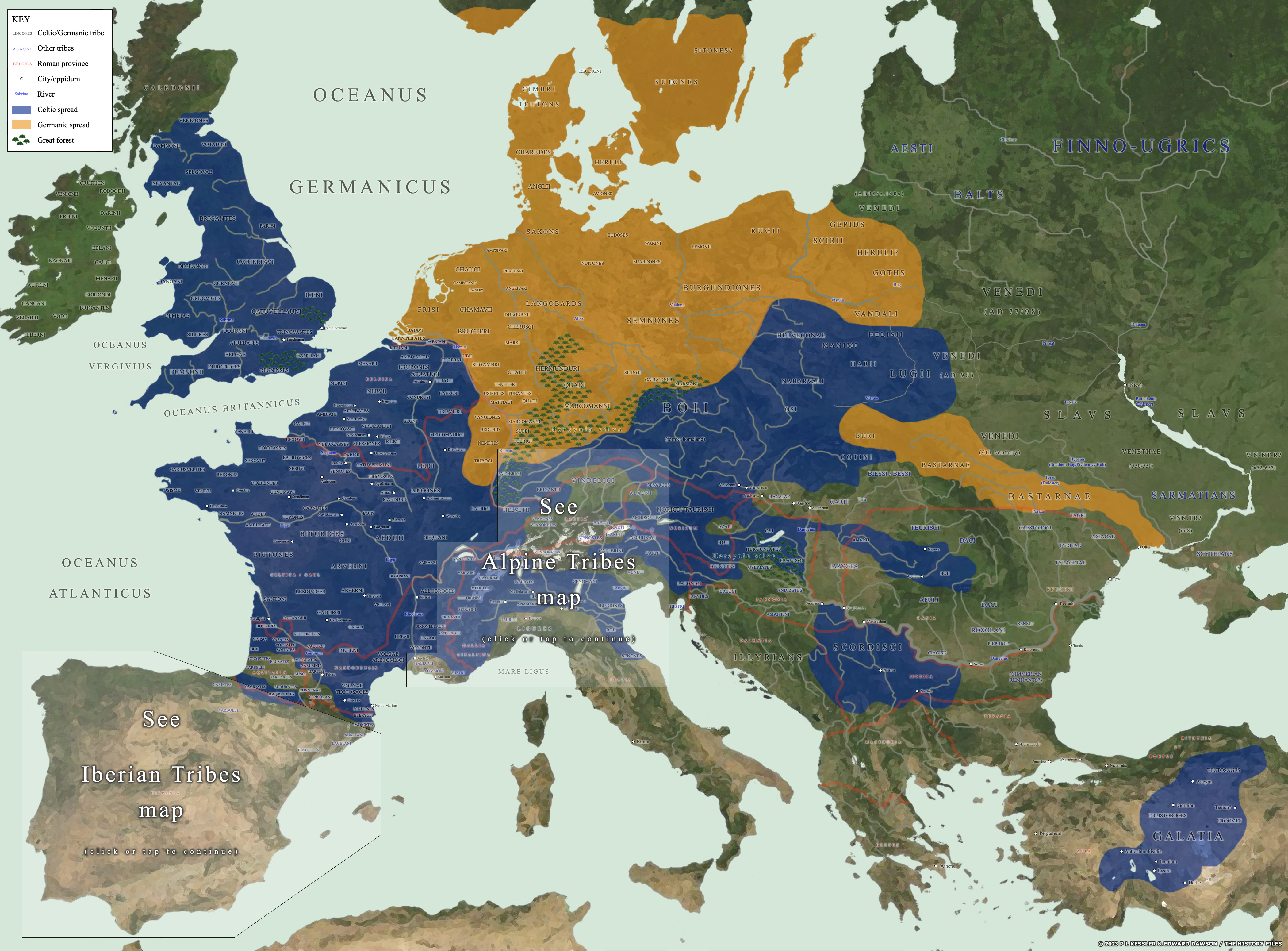
As tbickie76 pointed out, the British genome is and has been the result of both continuity and migration going back long before anything that can be called history, but I’m not sure genetics and ethnicity are the most useful criteria for identifying “who” an ancient people are at a given time and place, specifically here the British on the eve of Roman conquest. At the time of Roman expansion into northern and western Europe, the people living in this region can generally be called Celtic, a term which refers to a broad group of languages as well as a continuum of cultures and religious practices across a region that included modern France and Britain. The names of many British rivers are of celtic origin (Avon, Mersey, Severn, Thames), as is that of the Isle of Wight and the city of Leeds. This very detailed map (edit: also here) shows the extent of Celtic and Germanic speaking tribes throughout Europe in 52 BC.
The Romans recognized the ties between those mainlanders they called Gauls and the tribal people living on the mysterious island they called Britannia. Gauls living in northwestern Europe and Britons living in the south of the island traded with each other across the channel and lived in societies with similar cultural patterns and religious practices. They lived in small settlements that the Romans called “Oppida”, were dominated by warrior elites alongside a priestly class of Druids, and constructed hilltop fortresses for defense. Julius Caesar made two rather quixotic stabs at an invasion of Britain in 55 and 54 BC, Rome’s first military contact with the island, ostensibly as retribution against British tribes who had aided the mainlanders in a recent revolt against Roman rule.
Sources:
Asa Briggs "A social History of England"
Adrian Goldsworthy "Caesar: Life of a Collossus"
Simon Schama "A History of Britain"
I think there's a fundamental misunderstanding in this question about how ethnicity and genetics works. While your question perhaps portrays ethnic groups like a simple video game mechanic where one solid group comes to replace another, the reality is far more complex. Labels like 'Roman' 'Caledonian' 'Celt' etc.. don't so much describe unified 'races' of competing people but rather complex and overlapping cultural identities.
It's not as if one group was living in Britian only to be wiped out and replaced by another, but rather people who's genetic history in Britian going back before recorded history, mixed with immigrants (to this day) who gradually adopted different cultural ideas either through trade or conquest.
It's perfectly possible that a linear family going though the generations would at one time consider themselves to be a certain Celtic tribe, then after the Roman conquest mix that identity with a broader Roman one, then centuries later start to identify with a Germanic Anglo Saxon identity as it became dominant.
As a follow up question, do the Irish descend from the Scythians or is it more folklore than fact?
I believed the early inhabitants of Ireland were Celtic people that came from the north of the Iberian peninsula and, before that, from the area currently belonging to Austria, where the core of the Celtic culture began. However after reading a bit from this article it seems that the Irish are related to the Scythians, who lived more or less where Ukraine is now. Could a historian clarify this matter?