Follow-up question: Did the increasing quality and affordability of photography in the late 1800s help popularize Impressionism, since it purposefully didn't attempt to realistically recreate landscapes?
(1/2)
As you can probably tell from the jumble of responses and counter-responses that your question has thus far attracted, the relationship between painting and photography is a complex and interesting one. It's a relationship that isn't really reducible to a strict binary of opposition and embracing, but rather a series of relationships that depends on country/culture, era, and the tastes and talents of individual practitioners. I'm going to write my own answer to the question which I hope will be relatively comprehensive, rather than responding to individual other answers, some of which are on the right track and others of which I disagree with in whole or in part. I’ll do my best to pepper my response with appropriate images, though even with RES reddit is not the ideal platform for creating image-heavy text posts.
First, as others have noted, art historians do not tend to see the "invention" of photography as happening at a single discrete moment in time, but rather as being a process. It's often thought that the daguerreotype, the technique unveiled to the world by Louis-Jacques-Mandé Dauguerre in 1839, was the first photographic process as we understand it. There are at least two ways in which 1839 as a hard "start date" for photography as we understand it today is imperfect, however. The first is that the daguerrotype is not a process of mechanical reproduction like other photographic processes. For example, with gelatin silver photography (and similar metal-based processes), which is one of the most familiar black-and-white processes, the image is first captured on a glass or film negative before being printed onto photo-sensitive paper. The negative stays intact, and can be used more-or-less forever to create images which are exact replicas of the negative. The daguerrotype, at least as it was first formulated by Daguerre, creates a reproduction of the light that enters the aperture of the camera, but it prints directly onto the photo-sensitive substrate (usually a copper or other metal plate), creating a singular image. So though the daguerrotype can be said to have pioneered the transfer of an image onto a photosensitive surface, it would take additional advances before one of the key features of photography, its seriality, would become a part of the question.
The second reason that the daguerrotype should be more appropriately seen as part of a continuum rather than a single generative moment has to do with how Daguerre got the idea for the daguerrotype to begin with. Put simply, he didn't just come up with the idea for a photographic camera out of whole cloth. There was a long history of the use of a variety of pre-photographic devices, often by artists as an aid to mimesis. The most important of these are called the camera lucida and the camera obscura. The latter involves a large space, usually a room, in which a single hole has been punched. The light from an external scene will enter the hole, creating an inverted image of whatever is going on outside the room. This phenomenon has been recorded for thousands of years, and likely was used as a drawing aid at least as far back as ancient Greece. The camera lucida operates on similar principles, though with the addition of lens(es) and/or prism(s) to project the image onto a piece of paper or other support, allowing for ease of tracing or copying. The camera lucida has long been used as an artist’s aid. In fact, you will sometimes find books or articles published in a “gotcha” tone accusing this or that artist (like Vermeer, for example) of using a camera lucida as an aid to their drawing. Such accusations would, in my opinion, have puzzled such artists, who saw the camera as a perfectly appropriate tool for the creation of their art. Anyway, Daguerre was trying to figure out how to record the image from his camera obscura directly onto a surface for a couple of decades before he finally figured it out.
OK, so that’s some background on the invention of photography. So what relationship does it have with painting? Well, first of all, as I already pointed out (as have others in this thread), various optical devices were frequently used by painters going back hundreds or even thousands of years. Daguerre himself was a painter, as were many of the other earliest photographic practitioners. Regardless of whether we see 1839 as a moment of pure genesis or merely an important inflection point in an ongoing process, it is undeniably true that as the nineteenth century wore on, and especially at the beginning of the twentieth century, photography became more and more sophisticated, and more and more commonplace. At the same time, Western art was undergoing a process of increasing abstraction, with a transition from the emphasis on close mimesis found in Romantic and Realist art giving way to completely nonfigurative art by ca. 1910. Surely, then, doesn’t it make sense to argue that photography plays a, if not the key role in this process of transition from illusionism to abstraction?
Well, maybe. But correlation, as we are so fond of hearing, does not imply causation. Let’s explore what some artists and art historians have said and done about it. I saw a commenter somewhere in the thread asking about the relationship of Impressionism to photography. From the vantage point of history, we (rightly) see Impressionism as the first step in the development of artistic modernism, and the subsequent development of abstraction. However, for Edouard Manet, Claude Monet, and other artists whom we associated with Impressionism, the movement and its processes were actually a response to what they saw as the increasing artificiality and stultified nature of painting in Second Empire France. Painting at the time was governed by the Salons, the official art exhibitions governed by the Academie des Beaux-Arts. The type of art favored by the Salons was, generally speaking, a combination of the Neoclassicism of figures like Jacques-Louis David and the exoticized Romanticism of people like Jean-Leon Gerome. Perhaps the exemplary figure in Salon painting around the time of the invention of photography (and still influential by the time of Impressionism was Jean-Auguste-Dominique Ingres, whose voluptuous female nudes defined beauty for French art connouisseurs at the time. Impressionism, by contrast, sought something different, fresher, more immediate. Though when we think of Impressionism now, we might think of beautiful land- and seascapes by artists like Monet, at its core Impressionism was actually an urban movement. In contrast with the carefully-planned canvases of the Salon painters, Impressionists sought to move out into the city, capturing fleeting and contingent views of everyday life in the metropolis. The contemporaneous invention of tubed paint allowed them to carry their easels out into the world, capturing the momentary, fleeting qualities of urban life.
Contrast this with early photography, which rather famously took a long time to capture its images early on. Daguerre is widely believed to have created the first street photograph– notice how empty it looks. All of the foot and vehicular traffic was too fleeting to be captured by the photosensitive materials available to him, save for a single shoe-shiner that was captured at the lower left of the image. Contrast that with this famous Monet painting of the Gare-Saint-Lazare train station, which captures all the wonderful movement of light and steam in an exact instant.
Does that mean that photography had no impact on Impressionism? Well, maybe let’s not go that far. Other art historians have pointed out how Impressionist paintings eschew the careful compositions of their Salon counterparts, with figures, buildings, and other parts of the image casually cut off. This gives the paintings a quality which we now might liken to a snapshot, capturing merely what is in front of the observer at a given time, whether it’s compositionally convenient or not. Many art historians believe that this quality was influenced by photography, which has a more limited means of influencing the composition of the final image than a painting. A photographer can move her apparatus around to create a better or more pleasing shot, but she can’t simply omit compositionally inconvenient details (eventually techniques for editing objects out of photos were developed, of course, in its formative years this wasn’t yet possible) the way that a painter can. So when an Impressionist creates an image that has some sort of awkwardly cut off or otherwise odd compositional detail, he or she very well may be responding to the immediacy of the photographic process.
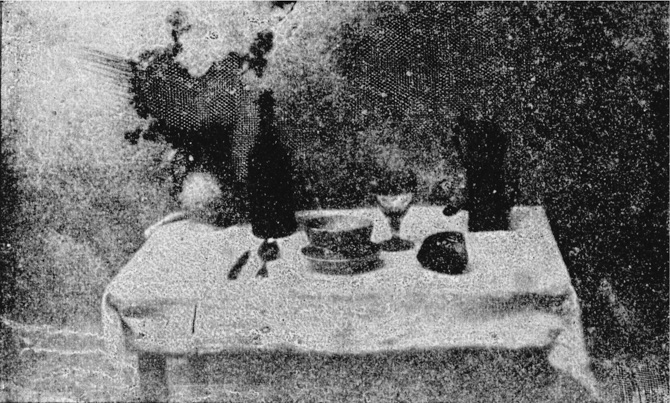
I'll just add to u/pipkin42's terrific comments that it took some time for photography to start to be experimented with as an artistic medium, and even longer for society at large to consider it an artistic medium in its own right. For a long time photography was seen merely as a technology. In most cases it was used to record and document. There are some very early and early photographs that are still lifes, like Niepce's 1827 heliograph "Still Life", but these were more a way to test the technology on an easy-to-capture subject than artistic works akin to still life paintings. Portraiture, including self-portraits, mainly start with the daguerreotype, but most photographers are again merely looking to record someone's appearance and therefore not trying to create an emotion or play with composition or lighting in an artistic manner. Some of these works, like Robert Cornelius' 1839 "Self-Portrait", are visually interesting to contemporary viewers due to the limits of the technology and aging process of the plates, but it's not really what the photographers were aiming for.
Even as the technology continued to develop at a very fast pace - the daguerreotype, invented around 1837, became wildly popular in the 1840s and 1850s for portraiture but was all but replaced in 1860 by cartes de visites (which used the albumen print method), which themselves were overtaken in popularity by cabinet cards (typically but not always albumen prints) after 1870 - and more and more people took up photography as a profession or a hobby, it remained largely seen as a technology, although some people were starting to discuss whether it should be seen as an artistic medium. In 1853, the first meeting of The Photographic Society of London (now the Royal Photographic Society of Great Britain), whose membership included both professionals and hobbyists, included a lecture entitled "Upon Photography in an Artistic View," in which the lecturer "denied photography's position as an independent art, and urged photographers who were taking studies to be used by painters to put the image slightly out of focus" so the image would better lend itself to being translated into painting. (from The History of Photography by Beaumont Newell, 1982 edition) Photography began to be exhibited at World's Fairs and other exhibitions, but they were largely categorized as technology rather than art. At the first World's Fair in London in 1851 (also known as The Great Exhibition), most photographic works, which included daguerreotypes and calotypes, were classified under “Machinery, Class 10 (x) – Philosophical, Musical, Horological, and Surgical Instruments" in the official catalogue, and although a few were under "Fine Arts, Class 30 (xxx) – Sculpture, Models and Plastic Art, Mosaics, Enamels, etc.," all photographic works were judged under Machinery Class 10. Several won prizes, including Mathew Brady's work, most of which would be best classified today as documentary photography, and Martin Lawrence's "Past, Present, and Future".
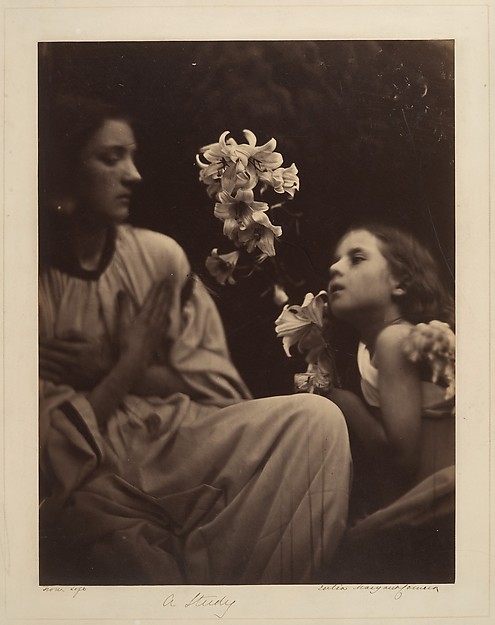
Julia Margaret Cameron is the earliest photographer I know of that truly treats photography as an art form. Cameron experimented with dramatic lighting, and took advantage of the blurriness that was difficult to avoid in early photography to create a soft focus, to create dynamic, emotional portraits of her friends and family ("John Herschel with Cap" (1867)) and literary and biblical scenes and figures ("A Study (After Perugino / The Annunciation)" (1865)) that evoke the works of her friends the Pre-Raphaelites. The uniqueness of her work was well received by some - the Met Museum says "[w]ithin eighteen months [of first picking up a camera] she had sold eighty prints to the Victoria and Albert Museum" - but scorned by others: again from the Met Museum, a 1865 review of her work in the Photographic Journal said "Slovenly manipulation may serve to cover want of precision in intention, but such a lack and such a mode of masking it are unworthy of commendation," which to me has striking parallels to criticism of the Impressionists.
I was wondering, surely realistic portrait painting was negatively affected? [This] (http://www.poetrymagazines.org.uk/magazine/record.asp?id=9820) suggests that there was indeed a decline, which is ongoing. Obviously, plenty of portraits are still being painted that are not intended to be realistic or recognizable.