Obviously with major exceptions (like the original settlement of North and South America 20,000 years ago, or the colonization of Hawaii) why did Asia have so much less contact with the Americas than Europe did in more recent history? The Norse colonization started in the late 10th century and European colonization started in earnest in 15th century. The distance from Spain to Trinidad is 4,000mi and the distance from England to Virginia is 3700mi. The distance from Japan to California is 5,300mi which is larger though at its smallest point the continent is separated from Alaska by only 55mi. Is it that most of that [Siberia/Russian] area is lightly inhabited and colonization required major civilizational might? But is 1,300mi enough of a difference to account for the lack of Japanese contact?
Apologies for the late answer.
You’re absolutely right—it would be odd if there was no contact between two landmasses only 55 miles away, and as it turns out, there was! There is strong evidence of sporadic trade between native Alaskans and native Siberians, with weaker evidence suggesting trade as far southwest as Japan. Additionally, there have been several periods in history where migrants from either Siberia or Alaska have colonized the other landmass.
There are three periods of Siberian settlement of Alaska. The first of these Siberian settlement periods occured sometime before 14,000 BC, almost certainly later than 40,000 BC. At this time, Earth’s sea levels were far lower, and Siberia was connected to North America by a stretch of low-lying land called the Bering Land Bridge. This is the most widely accepted theory as to the origin of most Native Americans. Y-chromosomal Haplogroup Q is extremely widespread among Native Americans as well as certain groups of Siberians, indicating a relationship between them. Even more convincingly, prehistoric human remains of the Siberian Mal’ta-Buret’ culture ~22,000 BC were found to show striking genetic similarities to both Native Americans and Western Europeans.
The second period was the Na-Dene migration circa 6,400 BC. This was a migration of seafaring Siberian people to NorthAmerica via the Aleutian islands. The primary evidence for this timing is the Anangula Site, which has extremely similar technology to contemporary sites in Eastern Siberia. Y-chromosomal Haplogroup C2 is most common among speakers of the modern native American Na-Dene languages, as well as several Siberian groups. One of these Siberian groups are the Ket People, and the Ket language has recently been linked to the Na-Dene languages of North America. This proposed language grouping, the “Dene-Yeneisian Languages” would be the first ever language family known to span both the Old World and New World.
Famous geneticist Luigi Cavalli Sforza proposes in his book The Great Human Diasporas that, based on genetic evidence, “it is possible that the Japanese expansion [across the Sea of Japan] may be linked to one of the Paleolithic migrations form eastern Asia to America.” though he adds that, if this even happened, there currently is not enough archaelogical evidence to guess as to when. I find this claim highly questionable, but nonetheless fascinating and worth further investigation. I mention this mainly because you asked about Japanese contact with North America, not because it’s confirmed or even especially well supported. If the migration did happen, however, this second migration is likely the one it corresponded to.
The third and final Siberian migration to North America occured around 2,500 BC, and introduced the Paleoeskimos to the North American continent. The Paleoeskimo people initially settled the Seward Peninsula of Alaska, having sailed from Chukotka, then spread southwards along the Alaskan coast (including the Aleutian islands off the Southwestern Alaskan coast) and eastward along the Northern coast of Canada and to Greenland. The Paleoeskimos are the closest related to modern Siberians of all Native American groups.
The modern day Eskaleut (Eskimo and Aleut) languages have been suggested to be related to the Chukotko-Kamchatkan family of Eastern Siberia, based on strong similarities in grammar and phonology. Personally I believe that the languages are genetically related (i.e. originate from a common ancestor), though this is highly uncertain. After all, both Eskaleut and Chukotko-Kamchatkan language speaking peoples had regular contact with eachother, and their languages certainly would have influenced eachother over the course of over four millenia. The once highly popular Altaic Hypothesis was disproven in 2011 on similar grounds—what had appeared to be related languages across Asia were in fact distinct language families which had influenced eachother over the centuries. The Altaic Hypothesis, however, was disproven based on analysis of medieval era texts, but as neither native Siberian nor native Alaskan groups had written languages, this sort of study is impossible.
Interaction between Alaska and Siberia increased starting in the later half of the first millenium BC with the invention of the Umiak by the Old Bering Sea (warning: 40mb pdf. Tons of info though) people. The Old Bering Sea were an Eskimo group, as evidenced by their material culture, that were especially widespread not in Alaska but rather on the Chukotka peninsula of Siberia. The Old Bering Sea were in unique in that they primarily subsisted off of walruses. Unlike any other species of seal, walruses have large, protruding tusks, which were useful in both the building of tools and in production of artwork.
Starting around 600 AD, trade activity exploded around the Bering Strait. Umiaks were capable of sailing for long distances compared to previous kayaks, access to Siberian iron made trade worthwhile (Walrus ivory was well liked by native Siberians), and innovations in whaling made trade possible by enabling an increased food supply.
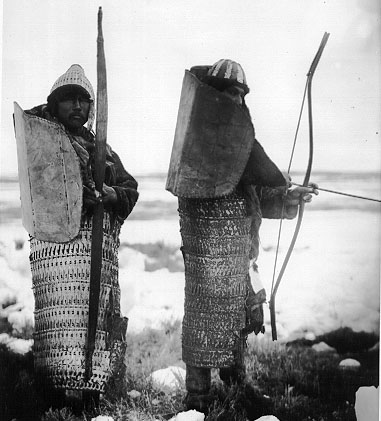
The toggle harpoon that had enabled whaling spread along these trade routes as far south as the Okhotsk people of modern Japan, as did walrus ivory itself. This could indicate Alaskan-Hokkaido* trade, but quite likely Siberian tribes served as mediators. Toggle Harpoons also spread as far east as Greenland and as far south as California. Bronze items, spread to Alaska as well via Siberia. There are noticable similarities between the armor used by soldiers of various Eskimo groups, and that used by the Japanese. This is particularly evident in their breastplates. Compare this Japanese Kozane dō, to the Koryak armor or to this Yupik cuirass. While the materials used differ substantially, the basic lamellar plate design is found in all three.
This trade continued for over a millenium, and with that trade came increased settlement of Siberia by native Alaskan people. "Arctic Adaptations" by Igor Krupnik says that around 1800, as much as a quarter of the Eastern Siberian Coastal population were Eskimos. Krupnik sites a 1973 Russian scientific paper “Distinctive Features of the Social Organization of the Asiatic Eskimos”, which unfortunately I do not have access to. The trade between native Siberians and Alaskans lasted until 1948, when Cold War tensions between the United States and Russia forced an end to all native boat travel between Alaska and Eastern Siberia. Since 1989, this contact has revived on a smaller scale following an agreement that natives of Chukotka and Alaska could travel to meet with eachother.