Prussia played the leading role in the unification of Germany, the Prussian ruling family provided the Kaiser of Imperial Germany, many of the leading figures in Imperial Germany were from Prussia and owned massive estates in Prussia. With this kind of influence and history one would think that massive amounts of historical and cultural capital were lost during World War II and it seems to me that very little of it is talked about or preserved. I was very curious if there was a sense of loss in Germany over not just the territory but the history and culture that came with the regions that were lost.
One thing that really sparked my interest was looking at google maps images of the countryside in old East Prussia and towns look very German and there are tons of abandoned estates, churches and run down towns that clearly were populated by Germans not even 75 years ago.
"The Oder-Neisse, Eastern provinces - they're gone! They don't exist anymore"- Konrad Adenauer in conversation with Willy Brandt, 1953.
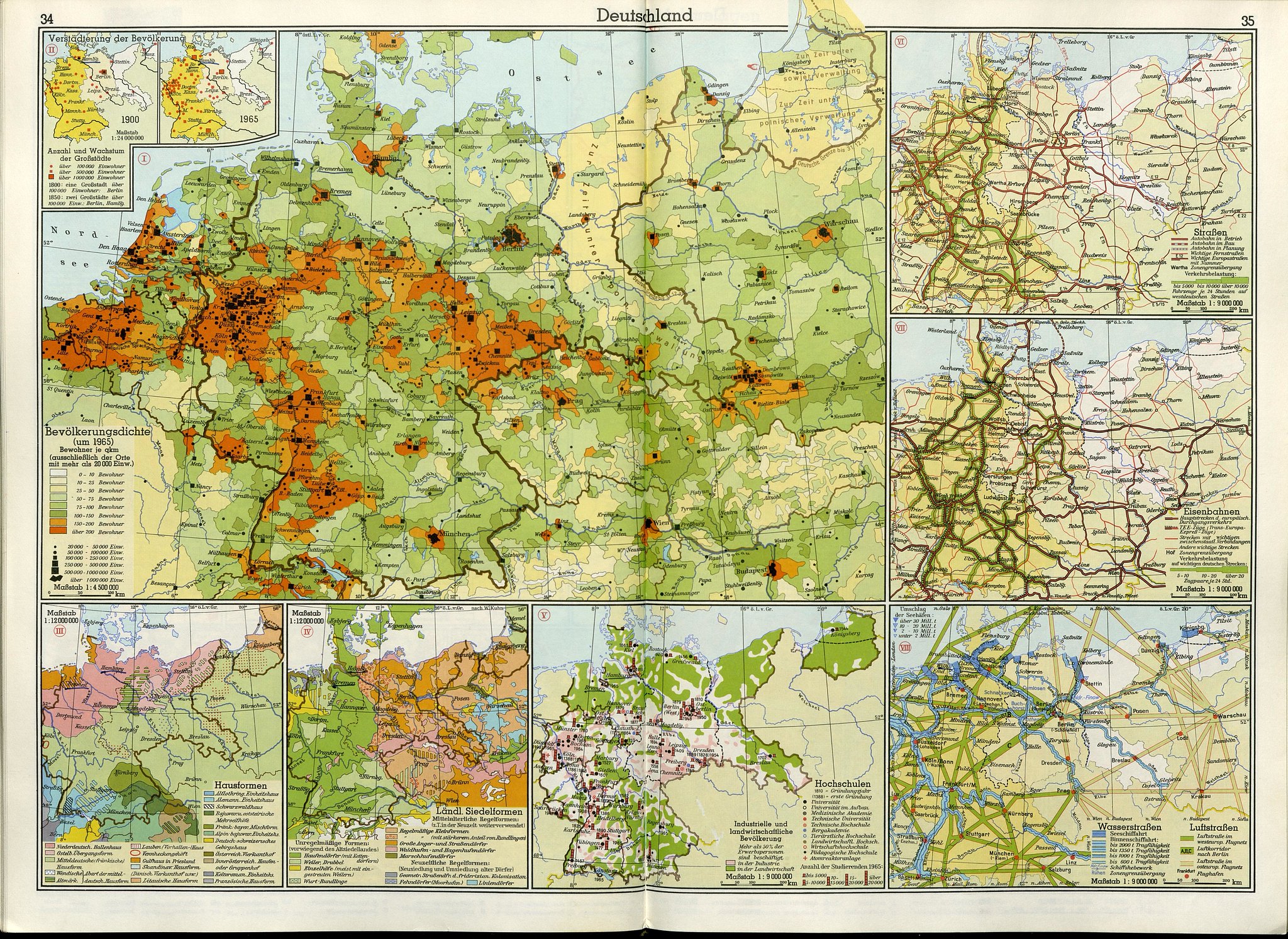
One of the curious features of Cold War-era maps produced in the FRG was that often listed the territories beyond the Oder-Neiße line as "under Polish/Soviet Administration." This Diercke Weltatlas map from 1970 not only kept the old 1937 German borders intact, its cartographic language treated German division as an ephemeral phenomenon. This sentiment was not just limited to FRG maps. Adenauer made a public statement of a "right to one's homeland" in his 1957 Face the Nation interview when discussing the Oder-Neiße. Although on the surface, the importance of the Oder-Neiße within West German political discourse looks like a revanchist sentiment, in reality its importance within FRG politics is relatively prosaic. Although there were some revanchists within the FRG, the FRG's political mainstream adapted the position that Oder-Neiße area was under temporary control due to reasons of domestic and international politics.
At the core of the Adenauer generation's opposition to the Oder-Neiße line was the issue of sovereignty. Even as it became increasingly clear that Germany was to be partitioned, the main goal of FRG politicians was a return to normalcy and assert that Germany was a fully-functioning sovereign nation. Adenauer's basic position, which was reflective of both SPD and FDP's opinion, was that Germany's final borders needed to be decided by an all-German government in negotiation with the deciding parties. The charter generation of the FRG asserted that it was that all-German government. The FRG's Basic Law asserted that it applied to the whole of Germany including the Eastern zones and territory now controlled by the USSR and Poland. Far from being quixotic, the FRG politicians knew that the Oder-Neiße revision was unachievable as exemplified by the above Adenauer quote, the Oder-Neiße issue possessed something of a Realpolitik character. Keeping the issue alive was one way for the FRG to assert that it was the true political inheritor of Germany by counter-intuitively asserting that Germany was incomplete. Heinrich von Bretano, the FRG's Foreign Minister would say in 1956:
I have stated very plainly. . . [that] there is no German Federal Government, either today or tomorrow, which can recognize the Oder-Neisse Line as the frontier. Firstly, it will not do so because it is not entitled to do so. It is not entitled to dispose of German territory. Secondly, it will not do so because it is not entitled to do so towards the people, the German people, who have lived there for centuries.
The latter half of the von Bretano quote exemplifies another aspect of the Oder-Neiße issue: its importance to electoral politics. A sizable portion of the expellees ended up in the FRG and they became an important voting bloc in the FRG. In the early decades of the FRG, most of the mainstream political parties sought to court this voting bloc and keeping the issue alive was one of tactics used to court them. The Bund der Vertriebenen (Federation for Expellees/BdV) formed in 1954 as a pressure group for expellee rights and organization. In addition to pioneering a very noxious form of anticommunist politics, the BdV also published a massive amount of materials on this lost German territory as well as organizing social events within the FRG for the expellees. The strength of the BdV was important element of Adenauer's constituency even though the Rhenish Chancellor had little love for historic Prussia and recognized that there was no way Oder-Neiße was not going to be the border in the future. This political pressure abated somewhat during the period of Ostpolitik, but it was still present. The expellees also created other special interest groups and organizations that kept the issue alive during the 1960s and 1970s as it became more apparent that the borders were fixed.
Although some of these expellees' leaders were revanchist, most of its membership recognized that this territory was gone. Tours of the lost East organized by these groups in the 1960s and 70s often underscored the permanence of this loss. Much of the time these tours revealed the discrepancy between the more prosperous FRG and the poverty of the Eastern bloc. Demshuk's recent study of these groups persuasively argues that as new immigrants to the FRG, the amount of attention paid to the Heimat of the East was a mechanism to cope with their internal migrant status by creating a "Heimat of memory" to assert their German identity and heritage in the FRG.
This Heimat of memory comes the closest to the sense of loss from these territories. This assertion of German identity was important in the early decade of the FRG because there were real pressures on the expellee community in this period. Most of their initial housing was quite poor; repurposed barracks at Dachau was one of the early centers in southern Germany and expellees tended to be among the first residents of the FRG's public housing tenements. While hindsight makes the BdV's attacks on the Oder-Neiße look rather Sisyphean, the expellee organizations' protests and advocacy of more spending for housing is far more understandable. Both federal and state governments in the late-1940s and early 50s were quite reluctant to part with funds for Volksdeutsche. The romance of these lost territories was one of the major subfeatures of BdV and other expellee materials meant for consumption by other expellees. BdV conventions and other forms of social organization were a means for this diaspora to socialize and build a sense of community in a nation in which they were regional outsiders.
The sense of loss was arguably strongest among the first generation of expellees, but subsequent generations tended to assimilate into wider FRG society. The BdV fought Ostpolitik and even attacked Kohl in 1989 when he met with the Polish President Tadeusz Mazowiecki and reaffirmed the territorial line. These attacks made little headway against the mainstream FRG parties and the aging expellee population was no longer the voting bloc it once was. This was part of the reason why Kohl's complete abandonment of Eastern territories with reunification did not register much in German politics. As with Adenauer, Kohl recognized they were not worth the trouble and even a vague Soviet offer of exchanging Kaliningrad for loan forgiveness did not gain any real traction.
One of the more roundabout ways in which the Eastern territories has entered into German public memory post-1989 is through film. The fall of the Iron Curtain and lower operating costs in Eastern Europe made location filming there quite attractive. Some of the older city architecture such as Wroclaw's can stand in for a historic Germany that no longer is visible in Germany's modern cities. Bridge of Spies, for example, used the Wroclaw to stand in for Berlin. Non-German and German filmmakers have also been using Silesia for location shots or border towns like Görlitz as a means to capture a vision of a German past without having to place too much effort into sets and location dressing.
But as a whole, the narrative of lost territories is a dying one in the Berlin Republic. Most mainstream politicians do not really feel appeasing the remnants of the BdV worth alienating Polish relations and reabsorbtion into Germany would lead to the minor problem of what to do about the Polish and Russian inhabitants. By the same token, the few expellee groups active today also flirt with a type of reactionary neo-Völkisch politics of the German far right. While such political branding was an advantage for the CDU during the Cold War 1950s, it is a political liability in 2017.
Sources
Demshuk, Andrew. The Lost German East: Forced Migration and the Politics of Memory, 1945-1970. New York: Cambridge University Press, 2012.
Hughes, R. Gerald. "Unfinished Business from Potsdam: Britain, West Germany, and the Oder-Neisse Line, 1945–1962." The International History Review 27, no. 2 (2005): 259-294.
Liulevicius, Vejas G. The German Myth of the East: 1800 to the Present. Oxford: Oxford University Press, 2009.
Hey there. I wouldnt say that germany as a whole tries to distance itself from prussia. If we're talking about bavaria, that certainly would be true. Prussian culture is still present in modern germany. For instance that Preußens Gloria is still frequently played at marksmen festivals. The "german values" stem inherently from what used to be "prussian values" although they can be traced back to the teutonic knights.
My family lived in prussia but was displaced by the red army and I dont feel like I lost something. It simply does not exist in the heads of the average german citizen. When the soviet union fell, they even tried to sell east prussia back to germany but the chancelor at the time (Helmut Kohl) declined. The german reunification was a huge project on its own and nobody wanted to touch a peace of land that was
Does this answer your question?