I recently finished reading Bernard Cornwell's Saxon Stories, and I'm curious about the main character's, for lack of a better term, catchphrase. For anyone reading that's not already familiar, "Wyrd bið ful aræd" is Old English for "Fate is wholly inexorable." It means that there's nothing anyone can do to change their fate since it's already written by the gods, or, more specifically, the Norns. While the modernized version of the phrase is pretty easy to find, I'm having difficulty finding how "Wyrd bið ful aræd" would have looked in actual Old English. After researching it myself, I even tried my own hand at writing it to see how it would have looked. Please ignore that it was written on a card from the bar! So how would the phrase really have been written in the 11th century? How close was I in my attempt?
Another random question about the Saxon Stories: I watched the Last Kingdom on Netflix as well, but the depiction of the shield wall didn't quite match the image I had in my head or what I've seen in YouTube videos of reenactments. There's some credence to the show since Cornwell describes soldiers protecting each other's heads from strikes from above, but that doesn't seem feasible without completely exposing yourself to attacks from below if there's only one line of shields as shown in this video. Is the Last Kingdom's version of the shield wall having three layers or rows of shields accurate, or is it another one of Hollywood's bastardizations for the sake of looking cool? How does it compare to History Channel's Vikings?
I really enjoyed the Saxon Stories, so I'm open to any additional comments or discussion that /r/AskHistorians might like to add! Thanks!
Hopefully someone else can step in on your second set of questions, but in regards to your first one:
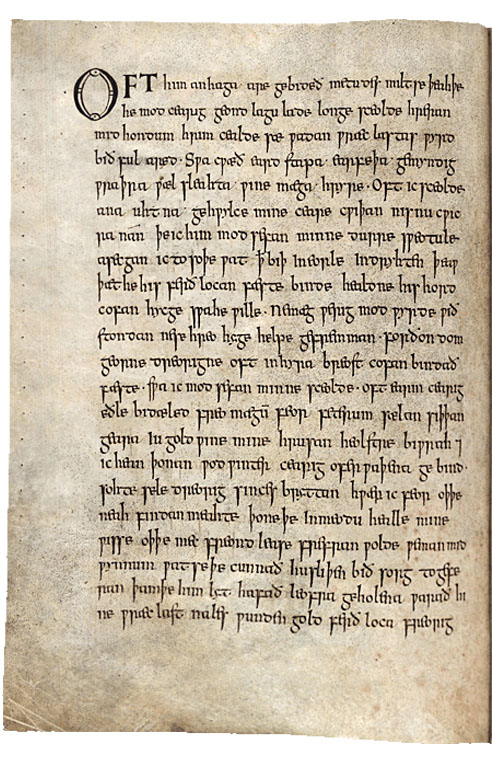
The line "Wyrd bið ful aræd" can be found in the poem "The Wanderer". This poem is contained in the codex known as The Exeter Book. The Exeter Book is generally dated to the late 10^th century, though we can at least trace it back to the late 11^th , when it is thought to have been donated to the Exeter Cathedral by Leofric (and by donated I mean given to the cathedral in his will).
This is the leaf that "The Wanderer" starts on. You can see "Wyrd bið ful aræd" starts at the far right of the third line and continues into the fourth line, like so (please forgive my usage of mspaint).
So comparing the original to your attempt. Pretty close all things considered. The stem on the d is horizontal in the original. The wynn is lower case, but your capital wynn is pretty accurate as far as I can tell comparing to other manuscripts. Also, interestingly the 'æ' is not included in the original 'aræd'. It is spelled 'ared'. That's likely just a quirk of the scribe. Back then spelling was a lot less standardized. But yeah, pretty solid attempt overall.
If you'd like any more info, feel free to ask. And for pointers on your writing I'd suggest heading to /r/calligraphy or one of their related subreddits. Lot of good info to be found over there.
Hopefully I can give some answer to your second question. That clip from the Vikings is interesting, because if anything it shows the Vikings fighting with what were actually Anglo-Saxon tactics.
We don't have very many sources for how the Anglo-Saxons actually fought, beyond what we can guess at simply by the weapons they used. Archaeology can often confuse things because of the way in which finds can be interpreted. We tend to find swords and axes in early Anglo-Saxon graves, but we don't find axes, arrowheads or javellins, which has led to some suggestion that the Anglo-Saxons didn't use them. But we only find swords and spears because they had specific symbolism attached to them, whereas an axe or a bow was just a tool.
We have four main sources for Anglo-Saxon combat: The Anglo-Saxon Chronicle, the poem The Battle of Maldon (991), Orderic Vitalis' history of the Battle of Hastings, and the Bayeux Tapestry. These span more than 100 years of changing warfare, but between them we can piece together some picture. Most accounts of battles simply record that a battle happened, but don't go into details about the fighting, but for the Battle of Brunanburh in 937, the ASC does.
The shield wall was not the be all and end all of combat, but it was the lynch-pin about which all else turned. An Old English term often used is warhige or "war hedge" which gives you an idea of how bristling and effective the tightly-packed shieldwall could be. In fact, it remained a mainstay of English warfare well after the conquest. Aelred of Rievaulx's Relatio de Standardo about the Battle of the Standard in 1138 recounts that the English militia are successful against the Scottish because of their highly disciplined shieldwall. William of Malmesbury's Gesta Regum Anglorum calls the Anglo-Saxon shieldwall at Hastings a scutorum testudo. This lends credit to the "Vikings" clip and suggests that a full "war hedge" was multi-layered and designed to withstand bombardment as well as melee. Both William of Malmesbury and Orderic Vitalis recount how neither cavalry nor archers are able to overwhelm Harold's shieldwall at Hastings.
The Bayeux Tapestry shows us a shield wall in action but takes some liberties with the shields. The Battle of Maldon tells us that the Anglo-Saxons would likely have been using round shields.
Additional warfare would have been happening around the shield wall. Missiles played a prominent role, with javelineers and archers skirmishing as the shield walls closed with the enemy, and trying to disrupt the enemy formation, if they had one. The Battle of Maldon recounts that:
Then loosed they from their hands the file-hard lance,
The sharp-ground spears to fly.
Bows were busied - buckler met point
Bitter was the battle-rush, warriors fell
Similarly, at the Battle of Brunanburh, the ASC notes that just as many of the Scots and Danes were killed by the spears, there was also "many a northern warrior shot over his shield." As the shield walls clashed with the enemy, this may have been the opportunity for nobles and their retinue warriors to charge. At Brunanburh, "Edward's sons (King Æthelstan and his brother Edmund Atheling) clove the shield wall, hewed the linden-wood shields with hammered swords." When the Danes break and flee, they are chased and routed by mounted West Saxons who also use swords in combat.