Looking for examples of Nazis in pulp fiction once thing that stands out that not only do these stories seem heavily sexualized (at least going by their cover) but almost always proclaimed with emboldened letters to be "for men only"; "men's epic"; "bluebook for men"; "men's"; "true men stories"; "real men"; "real action for men"; "man to man"; "sir"; "new man"; "all man"; "men today"; and "man's life".
The fact that in a contemporary context magazine of pornographic content and with these names would be assumed to be at odds with covers featuring scantily clad women aside, is there any significance to this marketing strategy/names other than the stories contained being pornographic? Does it hold some other significance? Is there pulp featuring the Nazis that is not decidedly not about things like "fantastic raid on the Nazi desert brothel"; "beauties for the Nazi's artists of agony"; "embrace me and die, american schweinhund"; or "the golden nudes for the Nazi mad sculptor"?
Finally, is there any sort of discernible connection (as an inspiration of sorts maybe) between the American pulp genre featuring Nazis and the Israeli Stalagim genre?
Looking for examples of Nazis in pulp fiction once thing that stands out that not only do these stories seem heavily sexualized (at least going by their cover) but almost always proclaimed with emboldened letters to be "for men only"; "men's epic"; "bluebook for men"; "men's"; "true men stories"; "real men"; "real action for men"; "man to man"; "sir"; "new man"; "all man"; "men today"; and "man's life".
Okay, a little background here. For the most part pulp magazines flourished in the interwar years, between 1920 and 1940; the Nazi Party in Germany became prominent during the 1930s after Adolf Hitler was appointed Chancellor in 1933. For the most part pulp fiction before WWII didn't feature the Nazis very much - they were more likely to draw on WWI stereotypes of the Germans, as in H. P. Lovecraft's "The Temple" (Weird Tales Sep 1925), and then during and immediately after WWII the Nazis were featured primarily as villains - this was also the case for comic books (which are sort of the direct inheritors of the dying pulp tradition), such as Captain America Comics #1 (1941) which depicted the eponymous hero punching out Adolf Hitler on the cover.
After the war, beginning in the late 1940s but really coming into its own in the 1950s and 60s are what are more generally known as Men's Adventure Magazines, or The Postwar Pulps. A great source on those is editor Adam Parfrey's It's A Man's World, but a little background is in order.
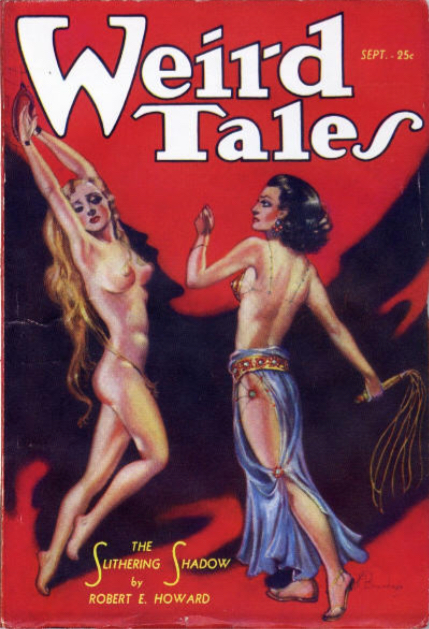
One of the trends during the waning period of the interwar pulp fiction period in the 1930s is a genre called the Weird Terror pulps; these were inspired by the risqué covers of fantasy and science fiction magazines like Weird Tales, which often featured nude or scantily-clad women, sometimes in poses of flagellation or incipient torture; these titillating covers sold better, and it is possible that the sadistic element helped it get past the censors - in the 1930s flagellation literature was not always considered erotica, and so became more widely translated, published, and advertised by publishers of gallantia and curiosa (some of whom advertised in pulps). A great book on that whole scene is Bookleggers & Smuthounds: The Trade in Erotica 1920-1940...but I'm getting away from the point. Where Weird Tales might feature the occasional nude cover, or a woman whipping another woman - like the Sep 1933 issue - following a scene in one of the stories contained therein, the Weird Terror magazines specialized in the sadistic/erotic element; to a (less sexualized) degree, this was also true of some crime comics in the decade before the formation of the Comics Code in 1945.
World War II, however, changed the market and ushered in a new breed of magazine - aimed at an audience with different focus. These were aggressively macho, and concerned about the appearance and definition of what it meant to be a man in a period when most young men didn't go to war, and more women were leaving home and entering the workplace. I'm going to raid part of an earlier answer here:
In pulp studies in general the "Crisis in Masculinity" is the treatment of sexual and gender archetypes as the pulp period progresses - it being remembered that the pulps really peaked in the interwar period. The 1920s and 30s pulps saw a great deal of stereotyping of male and female characters, but nothing like how men's adventure magazines became in the post-war 50s and 60s, as the aggrandizement of macho and he-man archetypes really hit its zenith in magazines like Man's Life, Stag, Real Men, and True Men.
A little closer to home, you have the personal question of masculinity as answered by the likes of H. P. Lovecraft and Robert E. Howard in their own lives and fiction - Howard gets most of the focus, partially because of the success of the Conan the Barbarian (1981) film starring Arnold Schwarzenegger, the comic books, and the novels with painted covers by Frank Franzetta which all tend to emphasize the body builder/physical culture physique - and led a number of folks in the 70s and 80s and even the 90s to wonder if there wasn't a homoerotic undertone to the whole thing - as emphasized in the chapter “Is Conan Dating Clark Kent?” of Harry Harrison’s Great Balls of Fire! An Illustrated History of Sex in Science Fiction (1977). For more general works you might start with Hard Boiled: Working Class Readers and Pulp Magazines and “Horror Is What a Girl Would Feel: Narrative Erotics in Depression-Era Pulp Fiction.” in Delights, Desires, and Dilemmas: Essays on Women and the Media.
You want works like Masculinity and the Other: Historical Perspectives which has the essay "Two-Fisted Tales of Brutality and Belligerence: Masculinity and Meaning in the American 'True Adventure' Pulps of the 1950s and 1960s" by Bill Osgerby [/edit] It would probably help to demonstrate what I'm talking about by quoting a sample editorial from that Osgerby takes from the April 1959 issue of Man's Life:
It won't take the chroniclers long to figure out why our women started straying and prowling, and by just what process it all came about. Any garden-variety anthropologist will be able to trace the breakdown of the virile male, and the powerful emergence of the neurotic, sex-hungry, and philandering female. Other social scientists will note the drives and determinations emphasizing the shift in the balance of power, and all will be referring to today's America by such catchphrases as "The Dawn of Distaff Domination" and "The Birth of the Amazon Age."
So yeah, the men's magazines of the 50s were really pushing a kind of oppositional aesthetic, with men directly challenged by women becoming more outspoken, economically independent, and sex-conscious.
From the same author, you might also be interested in Give 'em Hell: Conflicted Masculinity in the American 'True Adventure' Pulps of the 1950s and 1960s. For some added context, you might also look at Fashioning Masculinity: Men Only, Consumption and the Development of Marketing in the 1930s, which though focused on Britain definitely has close parallels to the rise of men's magazines in the United States; and The Battle in Every Man's Bed: Playboy and the Fiery Feminists by Carrie Pitzulo, which isn't exactly pulp but Playboy was sort of an heir to a lot of the same attitudes as expressed in True, True Men, Man's Life, World of Men, etc. into the 1970s.
So Nazi fetishism angle is a confluence of three different but related currents - the WWII and postwar propaganda which demonized and exaggerated the image of the Nazi (and Japanese, etc.), the "masculine crisis" of post-war men dealing with a changing world, and the lingering pulp torture/sex/sadism tradition. These came together into the lurid postwar pulp covers that you encountered, as well as Nazisploitation media like the infamous Ilsa, She-Wolf of the S.S. (1975).
While the degree of sexual exploitation in the postwar pulps varied, they were generally not explicitly pornographic, not in the same sense as Playboy or its various imitators; there were some exceptions but I'm not a connoisseur of Nazi-themed postwar erotica so other than the fact that some examples of it exist, I'm not really able to trace any sort of themes or development from the sources I have on hand.
Finally, is there any sort of discernible connection (as an inspiration of sorts maybe) between the American pulp genre featuring Nazis and the Israeli Stalagim genre?
Stalag fiction, like lesbian pulp fiction and drug pulp fiction, happened around the same time period as the postwar pulps and competed for much the same market; one of the reasons that the interwar pulps failed postwar was the increasing availability of paperback books.
There's a similar psychology involved in both postwar pulps and Stalag fiction, although that's going a bit beyond straight history; you've got adolescents that grew up hearing and reading of Nazi atrocities, which makes them powerfully taboo - like rape, violence, sexual deviance, etc. Transgressing these moral or mental boundaries creates a great deal of excitement, and there's often a thin line between the thrill of horror and titillation - as was discovered by slasher movies in the 1980s. The Nazisploitation media found a niche (one which still exists) catering to that market.