In this episode of the podcast Writing Excuses, L.E. Modesitt Jr. said the only two successful cities that were placed in the middle a desert were Petra and Las Vegas. Is there any truth to this claim? Are these really the only desert cities that succeeded or are there others?
Here's the exact wording of Modesitt's claim:
There have only been, in human history, two cities in the desert that have actually succeeded. Now there are several turned into cities in the desert because of environmental degradation. But there are only two that actually started out as cities in the desert. One of them was Petra in the Jordan Sinai. Which existed only because the Nabataeans developed one of the most sophisticated forms of rainwater engineering. You can still supply literally thousands of people, even though the system is currently broke… Is partly broken, from its rainwater collection, and that’s in the middle of the desert. The second factor was it was on the intersection of caravan routes from the trade from the Middle East to Egypt. At that time, Egypt of course was one of the most prosperous areas...
The other one, by the way, is Las Vegas, which was only enabled by another great massive waterworks, otherwise known as the Boulder or Hoover dam. Neither city would exist without those modifications of the environment. But you aren’t going to have a city in the middle of the desert, because you have to have food. You can’t grow food in the desert. You can’t ship it over all of that sand without an incredible price to it, and you can’t afford it.
Thanks in advance!
It would help to know his definition of succeeded. There were numerous cities in the American West. Also his definition of desert. Contrary to what I think he might be saying, settlers and tradesmen didn't just build a city whereever they felt like it. City founding, at least in the American west, depended on access to resources.
Las Vegas historically sat on an oasis, and was a well known stopping point for traders headed west on the Spanish Trail to Los Angeles. Las Vegas even means "the meadows" in spanish.
In May of 1844, John C. Fremont visited the area and noted
"--After a day's journey of 18 miles, in a northeasterly direction, we encamped in the midst of another very large basin, at a camping ground called las Vegas--a term which the Spaniards use to signify fertile or marshy plains, in contradistinction to llanos, which they apply to dry and sterile plains. Two narrow streams of clear water, four or five feet deep, gush suddenly, with a quick current, from two singularly large springs; these, and other waters of the basin, pass out in a gap to the eastward. The taste of the water is good, but rather too warm to be agreeable; the temperature being 71° in the one, and 73° in the other. They, however, afford a delightful bathing-place."
I am not saying it was easy, but Vegas wasn't just surrounded by sand.
Source for Fremont quote: http://www.gutenberg.org/files/9294/9294-h/9294-h.htm
If you'd simply like other examples of populated desert cities, Phoenix, Faiyum, Riyadh, Hermosillo, Arica, and so many more exist.
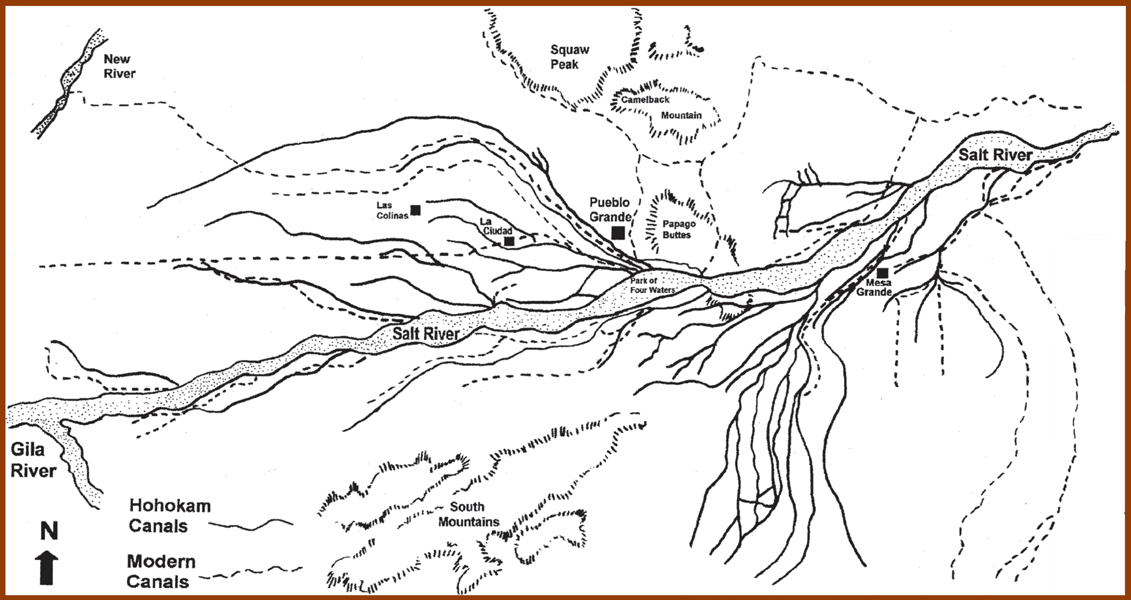
Some of these were founded in the colonial era, but urban centers in the desert predate Europeans by centuries or millennia. Great examples can be found in what is now Phoenix, Arizona and the ruins of Paquime in Chihuahua, Mexico. Both of these areas were home to thriving urban centers with high population density and in fact both are home to cities today, despite consistently arid climates. Moreover, both are (and were) well-established agricultural centers, with the nearby and incredibly arid Yuma county producing "90% of all leafy vegetables grown in the United States, November through March." in modern times. What's key here should be the understanding that desert climates are not necessarily inhospitable, nor were they barren even before modern hydraulic engineering. This is particularly obvious when we look at Hohokam Arizona, where this extensive canal system was uncovered by early settlers, lifelines of urban centers long since turned to dust. These canals and the upstream-most "Lehi" branch in particular used vast amounts of water, often consuming the entirety of the Salt and Gila River outflows.
Now, the overall argument being made is that urban centers are co-located with the resources to sustain them. I'm certainly not contradicting this, but it seems almost a tautology. People who are alive will obviously be living where they can access the resources to stay alive. In some cases like Phoenix, the desert itself can offer sufficient resources to enable this. In other cases like that of Arica, it is the primary port of access for the Bolivian highlands and the vast mineral wealth they contain, as well as that of the Northern Atacama. The trade these linkages produce allows inhabitants to simply import what they need, even if it's not available locally. A simple "deserts are uninhabitable" peeve belies the very complex and varied ways people learn to survive.