Between the 11th and 15th centuries, the English held large amounts of land in what is today France, like Aquitaine, Anjou, and Normandy. But were these territories considered part of the "Kingdom of France" at the time? I use "part of" loosely here since I'm aware that feudalism took much power away from the French kings anyway.
I know that this situation began in 1066 when William the Conqueror, who was Duke of Normandy, became King of England but also kept his old title. What I don't understand: the Duchy of Normandy (and later acquisitions like Aquitaine and Anjou) was originally a fief of the kings of France. How did this relationship change when a vassal of the French king became a king in his own right somewhere else?
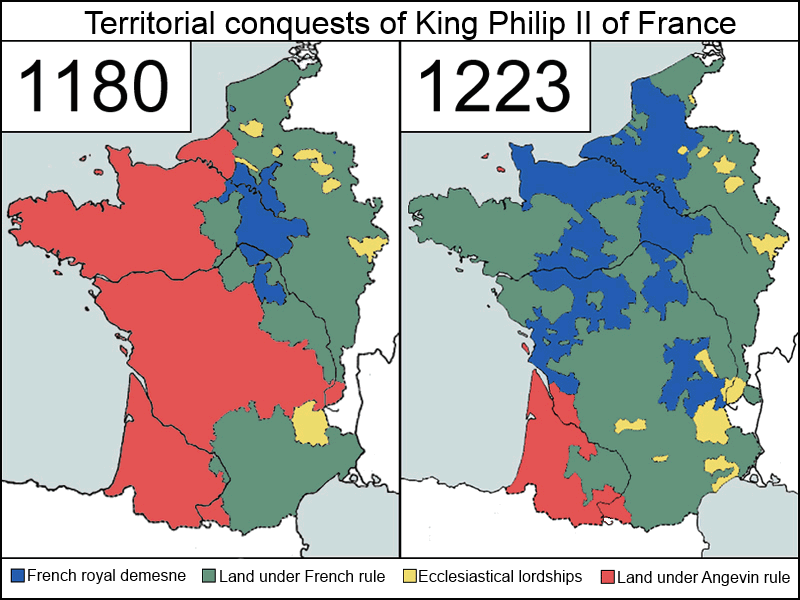
The source of my confusion is somewhat illustrated by maps such as this one and this one, which appear to show English ("Angevin" or "Plantagenet" on the maps) possessions as distinct from lands of the French king and his vassals. Yet I've never heard anyone describe Aquitaine or Anjou as part of England. If I am a landowning noble somewhere in the "English possessions" on the continent and the King of France is at war with the King of England, which one is "my" king, at least in theory?
From my understanding they were considered part of France.
So while as King of England the Plantagenet were the equal of the French king, they also needed to pay homage to him as their liege Lord as their role as Duke of Normandy / Aquitaine etc... In Dan Jones' "The Plantagenets" he talks about how this was often slightly fudged over though. When agreements were made between the two kings, or the English did their homage to new French kings, any agreements were generally quite wooly rather than going into specifics about how much duty the English would owe the French for those possessions.
In terms of the local areas, they often saw themselves as more loyal to the English as their local lord, rather than seeing themselves as part of a united France yet. For example in Gascony a lot of their trade was done with England, and some of the local families such as Buch and Lebret consistently sided with the English king as their local lord against the French.
However, strong French kings who were trying to take some of the English possessions in France, would try to take advantage of the situation. For example, if a local French family was in dispute with the English King, the French king would offer to arbitrate as the ultimate ruler of both in France. Thereby making the English King need to plead his case to the French case, as if he was subservient.
This is covered a bit in Dan Jones' books, The Black Prince by H. J. Hewitt, and I think some in Marc Morris' Edward I