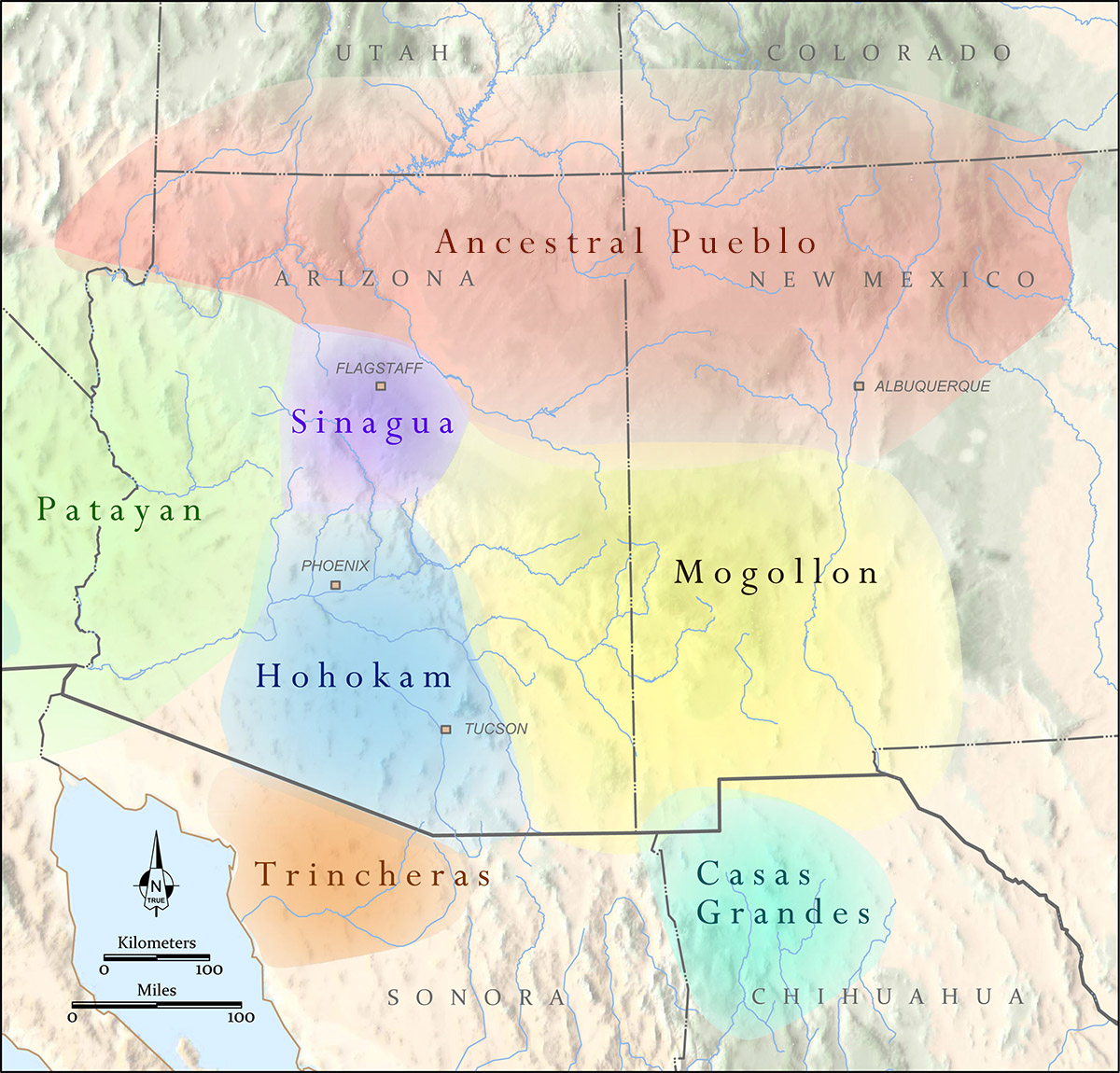
This is a complicated question and one that you could quite easily devote the better part of a thesis too. I'm going to focus entirely on the Southwest and Mesoamerica, as those are two culturally related areas that I am well acquainted with, as opposed to the far more remote and alien Pacific Northwest. To get semantics out of the way as well, I don't agree that the architecture of the Southwest or its culture were necessarily less "complex" either. Pueblos and the Hohokam Canal system are examples of massive works on the scale of Mesoamerica, prompting early settlers and archaeologists to name many after Mesoamericans. Today we know that these remains are the record of a distinct cultural area that with its own institutions and processes. Yet for all this, I don't disagree with the heart of the question. Institutional, economic, and political processes in Mesoamerica were unquestionably more complex than those in the Southwest.
The question of why some areas develop greater complexity than others is one that archaeologists have been asking for over a century. If you look through the literature, theories general fall into a number of distinct hypotheses:
The alternative view demands that we acknowledge that ... we need to approach regularities in the archaeological record, not from a perspective which views pattern as a direct behavioural response to stimuli, but which interprets change and patterns within a historically specific context. -^1
Aggrandizing theories: This is an older class of theories that's always found favor in the Pacific Northwest and Europe, but largely rejected within the Southwest. In these types, "Great men" become wealthy from resource surpluses and use their resource wealth to coerce action from others. However in places like the Southwest and parts of Mexico, we find massive projects being undertaken with no little sign of the inequality these theories require.
Theories of necessity: These theories argue that the political and institutional realities of a society reflect the needs of that society and are well optimized to serve it. Societal "failures" in this light are merely periods of stress forcing people to develop new systems better suited to their conditions.
Constructed urbanism: Combining the previous two classes, this type holds that centralized systems are actively constructed and that once built, invent their own needs for political and social complexity in a positive feedback loop. These sorts of theories are shockingly old, originating from medievalist historians god only knows how long ago. However, their modern application to mesoamerica is often argued today by Michael Smith, who I don't wholly agree with, but has influenced me.
So let's compare the Southwest with Mesoamerica. The most obvious difference is the climate. Parts of Mesoamerica are quite lush, especially in winter during the rainy season. The southwest by contrast is significantly more arid, particularly along the coast near the Gulf of California. However it also has several very large rivers, which were semi-stable sources of water for many centuries. Nevertheless aside from the Valley of Mexico, the classic-era lowland Yucatan, and the Salt & Gila valleys in Arizona, agriculture across both regions was largely similar in relying on check dams and minor water control features, occasionally with small canals or dams.
In terms of economy, both regions were again similar, with the dietary staples of corn, turkey, and agave present in both by the advent of regional urbanization around ~2000 BCE. Obsidian and chert sources were abundant in both, while sea shells were imported from coastal areas by inland groups. By classic periods in both areas, staple products had diverged somewhat. The Southwest was (and remains) the primary source for turqoise and other copper-bearing minerals. Greater obsidian access and biological diversity allowed Mexicans to export resources north in return.
In terms of society and politics, it's difficult to overstate the regional differences. Mesoamerica at various points developed massive inequalities in every sphere, nurtured vast empires, and sustained some of the highest population densities in the world. Even today, Mexico city remains the second-largest city in the Western hemisphere behind NYC. Crucially, the Southwest in almost all periods and areas lacked any significant intra-group inequality. Down in Mexico, elites were a common feature across almost all of Mesoamerica. Although they would contribute greatly to the success of the Spanish conquest, during the classic period elites helped to sustain and build the massive redistribution networks that characterized later Mesoamerica.
In modern times the Southwest is one of the most important agricultural regions in North America, producing around a quarter of the value of Mexico's and the US's combined agricultural value despite the overall arid climate. In the past the exact distribution would have been somewhat different, with the valley of Mexico and the Yucatan featuring more prominently.
That leads us into our first understanding why the Southwest and Mesoamerica differed. We know the region that today feeds a substantial portion of North America in historic times contained a tiny fraction of the population Mesoamerica contained. If we were to look at these regions solely from a perspective of ecological determinism, even taking into account carrying capacities and "prehistoric" population densities, the massive discrepancies makes little sense.
"But wait," I hear you say. "What if the aggrandizing elites the Southwest lacked help to grow populations and reduce famine (a common issue in the historic Southwest)?" This is certainly a question well-worth asking and one that archaeologists have not quite lain to rest despite decades of trying. In the Southwest, the periods of highest population density are actually those with some of the lowest conflict (Kohler 2014), and the areas with the most sophisticated architecture and apparent complexity offer little evidence of strong hierarchy. As Jennings et al. (2016) noted, aggrandized cities in fact seem to be a barrier to hierarchies. So aggrandization by itself is not an adequate theory either.
We're left then with the third class of theories: necessity and systems theories. Were the environmental and population pressures of Mesoamerica such that they encouraged the political and economic specialization the region so clearly developed? Again, this is a question that we simply can't answer yet. On one hand, Mexican elites clearly profited from the centralization induced by the rise of Mexican city-states, eventually controlling large swathes of Mesoamerica. On the other, the great mesoamerican hierarchy we see seems to have arisen largely after that centralization. In the Southwest, a rather different process seems to have been ongoing that actively resisted economic specialization (and thus political hierarchy). See Freeman and Anderies et al. (2014).
So why did the Southwest and Mesoamerica develop so differently? The simplest answer is that we don't really know. Ecological factors are largely overstated, but important nonetheless. Aggrandization seems to be both a cause and a feature of the divergence. Necessity brings with it numerous chicken-and-egg problems that we don't know how to fully resolve. More modern theories like Smith's constructed urbanism focus too heavily on urban cores for my taste and almost ignore critically important urban peripheries.
In all probability each of these theories has some merit to the actual answer. Mesoamerica probably had some level of ecological advantages to large populations. Aggrandizing leaders probably allowed for massive (and sometimes violent) integrative projects, establishing larger empires than would ever have evolved in the Southwest. And political/economic specialization probably increased and consciously were increased to meet the systemic needs of these fledgling polities. But putting all of these into an entirely coherent picture that we can all agree on simply isn't possible yet.
Gaffney, V., & Van Leusen, M. (1995). Postscript-GIS, environmental determinism and archaeology: a parallel text. Archaeology and geographical information systems: a European perspective, 367-382.
Kohler, T., Ortman, S., Grundtisch, K., Fitzpatrick, C., & Cole, S. (2014). The better angels of their nature: Declining violence through time among prehispanic farmers of the Pueblo Southwest. American Antiquity, 79(3), 444-464.
Jennings, J., Earle, T. K., Smith, M. E., Lobo, J., Ur, J., Jennings, J., & Earle, T. K. (2016). Urbanization, state formation, and cooperation: a reappraisal. Current Anthropology, 57(4), 000-000.
Freeman, J., Anderies, J. M., Torvinen, A., & Nelson, B. A. (2014). Crop specialization, exchange and robustness in a semi-arid environment. Human ecology, 42(2), 297-310.
For the Pacific Coast, are you referring to a centralized style of government and pyramids, respectively?