In antiquity, a lot happened in modern Iraq / Syria. For huge segments of history, there was some kind of empire operating out of modern Iran, and it tended very often to wind up in showdowns against the powers on its western border. There were all kinds of fun wars between the Greeks and the Persians, the Romans and the Parthians, the Byzantines and the Sasanians, and more.
Basically, it seems that there was usually an empire operating out of Iran, and a lot happened on its western border. But what about the eastern border? I've only ever heard of one war being fought in that area, and that was Alexander trying to push east and being turned down by his own men.
Was Alexander the only campaigner to try to march east out of modern Iran? Did the successive empires in this area ever fight major wars on their eastern border? Did different empires allocate the region different priorities? Were efforts made by Indian powers to march west?
My secondary goal in asking this is to try and understand what other commitments the empires in this area may have had aside from their western border, to better understand their actions on that front.
Thanks in advance for any answers.
Safeguarding the eastern frontiers was probably at least as important for the stability of any Iranian based empire as any struggles in the west. However we are very often far less well informed about the situation in the east than we are about the west. For the later we have often some very valuable written records like the works of Herodotus, Ammianus Marcellinus or Procopius that supply detailed account of the wars the ancient Greeks and Romans waged against their Iranian neighbors. The same can not be said about the east. Here we have often to make do with much shorter notices in western chronicles or use other kinds of sources like numismatics.
Just as a quick note: I’m going to assume that you’re only asking about classical antiquity (roughly from the 6th century BC to the 7th century AD) as anything beyond that is outside of my expertise anyways.
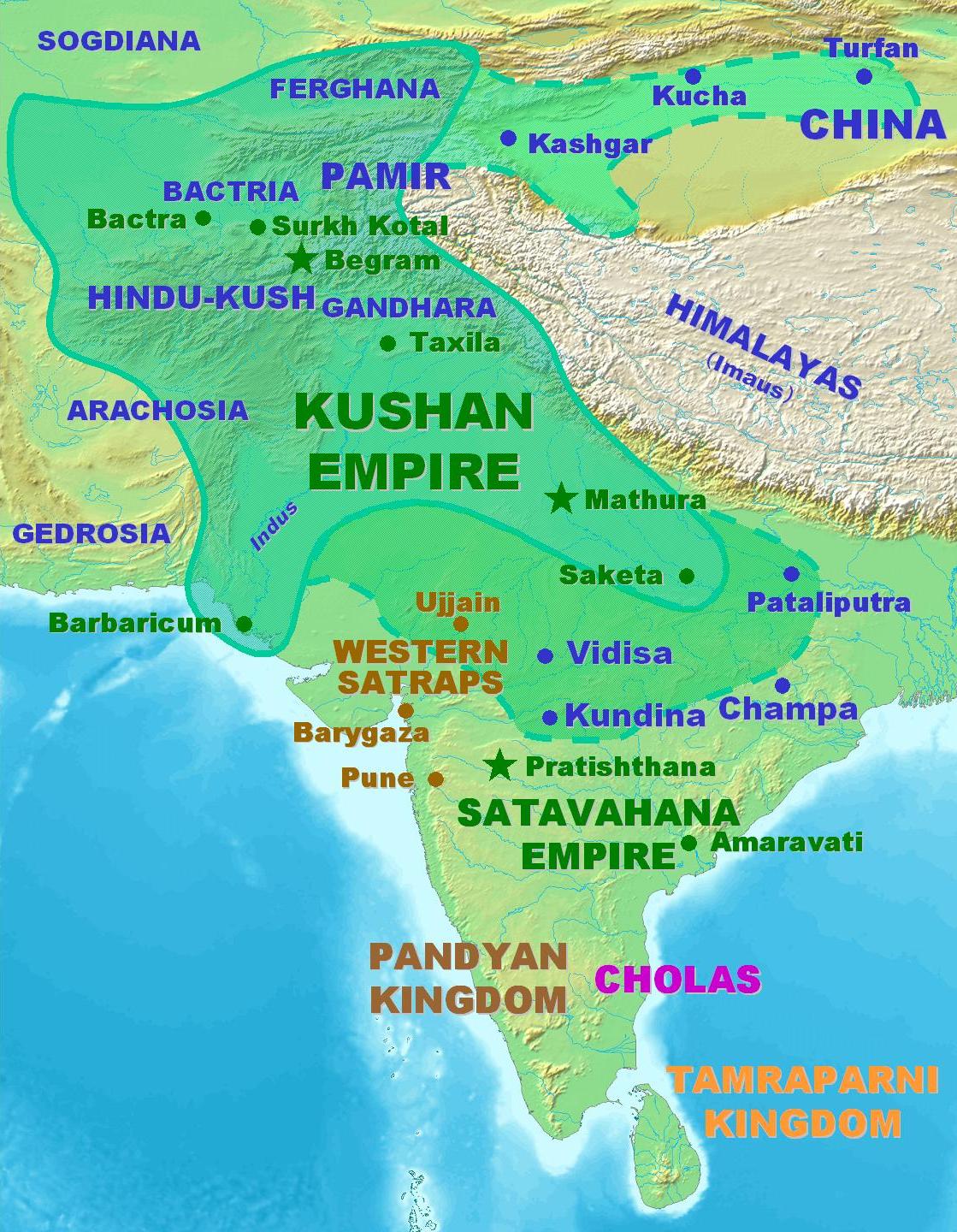
Roughly the eastern frontier of ancient Iran can be divided in to two regions: Central Asia/Transoxiana on the one side and the northwest of the Indian subcontinent on the other. Both are divided by huge mountain ranges like the Hindu Kush. In antiquity northwestern India for most of the time seems to have been divided into small petty kingdoms while the center of Indian state formation lay further to the east in the Ganges valley around the city of Pataliputra. This meant that the Northwest of India frequently became the target for invasions by Iranian based empires while expansions in the opposite direction only very rarely occurred. Transoxiana on the other hand was neighboring the steppes of inner Asia with its formidable nomadic population which meant that threats for the stability of Iran could frequently arise from there. At several times Transoxiana even became a center for larger empires in its own right which would expand into Iran as well as into India.
The first Iranian based empire which asserted long lasting control over the east was the state established by the Achaemenid dynasty in the 6th century BC. Those are the Persians that the ancient Greeks faced in the west about who Herodotus among others wrote. In Transoxiana they seem to have struggled quite a bit with nomadic tribal groups based north of the river Jaxartes/Syr Darya which ancient sources call Saka or Massagetae. Those groups seem to have been Iranian speakers and very similar to the Skythians further to west which the Greeks encountered north of the Black Sea. They could form a considerable threat to the Achaemenid Empire and several Persian kings were forced into conflict with them. The founder of the dynasty, Cyrus the Great, is even said to have died in battle against the Massagetae. All in all the Achaemenids however were able to hold on to their possessions in Transoxiana. No similar threat existed in India and the Persians were even able to incorporate the Indus valley into their empire under the rule of Darius I.
Achaemenid rule in the east like pretty much everywhere else came to an end with the spectacular conquests of Alexander the Great. Alexander arrived at Transoxiana in 329 BC while pursuing the murderers of the Persian king of kings Darius III. It would take him until 226 BC to gain secure enough control over the region in order to be able to leave towards India. This means his struggles in Central Asia were almost as long as it took him to subdue the entire rest of the Persian Empire. Part of the reason for this was the determined resistance that the nomadic elements from within as well as outside Transoxiana could put up. To anchor his rule Alexander founded several new cities in which he permanently settled some of his soldiers. When he finally entered India by crossing the Hindu Kush he encountered several petty kings which means that Achaemenid central control had slipped away in the meantime. Some of the local rulers submitted voluntarily to the Macedonians while others had to be subdued by force. While in the Indus valley Alexander gained knowledge of the kingdom of Magadha, the largest state on the subcontinent which was based in the Ganges valley. While Alexander seems to have been willing to take on this next foe his soldiers famously were having none of it and he was forced to finally withdraw towards Babylonia.
After Alexander’s death in 323 BC his realm was divided between several of his former generals. By far the largest share fell to a man called Seleukos who founded a dynasty that for the next few centuries inherited the Achaemenid role as masters of the Iranian highland. For the early Seleucids Transoxiana gained great importance. Seleukos had even married the daughter of a local noble, Apame, and continued Alexander’s policy of settling Greeks in the region. Only now Greek rule gained a more permanent footing in Central Asia. Seleukos’ and Apame’s son Antiochos would govern as a viceroy in the east until he succeeded his father in 281 AD. On the other hand the situation on the other side of the Hindu Kush was quite different. In the meantime an energetic new ruler called Chandragupta Maurya had gained the throne of Magadha and he had started out on a campaign of expansion. He became the founder of the Maurya Empire, the first state to unify large parts of the Indian subcontinent. Seleukos was forced to come to terms with Chandragupta and left the rule over the Indus valley and even the southeast of Iran to him. No other Indian based empire of antiquity would reach out this far into the west.
In later generations the Seleucids became plagued by dynastic strife which made it possible for several of their local governors to gain independence. One of the most important was a man called Diodotos who had governed Transoxiana for the Seleucids. Around the middle of the 3rd century BC he claimed the title of king for himself and founded the new Graeco-Bactrian kingdom. Compared to the other hellenistic states our sources on this kingdom are relatively limited. Although it saw several changes in its ruling dynasty it was not only able to defend its independence against the Seleucids but also to successfully expand in several directions. Most spectacular were its forays into India where the Graeco-Bactrian kings even surpassed the achievements of Alexander the Great. The Maurya Empire had already seen better days when a Greek army sacked its capital of Pataliputra in the first half of the 2nd cenrury BC. The Graeco-Bactrian king Demetrios I Aniketos commemorated his triumphs in India by issuing coin portraits with him wearing an elephant scalp.
Unfortunately we lack any narrative sources to tell us the details about the end of the Graeco-Bactrian kingdom. Usurpations seem to have played a role in weakening it but it were new waves of invasions from the Inner Asian steppes that spelled its end. The first to sweep into Transoxiana towards the end of the 2nd century BC were the Sakas. They even reached the northwest of India where they founded a Indo-Scythian kingdom. Others settled in the south of modern Afganistan were they gave the region its new name, Sakistan/Sistan. In Transoxiana they were followed by a tribal group which Chinese sources call Yuezhi and Greek authors name Tocharians (both names probably refer to the same group). Those nomads were later responsible for the foundation of another great empire, that of the Kushan dynasty. In the first two centuries AD Kushan rule would expand into India in the southeast and Inner Asia in the Northeast. It would unify as far flung regions as the Ganges valley and the Tarim basin. This in turn enabled them to profit from the emerging trade networks between the eastern and western ends of the Eurasian continent. Greek, Roman, Iranian and Indian influences merged into a unique cultural milieu. Among the states that arose in eastern Iran throughout antiquity the Kushan Empire may very well be the most impressive one.
While the Kushan build their new empire they left the rest of Iran more or less to its own devices. In the meantime the Parthians had here taken over control from the Seleucids. Their ruling dynasty, the Arsacids, was of nomadic origin like the Kushan and like the Graeco-Bactrians they had started their history as rebellious Seleucid governors in East Iran. By the 1st century BC they had taken over most of Iran and Mesopotamia and come into contact with the Romans in the west with whom they would frequently struggle until the 3rd century AD. It seems that Parthian rule was organised in a relatively decentralized manner with local vassal rulers enjoying much freedom in most regions. One such subkingdom was that of the Indo-Parthians originally based in Sistan. Its rulers possibly descend from the Sakas that had settled the region. Around the beginning of the 1st century AD they even expanded into Northwest India where they displaced local Greek and Saka rulers until they in turn were driven out by the Kushan.