What was the benefit of having 4 vs 3 planes in a flight during ww2?
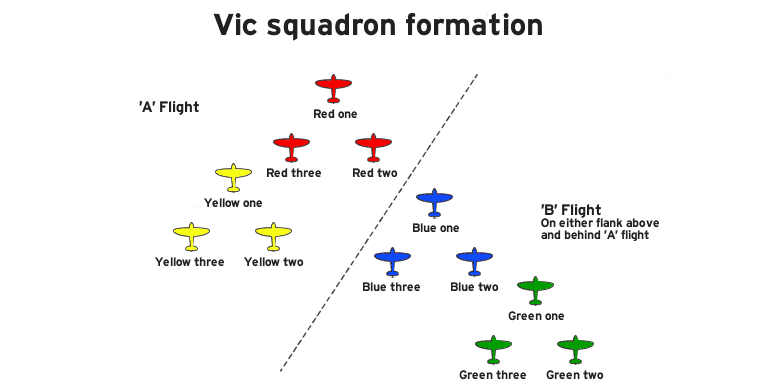
Aside from the benefit of an extra aircraft, the advantage of a four-plane fighter formation was that it was a much more flexible formation more suited to the aircraft capabilities of the day. The three-plane formation, called the vic in the RAF, resembled an arrowhead and ideally would work in conjunction with other vics in the squadron- seen here in this idealized depiction. The center of the arrowhead would be the vic's leader and his two wingmen would follow his lead. The rationale behind the vic was that a tight formation would concentrate firepower as well as maintain discipline as the wingmen followed the leader. This was a good formation for First World War aircraft and the planes of the 1920s as the aircraft of this period lacked reliable means of communication and if an independent plane flying by itself was a vulnerable target. For air forces meant to shoot down enemy bombers, the vic's concentration of firepower was also quite attractive as the bombers of the 1930s became faster and heavier.
The problem with the vic was that while the formation looked well for parades and air shows, it denied the initiative to the leaders' wingmen. The aircraft of the late 1930s were much faster and less docile than their predecessors, so a number of pilots found that maintaining a tight formation ate up a lot of their efforts in the cockpit. Instead of scanning the horizon or paying attention to the aircraft, the wingmen had to keep in touch with their leader and maintain the vee-formation while not colliding with their fellow aircraft and maintaining the same height as their leader. The RAF's use of the vic proved disastrous in the air battles over France in 1940, especially as the "tail-end charlies" (the last aircraft in the formation- in the diagram Green Three and Red Two) had no one covering their tail and the vic formation deprived them of situational awareness.
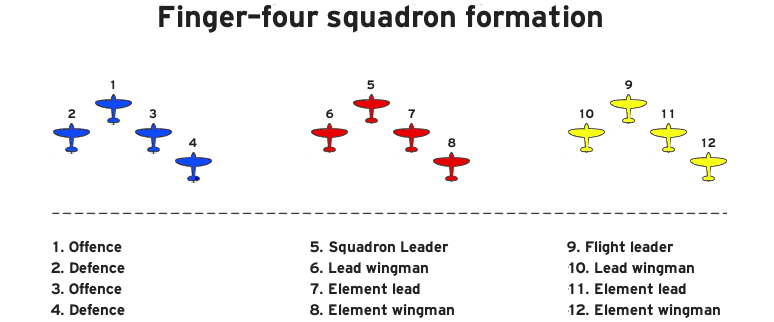
Not surprisingly, a lot of fighter leaders began experiments with looser formations. The Japanese experience in China led to a much more looser vic, which would remain the Japanese main fighter formation until the middle of the war. Both sides on the Spanish Civil War adapted a staggered four-plane flight as a solution to the problems and inflexibility of the vic. Termed the Schwarm by the Germans, the formation gradually became known as the finger-four in the RAF after its resemblance to the four fingers on the right hand- see this diagram. The finger-four not only freed up pilots from labor-intensive formation flying, but it also designated pilots to defensive and offensive roles within the formation. Although the heat of battle led to switched roles, the ideal finger-four had two pilots devoted to attack while the other two would protect the tail of the offensive line. The vic in contrast devoted all of its planes to the offense, but had only one pilot making the decisions for the whole formation.
The looseness of the finger-four was much more in line with the fighter aircraft of the day. The speed of the fighters in the late 1930s not only made the time between sighting an enemy and closing the distance much quicker than ever before, but also made the type formation flying pioneered in the 1920s much harder. For example, turning a vic required a juggling of throttles by the two wingmen while the leader stayed at a constant speed while the finger-four could switch position and reform quickly, as seen in this diagram. To add further to the vic's woes in the early war period, the clumping together of bunches of fighters on the same vertical plane made them a much more conspicuous visual target than the more spread out finger-four. Although poplar culture valorizes the dogfight between individual pilots and their skills, in air combat the advantage usual goes to the pilots that sighted the enemy first and were able to position themselves in an advantageous position whether with regards to altitude, cloud cover, speed, or use of the sun. Picking off a tail-end charlie might not have the glamor of Hollywood, but a kill's a kill and this type of attrition was deadly to the functioning of a fighter squadron.
The vic's days were limited after the Fall of France. It had some limited success in the Battle of Britain when radar-enabled ground-control intercept could place the formations where they were needed and its ability to concentrate fire on the bombers showed some of the formation's utility. But it was an inflexible air tactic for the planes of this generation and inferiority of a tight vic was quickly shown as soon as the war started.