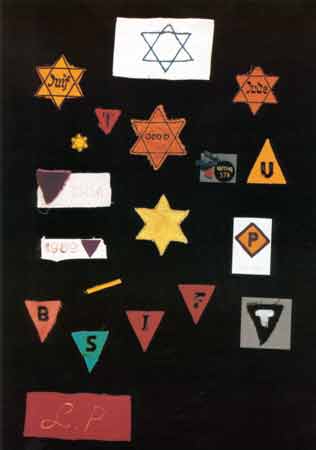
The association of pink with homosexuality was not the reason why the Nazis used pink for their CC badges, rather it was the result. /u/kugelfang52 and I have written on this subject before for example in this thread and here.
The gist of it is that specifically the pink triangle as a symbol was adopted by the gay rights movement in the US and Western Europe from the 1960s forward. Due to social changes and the search for a collective identity that would embolden the members of the homosexual community to stand together against the injustices they faced in society and combined with highly publicized trials against Nazis, the pink triangle was chosen as a symbol that exemplified the continued plight of homosexuals in the West.
t is unknown where it first appeared but throughout the latter half of the 60s and the 70s, it became more and more public as a symbol for their oppression and their struggle. Heinz Heger's book The Men with the Pink Triangle, which was one of the first works on the subject, is an example for this. The story of the persecution of gay men told as a story akin to the persecution of Jews in the Third Reich served as an important rallying cry and as an important unifying factor of the gay rights movement and its often disparate politics.
With its entry into politics, came a little later the historical research into the subject. First steps can be traced back to a 1977 study of Rüdiger Lautmann et. al., which used the International Tracing Service's identification cards of Nazi victims to trace the persecution of homosexuals. In subsequent years, a lot of local studies appeared detailing the histories of gay communities in cities like Berlin, Hamburg, Frankfurt and Köln. These however always remained fragmentary and were under-financed due to the lack of interest on part of universities and other institution financing research.
The real impact and popularity of the pink triangle symbol came with the HIV/AIDS crisis of the 1980s. Feeling ostracized and left to die by the public and the Reagan administration, the pink triangle took on a new meaning in US discourse. The message was, like the Nazis who had killed the homosexuals, the AIDS crisis was a blatant display of the state and society silently acquiescing with the mass deaths of gay men. This was when the symbol really made a public impact and resurgence and became both as a color and in form associated with homosexuality.
The other problem is that we know actually very little about the origin of the badge system, the reasons behind its design choices and how extensively it was really used. I hope that /u/kieslowskifan might know more but from my reading into the subject, what we know is as follows:
The badge system for CC prisoners has its origins in the early concentration camp system when prisoners who were arrested for political reasons had to wear some kind of red badge. It was most likely inspired by both the Weimar prison system and the Reichswehr military punishment camp system as well as POW camps in WWI. The first use of colored triangles dates back to Dachau under Theodor Eicke. In 1938 it was standardized by Himmler and the Inspectorate of the Concentration Camps. This is where this famous chart comes from.
Who spearheaded the design and chose the colors, we don't know because the sources were most likely destroyed before the end of the war. Also, and similar to the nominal "rules" that existed in the camps, we do not know how closely this chart and its classification system were followed in subsequent years. It's possible to say with absolute certainty that red, green, and black triangles were used as well as yellow Stars of David. We also have uniforms that bear some kind of large marking on the back denoting the inmates who wore them as likely to escape or belonging to a Sonderkommando.
The problem however is that with a lot of left-over uniforms, as Lizou Fenyvesi discusses in their article Reading Prisoner Uniforms: The Concentration Camp Prisoner Uniform as a Primary Source for Historical Research, that a lot of non-political prisoners removed their markings after liberation in order to avoid further stigmatization as criminal, gay, or asocial.
This is important in as far as we know that a lot of homosexuals imprisoned in concentration camps were imprisoned as criminals, as I describe in this answer regarding Sachsenhausen. This means that they would have most likely worn green triangles. The matter is complicated further by the fact that we only have very few recollections from former gay prisoners (13 in total) and that in other prisoner testimony, pink triangles only play a role in connection to Buchenwald. Here you can see the only ever recovered alleged pink triangle. It's the on with the "B" in it, on the bottom, and left of the green one with "S". It comes from the Buchenwald sub-camp Malachit and was issued in 1944.
Some historians doubt the veracity of this pink triangle because it would be very unusual to have gay Belgian – the "B" stands for Belgian – prisoners in a German Concentration Camp since the Nazis focused their persecution in German homosexuals (they didn't outlaw homosexuality in France for example). They hold that it is simply a red triangle with a lighter color.
Pink triangles aren't the only case where there is doubt if they were ever used beyond a certain camp. The blue triangles, denoting someone as an emigrant, are mentioned in prisoner testimony from Mauthausen as in use for German and Austrian former fighters for the Spanish Republic in the Civil War who were subsequently interned in France and handed over to the Nazis in 1941. But no blue triangle has ever been recovered and there are no testimonies about them being used elsewhere but Mauthausen and a few cases in Dachau.
Given all of these problems, there is little substantial to say on the origin of the badges, including the pink one, and how extensively it was used. We don't know who invented them, we don't know how standardized the system in practice really was and we don't know how widely they were used. We only can say that the symbol of the pink triangle has been successfully adopted by the gay rights movement in the years after the war and as such had a very important impact, culturally and politically, in terms of symbolizing the continued discrimination of homosexuals, especially in connection to the HIV/AIDS epidemic.