Obviously there is the partition of India into India and Pakistan (and then the split between Pakistan and Bangladesh). But given that many regions of India had long histories of independence, it's surprising that that process didn't go further. For example, you might suspect further partitioning based on linguistic borders. Why did the princely states all join India or Pakistan rather than being independent? Was maintaining unity a strong part of the independence movement?
There were many separatist movements active in India that started after or during independence in 1947 - to name a few: Khalistan (Punjab) until mid 90s, Dravida Nadu (Tamil Nadu) in the 50s and 60s, ULFA in Assam that continues till date on a low level. The northeastern states in particular saw themselves as culturally and geographically distinct from the rest of India and experienced a large variety of separatist movements - some of which demanded separate states or autonomy within the Indian Union, while others demanded complete independence.
Each movement was dealt with separately, but in general, the Indian government has been able to co-opt separatist leaders into mainstream politcs. A good example is when the plan to make Hindi the national language of India was shelved to placate Tamil separatism in the 60s. This has allowed politics to decentralize into regional power blocs that bicker a lot on internal issues, but keep the union territorially intact.
It is also worth noting that the partition of India was based on religious and not linguistic/ethnic/cultural lines.
India after Gandhi by Ramachandra Guha is a good reference for this topic.
Why did the princely states all join India or Pakistan rather than being independent? Was maintaining unity a strong part of the independence movement?
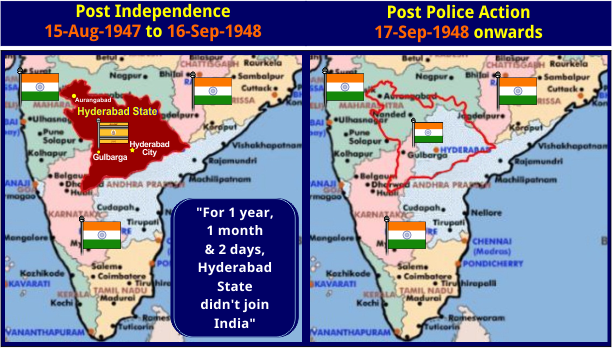
Independence for those states was an option on the table in early British plans, and states like Travancore and Hyderabad most notably did want to be independent, but independence was effectively no longer an option by 1947. Wanting to maintain unity across South Asia and the shared identity of being "Indian" only really developed alongside/out of the independence movement in the first place, so yes, the Indian National Congress, (think major figures like Gandhi, Jawaharlal Nehru, and Vallabhbhai Patel), did not want to see the princely states remaining independent.
Besides wanting to avoid Balkanization of India out of nationalism mixed with concerns that large-scale economic and administrative projects would become more difficult, part of the Congress' goal was to establish a democratic India where everybody would choose their elected officials, something which ran counter to the idea of a princely state. Additionally, having large independent states like Hyderabad in the midst of India was not preferable from a security standpoint. Eventually the princely states that wanted to be independent were all convinced/induced to abandon such notions. Travancore gave in after its leader survived an assassination attempt in the wake of increasing pressure on the part of the Indian National Congress to become part of India, and the Indian Army was actually sent into the state of Hyderabad in order to make it part of said country.