Before Arnold and modern body building, was there anyone comparable? That is, if you took Arnold back in time and put him in a Roman gladiator arena, would other gladiators be comparable?
Here's the only relevant answer from the archives I could find, by /u/vonadler and /u/talondearg and others, to tide you over until someone can give a real answer link
We can find historical sources approximating what was considered an aesthetically pleasing male body type, or an athletic male body, in many eras. But I don't know that we can extrapolate from that to say that these are examples of the male bodies with the largest muscles in their era, as the phenomenon of holding competitions to find the most muscular man is barely more than a century old.
We can get a more precise answer by about the 1890s, when the modern concept of "bodybuilder" started to emerge, or at least, became common enough to win the interest of photographers.
Many sources on bodybuilding label the German performer Eugen Sandow as the 'father of modern bodybuilding.' Sandow toured both Europe and the U.S., performing a flexing routine in vaudeville shows. In 1894, Thomas Edison filmed Sandow's routine, and used the film as marketing material for his kinetoscope camera. The Library of Congress has made the film available on youtube:
https://www.youtube.com/watch?v=HWM2ixqua3Y
That's probably the first film we have of a man famous simply for the size of his muscles, making a living by exhibiting them.
Sandow judged the first known bodybuilding competition in London in 1901, but didn't compete in it. I'm not sure why.
The bodybuilding world continued to grow after his retirement. The Mister Universe competition began about half a century later, in 1948. Here's (purportedly) a photo of that first podium trio:
https://www.flickr.com/photos/61234220@N04/5575153982/
It's subjective, of course, but with a look at those guys, I'd say Sandow at his peak wouldn't even be competitive in their competition. So the progress in peak muscle size over the period of that half century was pretty significant. Also, of some interest, the winner that year (John Grimek) was a man who had competed in several Olympic weightlifting events in the 1936 games (the most recent prior Olympics, thanks to the war). So, at least at that point, the distinction we see today between athletes who train for aesthetic effect and athletes who train for pure strength wasn't yet complete.
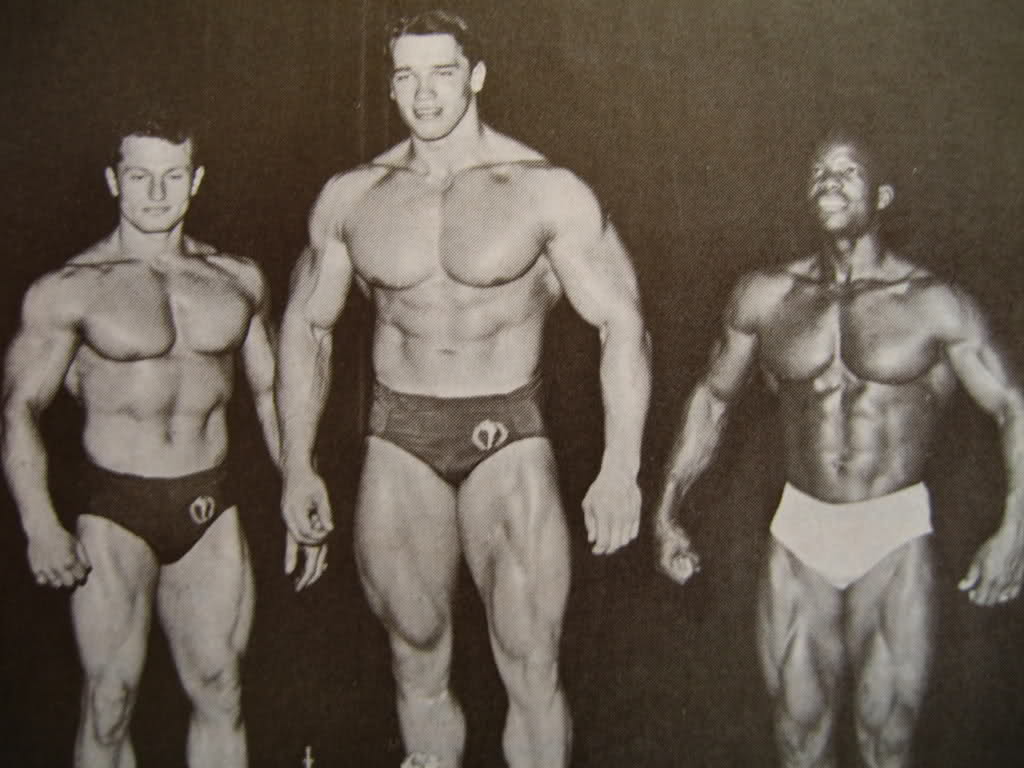
If we take Mr. Universe as our sample of the world's most muscular men, then growth continued rapidly from there. Arnold Schwarzenegger, who you reference in your question, won for the first time in 1967. Here is that podium:
https://musclemecca.com/imported-images/2009/02/10olhqa-1.jpg
Again, this is subjective, but by that point, I think the 1948 podium trio wouldn't have been competitive.
None of this proves to us that there weren't men like this in ancient Rome. But you can visually see the difference that developed just in the period from Sandow's 1894 film to the 1967 Mr. Universe podium. That progress occurred with the development of modern weightlifting equipment and with modern diets, when these men routinely consumed upwards of 6,000 calories per day and followed a guideline of no less than 1 gram of protein per pound of bodyweight per day.
It seems doubtful that the same thing could have been achieved with the diets and exercise equipment of the ancient world, but I am admittedly no expert in that field.
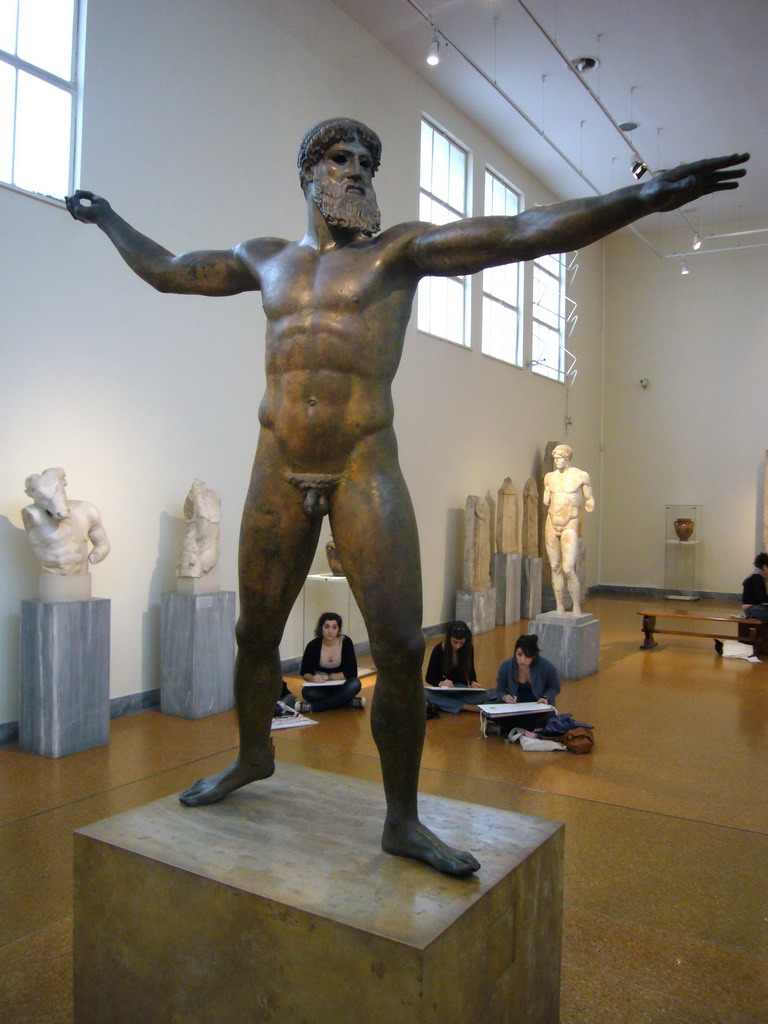
So, would a man from the 1967 Mr. Universe podium be considered "godly," to use your phrase, in the ancient world? Well, he wouldn't look anything like their conception of the gods. Compared to, say, the 5th century BCE Artimision Bronze, believed to be Zeus or Poseidon, our modern bodybuilder would be much more muscular. But, as the Romans didn't leave us any sculptures or drawings of their most muscular men (that I know of), I suppose it's always possible they had seen someone like our bodybuilders. But I doubt it, if only for the simple restriction of protein intake.
Edit - correcting statue photo link
I've been thinking a lot about this question, probably too much, and about how difficult it is to answer. The perspective I bring to it, to be clear, is that of someone trained in Ancient History who also happens to powerlift.
Here's the set of difficulties: you need to apprehend (a) ancient perceptions of strength, size, etc., in the context of mythology and in the context of daily life in a particular classical period; (b) have some kind of knowledge of real-world physiques in antiquity, e.g. archaeological findings and what they suggest; and (c) some knowledge of contemporary, well recent body-building history.
If we consider Arnold, and competitors of his era, we do know that steroid abuse was rife. We also know that a lot of modern training is only truly possible in the last 50 years. The history of barbell training, and of training specifically for physique, and the food science and food surplus to nurture these kinds of physiques is all surprisingly and relatively new.
As /u/Iphikrates points out in their excellent comment here, at least in classical Greece the 'ideal' of the hardened soldier is related a lot to the rigours of farmlife. This is very often contrasted with the leisure available to the wealthier, who being freed from the burden of physical labour are not likely to develop the same kinds of physiques as farmers.
So you've got something of a paradox, because the leisure and surplus wealth (and exhorbitant amounts of food required) do not normally correlate to a social status engaged in a lot of physical labour, even if you factor in, say, the ancient gymnasium.
But there are always outliers, aren't there. I would probably say, look at modern Strongman competitions. A different type of build to bodybuilders, because most strongmen are exceptionally tall, large, and just eat a lot (when there's no advantage to low body fat or weight classes, bigger is usually stronger). We might imagine that such figures existed in antiquity and were a source of spectacle, just as they were in the early days of circus strongmen.
I think the answer to this question is probably yes, they would be regarded as freaks, but freaks of nature or freaks of divinity? The answer has to remain speculative, because the question is speculative. We don't really have the data we'd like to formulate answers such as the physical limits of athletes and warriors in antiquity, beyond anecdata. However, we do know that modern bodybuilding, plus the era of steroids, produced physiques that were generally not possible in antiquity.
Edit:
It's worth looking at, for example, Geoffrey Kron's 2005 article 'Anthropometry, Physical Anthropology, and the Reconstruction of Ancient Health,Nutrition, and Living Standards', which discusses mean heights for Graeco-Roman skeletons. He puts the mean height of Italian males at 168.3cm, cf. Angel's mean height for Classical Greek males of 171.9cm. Those are quite good, considering, and compare to 20th century European societies. So, it's not that ancient people were necessarily under-nourished. However they weren't, generally, 'huge, jacked war-machines'.
I'm not a historian and would be happy to see this answer replaced by one written by someone more qualified. But I have read up on the question before and can provide some context.
We can find historical sources approximating what was considered an aesthetically pleasing male body type, or an athletic male body, in many eras. But I don't know that we can extrapolate from that to say that these are examples of the male bodies with the largest muscles in their era, as the phenomenon of holding competitions to find the most muscular man is barely more than a century old.
Sculptures like Myron's Discobulus show us athletes in motion as artists in the 5th century BCE imagined them.
Maybe more to your point, sculptures like the Artemisian Bronze show us how they imagined the bodies of the gods.
But we can't eliminate the possibility that there were men more muscular than these at the time, and they simply weren't considered models for gods or athletes.
We can get a more precise answer by about the 1890s, when the modern concept of "bodybuilder" started to emerge, or at least, became common enough to win the interest of photographers.
Many sources on bodybuilding label the German performer Eugen Sandow as the 'father of modern bodybuilding.' Sandow toured both Europe and the U.S., performing a flexing routine in vaudeville shows. In 1894, Thomas Edison filmed Sandow's routine, and used the film as marketing material for his kinetoscope camera. The Library of Congress has made the film available on youtube:
https://www.youtube.com/watch?v=HWM2ixqua3Y
That's probably the first film we have of a man famous simply for the size of his muscles, making a living by exhibiting them.
Sandow judged the first known bodybuilding competition in London in 1901, but didn't compete in it. I'm not sure why.
The bodybuilding world continued to grow after his retirement. The Mister Universe competition began about half a century later, in 1948. Here's (purportedly) a photo of the podium trio:
https://www.flickr.com/photos/61234220@N04/5575153982/
It's subjective, of course, but with a look at those guys, I'd say Sandow at his peak wouldn't even be competitive in their competition. So the progress in peak muscle size over the period of that half century was pretty significant. Also, of some interest, the winner that year was a man who had competed in several Olympic weightlifting events in the 1936 games (the most recent prior Olympics, thanks to the war). So, at least at that point, the distinction we see today between athletes who train for aesthetic effect and athletes who train for pure strength wasn't yet complete.
If we take Mr. Universe as our sample of the world's most muscular men, then growth continued rapidly from there. Arnold Schwarzenegger, who you reference in your question, won for the first time in 1967. Here is that podium:
https://musclemecca.com/imported-images/2009/02/10olhqa-1.jpg
Again, this is subjective, but by that point, I think the 1948 podium trio wouldn't have been competitive.
None of this proves to us that there weren't men like this in ancient Rome. But you can visually see the difference that developed just in the period from Sandow's 1894 film to the 1967 Mr. Universe podium. That progress occurred with the development of modern weightlifting equipment and with modern diets, when these men routinely consumed upwards of 6,000 calories per day and followed a guideline of no less than 1 gram of protein per pound of bodyweight per day.
It seems doubtful that the same thing could have been achieved with the diets and exercise equipment of the ancient world, but I am admittedly no expert in that field.
So, would a man from the 1967 Mr. Universe podium be considered "godly," to use your phrase. Well, he wouldn't look anything like their conception of the gods. He'd be much more muscular. But, as the Romans didn't leave us any sculptures or drawings of their most muscular men (that I know of), I suppose it's always possible they had seen someone like our bodybuilders. But I doubt it, if only for the simple restriction of protein intake.
I'm not a historian and would be happy to see this answer replaced by one written by someone more qualified. But I have read up on the question before and can provide some context.
We can find historical sources approximating what was considered an aesthetically pleasing male body type, or an athletic male body, in many eras. But I don't know that we can extrapolate from that to say that these are examples of the male bodies with the largest muscles in their era, as the phenomenon of holding competitions to find the most muscular man is barely more than a century old.
Sculptures like Myron's Discobulus show us athletes in motion as Greek 18:04:34 GMT-0400 (Eastern Daylight Time) artists in the 5th century BCE imagined them
Maybe more to your point, sculptures like the Artemisian Bronze show us how they imagined the bodies of the gods.
But we can't eliminate the possibility that there were men more muscular than these at the time, and they simply weren't considered models for gods or athletes.
We can get a more precise answer by about the 1890s, when the modern concept of "bodybuilder" started to emerge, or at least, became common enough to win the interest of photographers.
Many sources on bodybuilding label the German performer Eugen Sandow as the 'father of modern bodybuilding.' Sandow toured both Europe and the U.S., performing a flexing routine in vaudeville shows. In 1894, Thomas Edison filmed Sandow's routine, and used the film as marketing material for his kinetoscope camera. The Library of Congress has made the film available on youtube:
https://www.youtube.com/watch?v=HWM2ixqua3Y
That's probably the first film we have of a man famous simply for the size of his muscles, making a living by exhibiting them.
Sandow judged the first known bodybuilding competition in London in 1901, but didn't compete in it. I'm not sure why.
The bodybuilding world continued to grow after his retirement. The Mister Universe competition began about half a century later, in 1948. Here's (purportedly) a photo of the podium trio:
https://www.flickr.com/photos/61234220@N04/5575153982/
It's subjective, of course, but with a look at those guys, I'd say Sandow at his peak wouldn't even be competitive in their competition. So the progress in peak muscle size over the period of that half century was pretty significant. Also, of some interest, the winner that year was a man who had competed in several Olympic weightlifting events in the 1936 games (the most recent prior Olympics, thanks to the war). So, at least at that point, the distinction we see today between athletes who train for aesthetic effect and athletes who train for pure strength wasn't yet complete.
If we take Mr. Universe as our sample of the world's most muscular men, then growth continued rapidly from there. Arnold Schwarzenegger, who you reference in your question, won for the first time in 1967. Here is that podium:
https://musclemecca.com/imported-images/2009/02/10olhqa-1.jpg
Again, this is subjective, but by that point, I think the 1948 podium trio wouldn't have been competitive.
None of this proves to us that there weren't men like this in ancient Rome. But you can visually see the difference that developed just in the period from Sandow's 1894 film to the 1967 Mr. Universe podium. That progress occurred with the development of modern weightlifting equipment and with modern diets, when these men routinely consumed upwards of 6,000 calories per day and followed a guideline of no less than 1 gram of protein per pound of bodyweight per day.
It seems doubtful that the same thing could have been achieved with the diets and exercise equipment of the ancient world, but I am admittedly no expert in that field.
So, would a man from the 1967 Mr. Universe podium be considered "godly," to use your phrase? Well, he wouldn't look anything like their conception of the gods. He'd be much more muscular. But, as the Romans didn't leave us any sculptures or drawings of their most muscular men (that I know of), I suppose it's always possible they had seen someone like our bodybuilders. But I doubt it, if only for the simple restriction of protein intake.
I'm not a historian and would be happy to see this answer replaced by one written by someone more qualified. But I have read up on the question before and can provide some context.
We can find historical sources approximating what was considered an aesthetically pleasing male body type, or an athletic male body, in many eras. But I don't know that we can extrapolate from that to say that these are examples of the male bodies with the largest muscles in their era, as the phenomenon of holding competitions to find the most muscular man is barely more than a century old.
Sculptures like Myron's Discobulus show us athletes in motion as artists in the 5th century BCE imagined them (I know wikipedia is not an acceptable source here, but as these are just photos, I hope that's allowable).
Maybe more to your point, sculptures like the Artemisian Bronze show us how they imagined the bodies of the gods.
But we can't eliminate the possibility that there were men more muscular than these at the time, and they simply weren't considered models for gods or athletes.
We can get a more precise answer by about the 1890s, when the modern concept of "bodybuilder" started to emerge, or at least, became common enough to win the interest of photographers.
Many sources on bodybuilding label the German performer Eugen Sandow as the 'father of modern bodybuilding.' Sandow toured both Europe and the U.S., performing a flexing routine in vaudeville shows. In 1894, Thomas Edison filmed Sandow's routine, and used the film as marketing material for his kinetoscope camera. The Library of Congress has made the film available on youtube:
https://www.youtube.com/watch?v=HWM2ixqua3Y
That's probably the first film we have of a man famous simply for the size of his muscles, making a living by exhibiting them.
Sandow judged the first known bodybuilding competition in London in 1901, but didn't compete in it. I'm not sure why.
The bodybuilding world continued to grow after his retirement. The Mister Universe competition began about half a century later, in 1948. Here's (purportedly) a photo of the podium trio:
https://www.flickr.com/photos/61234220@N04/5575153982/
It's subjective, of course, but with a look at those guys, I'd say Sandow at his peak wouldn't even be competitive in their competition. So the progress in peak muscle size over the period of that half century was pretty significant. Also, of some interest, the winner that year was a man who had competed in several Olympic weightlifting events in the 1936 games (the most recent prior Olympics, thanks to the war). So, at least at that point, the distinction we see today between athletes who train for aesthetic effect and athletes who train for pure strength wasn't yet complete.
If we take Mr. Universe as our sample of the world's most muscular men, then growth continued rapidly from there. Arnold Schwarzenegger, who you reference in your question, won for the first time in 1967. Here is that podium:
https://musclemecca.com/imported-images/2009/02/10olhqa-1.jpg
Again, this is subjective, but by that point, I think the 1948 podium trio wouldn't have been competitive.
None of this proves to us that there weren't men like this in ancient Rome. But you can visually see the difference that developed just in the period from Sandow's 1894 film to the 1967 Mr. Universe podium. That progress occurred with the development of modern weightlifting equipment and with modern diets, when these men routinely consumed upwards of 6,000 calories per day and followed a guideline of no less than 1 gram of protein per pound of bodyweight per day.
It seems doubtful that the same thing could have been achieved with the diets and exercise equipment of the ancient world, but I am admittedly no expert in that field.
So, would a man from the 1967 Mr. Universe podium be considered "godly," to use your phrase. Well, he wouldn't look anything like their conception of the gods. He'd be much more muscular. But, as the Romans didn't leave us any sculptures or drawings of their most muscular men (that I know of), I suppose it's always possible they had seen someone like our bodybuilders. But I doubt it, if only for the simple restriction of protein intake.
I'm not a historian and would be happy to see this answer replaced by one written by someone more qualified. But I have read up on the question before and can provide some context.
We can find historical sources approximating what was considered an aesthetically pleasing male body type, or an athletic male body, in many eras. But I don't know that we can extrapolate from that to say that these are examples of the male bodies with the largest muscles in their era, as the phenomenon of holding competitions to find the most muscular man is barely more than a century old.
Sculptures like Myron's Discobulus show us athletes in motion as artists in the 5th century BCE imagined them (I know wikipedia is not an acceptable source here, but as these are just photos, I hope that's allowable).
Maybe more to your point, sculptures like the Artemisian Bronze show us how they imagined the bodies of the gods.
But we can't eliminate the possibility that there were men more muscular than these at the time, and they simply weren't considered models for gods or athletes.
We can get a more precise answer by about the 1890s, when the modern concept of "bodybuilder" started to emerge, or at least, became common enough to win the interest of photographers.
Many sources on bodybuilding label the German performer Eugen Sandow as the 'father of modern bodybuilding.' Sandow toured both Europe and the U.S., performing a flexing routine in vaudeville shows. In 1894, Thomas Edison filmed Sandow's routine, and used the film as marketing material for his kinetoscope camera. The Library of Congress has made the film available on youtube:
https://www.youtube.com/watch?v=HWM2ixqua3Y
That's probably the first film we have of a man famous simply for the size of his muscles, making a living by exhibiting them.
Sandow judged the first known bodybuilding competition in London in 1901, but didn't compete in it. I'm not sure why.
The bodybuilding world continued to grow after his retirement. The Mister Universe competition began about half a century later, in 1948. Here's (purportedly) a photo of the podium trio:
https://www.flickr.com/photos/61234220@N04/5575153982/
It's subjective, of course, but with a look at those guys, I'd say Sandow at his peak wouldn't even be competitive in their competition. So the progress in peak muscle size over the period of that half century was pretty significant. Also, of some interest, the winner that year was a man who had competed in several Olympic weightlifting events in the 1936 games (the most recent prior Olympics, thanks to the war). So, at least at that point, the distinction we see today between athletes who train for aesthetic effect and athletes who train for pure strength wasn't yet complete.
If we take Mr. Universe as our sample of the world's most muscular men, then growth continued rapidly from there. Arnold Schwarzenegger, who you reference in your question, won for the first time in 1967. Here is that podium:
https://musclemecca.com/imported-images/2009/02/10olhqa-1.jpg
Again, this is subjective, but by that point, I think the 1948 podium trio wouldn't have been competitive.
None of this proves to us that there weren't men like this in ancient Rome. But you can visually see the difference that developed just in the period from Sandow's 1894 film to the 1967 Mr. Universe podium. That progress occurred with the development of modern weightlifting equipment and with modern diets, when these men routinely consumed upwards of 6,000 calories per day and followed a guideline of no less than 1 gram of protein per pound of bodyweight per day.
It seems doubtful that the same thing could have been achieved with the diets and exercise equipment of the ancient world, but I am admittedly no expert in that field.
So, would a man from the 1967 Mr. Universe podium be considered "godly," to use your phrase. Well, he wouldn't look anything like their conception of the gods. He'd be much more muscular. But, as the Romans didn't leave us any sculptures or drawings of their most muscular men (that I know of), I suppose it's always possible they had seen someone like our bodybuilders. But I doubt it, if only for the simple restriction of protein intake.
I'm not a historian and would be happy to see this answer replaced by one written by someone more qualified. But I have read up on the question before and can provide some context.
We can find historical sources approximating what was considered an aesthetically pleasing male body type, or an athletic male body, in many eras. But I don't know that we can extrapolate from that to say that these are examples of the male bodies with the largest muscles in their era, as the phenomenon of holding competitions to find the most muscular man is barely more than a century old.
Sculptures like Myron's Discobulus show us athletes in motion as artists in the 5th century BCE imagined them (I know wikipedia is not an acceptable source here, but as these are just photos, I hope that's allowable).
Maybe more to your point, sculptures like the Artemisian Bronze show us how they imagined the bodies of the gods.
But we can't eliminate the possibility that there were men more muscular than these at the time, and they simply weren't considered models for gods or athletes.
We can get a more precise answer by about the 1890s, when the modern concept of "bodybuilder" started to emerge, or at least, became common enough to win the interest of photographers.
Many sources on bodybuilding label the German performer Eugen Sandow as the 'father of modern bodybuilding.' Sandow toured both Europe and the U.S., performing a flexing routine in vaudeville shows. In 1894, Thomas Edison filmed Sandow's routine, and used the film as marketing material for his kinetoscope camera. The Library of Congress has made the film available on youtube:
https://www.youtube.com/watch?v=HWM2ixqua3Y
That's probably the first film we have of a man famous simply for the size of his muscles, making a living by exhibiting them.
Sandow judged the first known bodybuilding competition in London in 1901, but didn't compete in it. I'm not sure why.
The bodybuilding world continued to grow after his retirement. The Mister Universe competition began about half a century later, in 1948. Here's (purportedly) a photo of the podium trio:
https://www.flickr.com/photos/61234220@N04/5575153982/
It's subjective, of course, but with a look at those guys, I'd say Sandow at his peak wouldn't even be competitive in their competition. So the progress in peak muscle size over the period of that half century was pretty significant. Also, of some interest, the winner that year was a man who had competed in several Olympic weightlifting events in the 1936 games (the most recent prior Olympics, thanks to the war). So, at least at that point, the distinction we see today between athletes who train for aesthetic effect and athletes who train for pure strength wasn't yet complete.
If we take Mr. Universe as our sample of the world's most muscular men, then growth continued rapidly from there. Arnold Schwarzenegger, who you reference in your question, won for the first time in 1967. Here is that podium:
https://musclemecca.com/imported-images/2009/02/10olhqa-1.jpg
Again, this is subjective, but by that point, I think the 1948 podium trio wouldn't have been competitive.
None of this proves to us that there weren't men like this in ancient Rome. But you can visually see the difference that developed just in the period from Sandow's 1894 film to the 1967 Mr. Universe podium. That progress occurred with the development of modern weightlifting equipment and with modern diets, when these men routinely consumed upwards of 6,000 calories per day and followed a guideline of no less than 1 gram of protein per pound of bodyweight per day.
It seems doubtful that the same thing could have been achieved with the diets and exercise equipment of the ancient world, but I am admittedly no expert in that field.
So, would a man from the 1967 Mr. Universe podium be considered "godly," to use your phrase. Well, he wouldn't look anything like their conception of the gods. He'd be much more muscular. But, as the Romans didn't leave us any sculptures or drawings of their most muscular men (that I know of), I suppose it's always possible they had seen someone like our bodybuilders. But I doubt it, if only for the simple restriction of protein intake.
I'm not a historian and would be happy to see this answer replaced by one written by someone more qualified. But I have read up on the question before and can provide some context.
We can find historical sources approximating what was considered an aesthetically pleasing male body type, or an athletic male body, in many eras. But I don't know that we can extrapolate from that to say that these are examples of the male bodies with the largest muscles in their era, as the phenomenon of holding competitions to find the most muscular man is barely more than a century old.
Sculptures like Myron's Discobulus show us athletes in motion as artists in the 5th century BCE imagined them (I know wikipedia is not an acceptable source here, but as these are just photos, I hope that's allowable).
Maybe more to your point, sculptures like the Artemisian Bronze show us how they imagined the bodies of the gods.
But we can't eliminate the possibility that there were men more muscular than these at the time, and they simply weren't considered models for gods or athletes.
We can get a more precise answer by about the 1890s, when the modern concept of "bodybuilder" started to emerge, or at least, became common enough to win the interest of photographers.
Many sources on bodybuilding label the German performer Eugen Sandow as the 'father of modern bodybuilding.' Sandow toured both Europe and the U.S., performing a flexing routine in vaudeville shows. In 1894, Thomas Edison filmed Sandow's routine, and used the film as marketing material for his kinetoscope camera. The Library of Congress has made the film available on youtube:
https://www.youtube.com/watch?v=HWM2ixqua3Y
That's probably the first film we have of a man famous simply for the size of his muscles, making a living by exhibiting them.
Sandow judged the first known bodybuilding competition in London in 1901, but didn't compete in it. I'm not sure why.
The bodybuilding world continued to grow after his retirement. The Mister Universe competition began about half a century later, in 1948. Here's (purportedly) a photo of the podium trio:
https://www.flickr.com/photos/61234220@N04/5575153982/
It's subjective, of course, but with a look at those guys, I'd say Sandow at his peak wouldn't even be competitive in their competition. So the progress in peak muscle size over the period of that half century was pretty significant. Also, of some interest, the winner that year was a man who had competed in several Olympic weightlifting events in the 1936 games (the most recent prior Olympics, thanks to the war). So, at least at that point, the distinction we see today between athletes who train for aesthetic effect and athletes who train for pure strength wasn't yet complete.
If we take Mr. Universe as our sample of the world's most muscular men, then growth continued rapidly from there. Arnold Schwarzenegger, who you reference in your question, won for the first time in 1967. Here is that podium:
https://musclemecca.com/imported-images/2009/02/10olhqa-1.jpg
Again, this is subjective, but by that point, I think the 1948 podium trio wouldn't have been competitive.
None of this proves to us that there weren't men like this in ancient Rome. But you can visually see the difference that developed just in the period from Sandow's 1894 film to the 1967 Mr. Universe podium. That progress occurred with the development of modern weightlifting equipment and with modern diets, when these men routinely consumed upwards of 6,000 calories per day and followed a guideline of no less than 1 gram of protein per pound of bodyweight per day.
It seems doubtful that the same thing could have been achieved with the diets and exercise equipment of the ancient world, but I am admittedly no expert in that field.
So, would a man from the 1967 Mr. Universe podium be considered "godly," to use your phrase. Well, he wouldn't look anything like their conception of the gods. He'd be much more muscular. But, as the Romans didn't leave us any sculptures or drawings of their most muscular men (that I know of), I suppose it's always possible they had seen someone like our bodybuilders. But I doubt it, if only for the simple restriction of protein intake.
I'm not a historian and would be happy to see this answer replaced by one written by someone more qualified. But I have read up on the question before and can provide some context.
We can find historical sources approximating what was considered an aesthetically pleasing male body type, or an athletic male body, in many eras. But I don't know that we can extrapolate from that to say that these are examples of the male bodies with the largest muscles in their era, as the phenomenon of holding competitions to find the most muscular man is barely more than a century old.
Sculptures like Myron's Discobulus show us athletes in motion as artists in the 5th century BCE imagined them (I know wikipedia is not an acceptable source here, but as these are just photos, I hope that's allowable).
Maybe more to your point, sculptures like the Artemisian Bronze show us how they imagined the bodies of the gods.
But we can't eliminate the possibility that there were men more muscular than these at the time, and they simply weren't considered models for gods or athletes.
We can get a more precise answer by about the 1890s, when the modern concept of "bodybuilder" started to emerge, or at least, became common enough to win the interest of photographers.
Many sources on bodybuilding label the German performer Eugen Sandow as the 'father of modern bodybuilding.' Sandow toured both Europe and the U.S., performing a flexing routine in vaudeville shows. In 1894, Thomas Edison filmed Sandow's routine, and used the film as marketing material for his kinetoscope camera. The Library of Congress has made the film available on youtube:
https://www.youtube.com/watch?v=HWM2ixqua3Y
That's probably the first film we have of a man famous simply for the size of his muscles, making a living by exhibiting them.
Sandow judged the first known bodybuilding competition in London in 1901, but didn't compete in it. I'm not sure why.
The bodybuilding world continued to grow after his retirement. The Mister Universe competition began about half a century later, in 1948. Here's (purportedly) a photo of the podium trio:
https://www.flickr.com/photos/61234220@N04/5575153982/
It's subjective, of course, but with a look at those guys, I'd say Sandow at his peak wouldn't even be competitive in their competition. So the progress in peak muscle size over the period of that half century was pretty significant. Also, of some interest, the winner that year was a man who had competed in several Olympic weightlifting events in the 1936 games (the most recent prior Olympics, thanks to the war). So, at least at that point, the distinction we see today between athletes who train for aesthetic effect and athletes who train for pure strength wasn't yet complete.
If we take Mr. Universe as our sample of the world's most muscular men, then growth continued rapidly from there. Arnold Schwarzenegger, who you reference in your question, won for the first time in 1967. Here is that podium:
https://musclemecca.com/imported-images/2009/02/10olhqa-1.jpg
Again, this is subjective, but by that point, I think the 1948 podium trio wouldn't have been competitive.
None of this proves to us that there weren't men like this in ancient Rome. But you can visually see the difference that developed just in the period from Sandow's 1894 film to the 1967 Mr. Universe podium. That progress occurred with the development of modern weightlifting equipment and with modern diets, when these men routinely consumed upwards of 6,000 calories per day and followed a guideline of no less than 1 gram of protein per pound of bodyweight per day.
It seems doubtful that the same thing could have been achieved with the diets and exercise equipment of the ancient world, but I am admittedly no expert in that field.
So, would a man from the 1967 Mr. Universe podium be considered "godly," to use your phrase. Well, he wouldn't look anything like their conception of the gods. He'd be much more muscular. But, as the Romans didn't leave us any sculptures or drawings of their most muscular men (that I know of), I suppose it's always possible they had seen someone like our bodybuilders. But I doubt it, if only for the simple restriction of protein intake.
I'm not a historian and would be happy to see this answer replaced by one written by someone more qualified. But I have read up on the question before and can provide some context.
We can find historical sources approximating what was considered an aesthetically pleasing male body type, or an athletic male body, in many eras. But I don't know that we can extrapolate from that to say that these are examples of the male bodies with the largest muscles in their era, as the phenomenon of holding competitions to find the most muscular man is barely more than a century old.
Sculptures like Myron's Discobulus show us athletes in motion as artists in the 5th century BCE imagined them (I know wikipedia is not an acceptable source here, but as these are just photos, I hope that's allowable).
Maybe more to your point, sculptures like the Artemisian Bronze show us how they imagined the bodies of the gods.
But we can't eliminate the possibility that there were men more muscular than these at the time, and they simply weren't considered models for gods or athletes.
We can get a more precise answer by about the 1890s, when the modern concept of "bodybuilder" started to emerge, or at least, became common enough to win the interest of photographers.
Many sources on bodybuilding label the German performer Eugen Sandow as the 'father of modern bodybuilding.' Sandow toured both Europe and the U.S., performing a flexing routine in vaudeville shows. In 1894, Thomas Edison filmed Sandow's routine, and used the film as marketing material for his kinetoscope camera. The Library of Congress has made the film available on youtube:
https://www.youtube.com/watch?v=HWM2ixqua3Y
That's probably the first film we have of a man famous simply for the size of his muscles, making a living by exhibiting them.
Sandow judged the first known bodybuilding competition in London in 1901, but didn't compete in it. I'm not sure why.
The bodybuilding world continued to grow after his retirement. The Mister Universe competition began about half a century later, in 1948. Here's (purportedly) a photo of the podium trio:
https://www.flickr.com/photos/61234220@N04/5575153982/
It's subjective, of course, but with a look at those guys, I'd say Sandow at his peak wouldn't even be competitive in their competition. So the progress in peak muscle size over the period of that half century was pretty significant. Also, of some interest, the winner that year was a man who had competed in several Olympic weightlifting events in the 1936 games (the most recent prior Olympics, thanks to the war). So, at least at that point, the distinction we see today between athletes who train for aesthetic effect and athletes who train for pure strength wasn't yet complete.
If we take Mr. Universe as our sample of the world's most muscular men, then growth continued rapidly from there. Arnold Schwarzenegger, who you reference in your question, won for the first time in 1967. Here is that podium:
https://musclemecca.com/imported-images/2009/02/10olhqa-1.jpg
Again, this is subjective, but by that point, I think the 1948 podium trio wouldn't have been competitive.
None of this proves to us that there weren't men like this in ancient Rome. But you can visually see the difference that developed just in the period from Sandow's 1894 film to the 1967 Mr. Universe podium. That progress occurred with the development of modern weightlifting equipment and with modern diets, when these men routinely consumed upwards of 6,000 calories per day and followed a guideline of no less than 1 gram of protein per pound of bodyweight per day.
It seems doubtful that the same thing could have been achieved with the diets and exercise equipment of the ancient world, but I am admittedly no expert in that field.
So, would a man from the 1967 Mr. Universe podium be considered "godly," to use your phrase. Well, he wouldn't look anything like their conception of the gods. He'd be much more muscular. But, as the Romans didn't leave us any sculptures or drawings of their most muscular men (that I know of), I suppose it's always possible they had seen someone like our bodybuilders. But I doubt it, if only for the simple restriction of protein intake.
I'm not a historian and would be happy to see this answer replaced by one written by someone more qualified. But I have read up on the question before and can provide some context.
We can find historical sources approximating what was considered an aesthetically pleasing male body type, or an athletic male body, in many eras. But I don't know that we can extrapolate from that to say that these are examples of the male bodies with the largest muscles in their era, as the phenomenon of holding competitions to find the most muscular man is barely more than a century old.
Sculptures like Myron's Discobulus show us athletes in motion as artists in the 5th century BCE imagined them.
Maybe more to your point, sculptures like the Artemisian Bronze show us how they imagined the bodies of the gods.
But we can't eliminate the possibility that there were men more muscular than these at the time, and they simply weren't considered models for gods or athletes.
We can get a more precise answer by about the 1890s, when the modern concept of "bodybuilder" started to emerge, or at least, became common enough to win the interest of photographers.
Many sources on bodybuilding label the German performer Eugen Sandow as the 'father of modern bodybuilding.' Sandow toured both Europe and the U.S., performing a flexing routine in vaudeville shows. In 1894, Thomas Edison filmed Sandow's routine, and used the film as marketing material for his kinetoscope camera. The Library of Congress has made the film available on youtube:
https://www.youtube.com/watch?v=HWM2ixqua3Y
That's probably the first film we have of a man famous simply for the size of his muscles, making a living by exhibiting them.
Sandow judged the first known bodybuilding competition in London in 1901, but didn't compete in it. I'm not sure why.
The bodybuilding world continued to grow after his retirement. The Mister Universe competition began about half a century later, in 1948. Here's (purportedly) a photo of the podium trio:
https://www.flickr.com/photos/61234220@N04/5575153982/
It's subjective, of course, but with a look at those guys, I'd say Sandow at his peak wouldn't even be competitive in their competition. So the progress in peak muscle size over the period of that half century was pretty significant. Also, of some interest, the winner that year was a man who had competed in several Olympic weightlifting events in the 1936 games (the most recent prior Olympics, thanks to the war). So, at least at that point, the distinction we see today between athletes who train for aesthetic effect and athletes who train for pure strength wasn't yet complete.
If we take Mr. Universe as our sample of the world's most muscular men, then growth continued rapidly from there. Arnold Schwarzenegger, who you reference in your question, won for the first time in 1967. Here is that podium:
https://musclemecca.com/imported-images/2009/02/10olhqa-1.jpg
Again, this is subjective, but by that point, I think the 1948 podium trio wouldn't have been competitive.
None of this proves to us that there weren't men like this in ancient Rome. But you can visually see the difference that developed just in the period from Sandow's 1894 film to the 1967 Mr. Universe podium. That progress occurred with the development of modern weightlifting equipment and with modern diets, when these men routinely consumed upwards of 6,000 calories per day and followed a guideline of no less than 1 gram of protein per pound of bodyweight per day.
It seems doubtful that the same thing could have been achieved with the diets and exercise equipment of the ancient world, but I am admittedly no expert in that field.
So, would a man from the 1967 Mr. Universe podium be considered "godly," to use your phrase. Well, he wouldn't look anything like their conception of the gods. He'd be much more muscular. But, as the Romans didn't leave us any sculptures or drawings of their most muscular men (that I know of), I suppose it's always possible they had seen someone like our bodybuilders. But I doubt it, if only for the simple restriction of protein intake.
I'm not a historian and would be happy to see this answer replaced by one written by someone more qualified. But I have read up on the question before and can provide some context.
We can find historical sources approximating what was considered an aesthetically pleasing male body type, or an athletic male body, in many eras. But I don't know that we can extrapolate from that to say that these are examples of the male bodies with the largest muscles in their era, as the phenomenon of holding competitions to find the most muscular man is barely more than a century old.
Sculptures like Myron's Discobulus show us athletes in motion as artists in the 5th century BCE imagined them.
Maybe more to your point, sculptures like the Artemisian Bronze show us how they imagined the bodies of the gods.
But we can't eliminate the possibility that there were men more muscular than these at the time, and they simply weren't considered models for gods or athletes.
We can get a more precise answer by about the 1890s, when the modern concept of "bodybuilder" started to emerge, or at least, became common enough to win the interest of photographers.
Many sources on bodybuilding label the German performer Eugen Sandow as the 'father of modern bodybuilding.' Sandow toured both Europe and the U.S., performing a flexing routine in vaudeville shows. In 1894, Thomas Edison filmed Sandow's routine, and used the film as marketing material for his kinetoscope camera. The Library of Congress has made the film available on youtube:
https://www.youtube.com/watch?v=HWM2ixqua3Y
That's probably the first film we have of a man famous simply for the size of his muscles, making a living by exhibiting them.
Sandow judged the first known bodybuilding competition in London in 1901, but didn't compete in it. I'm not sure why.
The bodybuilding world continued to grow after his retirement. The Mister Universe competition began about half a century later, in 1948. Here's (purportedly) a photo of the podium trio:
https://www.flickr.com/photos/61234220@N04/5575153982/
It's subjective, of course, but with a look at those guys, I'd say Sandow at his peak wouldn't even be competitive in their competition. So the progress in peak muscle size over the period of that half century was pretty significant. Also, of some interest, the winner that year was a man who had competed in several Olympic weightlifting events in the 1936 games (the most recent prior Olympics, thanks to the war). So, at least at that point, the distinction we see today between athletes who train for aesthetic effect and athletes who train for pure strength wasn't yet complete.
If we take Mr. Universe as our sample of the world's most muscular men, then growth continued rapidly from there. Arnold Schwarzenegger, who you reference in your question, won for the first time in 1967. Here is that podium:
https://musclemecca.com/imported-images/2009/02/10olhqa-1.jpg
Again, this is subjective, but by that point, I think the 1948 podium trio wouldn't have been competitive.
None of this proves to us that there weren't men like this in ancient Rome. But you can visually see the difference that developed just in the period from Sandow's 1894 film to the 1967 Mr. Universe podium. That progress occurred with the development of modern weightlifting equipment and with modern diets, when these men routinely consumed upwards of 6,000 calories per day and followed a guideline of no less than 1 gram of protein per pound of bodyweight per day.
It seems doubtful that the same thing could have been achieved with the diets and exercise equipment of the ancient world, but I am admittedly no expert in that field.
So, would a man from the 1967 Mr. Universe podium be considered "godly," to use your phrase. Well, he wouldn't look anything like their conception of the gods. He'd be much more muscular. But, as the Romans didn't leave us any sculptures or drawings of their most muscular men (that I know of), I suppose it's always possible they had seen someone like our bodybuilders. But I doubt it, if only for the simple restriction of protein intake.
I'm not a historian and would be happy to see this answer replaced by one written by someone more qualified. But I have read up on the question before and can provide some context.
We can find historical sources approximating what was considered an aesthetically pleasing male body type, or an athletic male body, in many eras. But I don't know that we can extrapolate from that to say that these are examples of the male bodies with the largest muscles in their era, as the phenomenon of holding competitions to find the most muscular man is barely more than a century old.
Sculptures like Myron's Discobulus show us athletes in motion as artists in the 5th century BCE imagined them.
Maybe more to your point, sculptures like the Artemisian Bronze show us how they imagined the bodies of the gods.
But we can't eliminate the possibility that there were men more muscular than these at the time, and they simply weren't considered models for gods or athletes.
We can get a more precise answer by about the 1890s, when the modern concept of "bodybuilder" started to emerge, or at least, became common enough to win the interest of photographers.
Many sources on bodybuilding label the German performer Eugen Sandow as the 'father of modern bodybuilding.' Sandow toured both Europe and the U.S., performing a flexing routine in vaudeville shows. In 1894, Thomas Edison filmed Sandow's routine, and used the film as marketing material for his kinetoscope camera. The Library of Congress has made the film available on youtube:
https://www.youtube.com/watch?v=HWM2ixqua3Y
That's probably the first film we have of a man famous simply for the size of his muscles, making a living by exhibiting them.
Sandow judged the first known bodybuilding competition in London in 1901, but didn't compete in it. I'm not sure why.
The bodybuilding world continued to grow after his retirement. The Mister Universe competition began about half a century later, in 1948. Here's (purportedly) a photo of the podium trio:
https://www.flickr.com/photos/61234220@N04/5575153982/
It's subjective, of course, but with a look at those guys, I'd say Sandow at his peak wouldn't even be competitive in their competition. So the progress in peak muscle size over the period of that half century was pretty significant. Also, of some interest, the winner that year was a man who had competed in several Olympic weightlifting events in the 1936 games (the most recent prior Olympics, thanks to the war). So, at least at that point, the distinction we see today between athletes who train for aesthetic effect and athletes who train for pure strength wasn't yet complete.
If we take Mr. Universe as our sample of the world's most muscular men, then growth continued rapidly from there. Arnold Schwarzenegger, who you reference in your question, won for the first time in 1967. Here is that podium:
https://musclemecca.com/imported-images/2009/02/10olhqa-1.jpg
Again, this is subjective, but by that point, I think the 1948 podium trio wouldn't have been competitive.
None of this proves to us that there weren't men like this in ancient Rome. But you can visually see the difference that developed just in the period from Sandow's 1894 film to the 1967 Mr. Universe podium. That progress occurred with the development of modern weightlifting equipment and with modern diets, when these men routinely consumed upwards of 6,000 calories per day and followed a guideline of no less than 1 gram of protein per pound of bodyweight per day.
It seems doubtful that the same thing could have been achieved with the diets and exercise equipment of the ancient world, but I am admittedly no expert in that field.
So, would a man from the 1967 Mr. Universe podium be considered "godly," to use your phrase. Well, he wouldn't look anything like their conception of the gods. He'd be much more muscular. But, as the Romans didn't leave us any sculptures or drawings of their most muscular men (that I know of), I suppose it's always possible they had seen someone like our bodybuilders. But I doubt it, if only for the simple restriction of protein intake.
We can find historical sources approximating what was considered an aesthetically pleasing male body type, or an athletic male body, in many eras. But I don't know that we can extrapolate from that to say that these are examples of the male bodies with the largest muscles in their era, as the phenomenon of holding competitions to find the most muscular man is barely more than a century old.
Sculptures like Myron's Discobulus show us athletes in motion as artists in the 5th century BCE imagined them.
Maybe more to your point, sculptures like the Artemisian Bronze show us how they imagined the bodies of the gods.
But we can't eliminate the possibility that there were men more muscular than these at the time, and they simply weren't considered models for gods or athletes.
We can get a more precise answer by about the 1890s, when the modern concept of "bodybuilder" started to emerge, or at least, became common enough to win the interest of photographers.
Many sources on bodybuilding label the German performer Eugen Sandow as the 'father of modern bodybuilding.' Sandow toured both Europe and the U.S., performing a flexing routine in vaudeville shows. In 1894, Thomas Edison filmed Sandow's routine, and used the film as marketing material for his kinetoscope camera. The Library of Congress has made the film available on youtube:
https://www.youtube.com/watch?v=HWM2ixqua3Y
That's probably the first film we have of a man famous simply for the size of his muscles, making a living by exhibiting them.
Sandow judged the first known bodybuilding competition in London in 1901, but didn't compete in it. I'm not sure why.
The bodybuilding world continued to grow after his retirement. The Mister Universe competition began about half a century later, in 1948. Here's (purportedly) a photo of the podium trio:
https://www.flickr.com/photos/61234220@N04/5575153982/
It's subjective, of course, but with a look at those guys, I'd say Sandow at his peak wouldn't even be competitive in their competition. So the progress in peak muscle size over the period of that half century was pretty significant. Also, of some interest, the winner that year was a man who had competed in several Olympic weightlifting events in the 1936 games (the most recent prior Olympics, thanks to the war). So, at least at that point, the distinction we see today between athletes who train for aesthetic effect and athletes who train for pure strength wasn't yet complete.
If we take Mr. Universe as our sample of the world's most muscular men, then growth continued rapidly from there. Arnold Schwarzenegger, who you reference in your question, won for the first time in 1967. Here is that podium:
https://musclemecca.com/imported-images/2009/02/10olhqa-1.jpg
Again, this is subjective, but by that point, I think the 1948 podium trio wouldn't have been competitive.
None of this proves to us that there weren't men like this in ancient Rome. But you can visually see the difference that developed just in the period from Sandow's 1894 film to the 1967 Mr. Universe podium. That progress occurred with the development of modern weightlifting equipment and with modern diets, when these men routinely consumed upwards of 6,000 calories per day and followed a guideline of no less than 1 gram of protein per pound of bodyweight per day.
It seems doubtful that the same thing could have been achieved with the diets and exercise equipment of the ancient world, but I am admittedly no expert in that field.
So, would a man from the 1967 Mr. Universe podium be considered "godly," to use your phrase. Well, he wouldn't look anything like their conception of the gods. He'd be much more muscular. But, as the Romans didn't leave us any sculptures or drawings of their most muscular men (that I know of), I suppose it's always possible they had seen someone like our bodybuilders. But I doubt it, if only for the simple restriction of protein intake.
We can find historical sources approximating what was considered an aesthetically pleasing male body type, or an athletic male body, in many eras. But I don't know that we can extrapolate from that to say that these are examples of the male bodies with the largest muscles in their era, as the phenomenon of holding competitions to find the most muscular man is barely more than a century old.
We can get a more precise answer by about the 1890s, when the modern concept of "bodybuilder" started to emerge, or at least, became common enough to win the interest of photographers.
Many sources on bodybuilding label the German performer Eugen Sandow as the 'father of modern bodybuilding.' Sandow toured both Europe and the U.S., performing a flexing routine in vaudeville shows. In 1894, Thomas Edison filmed Sandow's routine, and used the film as marketing material for his kinetoscope camera. The Library of Congress has made the film available on youtube:
https://www.youtube.com/watch?v=HWM2ixqua3Y
That's probably the first film we have of a man famous simply for the size of his muscles, making a living by exhibiting them.
Sandow judged the first known bodybuilding competition in London in 1901, but didn't compete in it. I'm not sure why.
The bodybuilding world continued to grow after his retirement. The Mister Universe competition began about half a century later, in 1948. Here's (purportedly) a photo of the podium trio:
https://www.flickr.com/photos/61234220@N04/5575153982/
It's subjective, of course, but with a look at those guys, I'd say Sandow at his peak wouldn't even be competitive in their competition. So the progress in peak muscle size over the period of that half century was pretty significant. Also, of some interest, the winner that year was a man who had competed in several Olympic weightlifting events in the 1936 games (the most recent prior Olympics, thanks to the war). So, at least at that point, the distinction we see today between athletes who train for aesthetic effect and athletes who train for pure strength wasn't yet complete.
If we take Mr. Universe as our sample of the world's most muscular men, then growth continued rapidly from there. Arnold Schwarzenegger, who you reference in your question, won for the first time in 1967. Here is that podium:
https://musclemecca.com/imported-images/2009/02/10olhqa-1.jpg
Again, this is subjective, but by that point, I think the 1948 podium trio wouldn't have been competitive.
None of this proves to us that there weren't men like this in ancient Rome. But you can visually see the difference that developed just in the period from Sandow's 1894 film to the 1967 Mr. Universe podium. That progress occurred with the development of modern weightlifting equipment and with modern diets, when these men routinely consumed upwards of 6,000 calories per day and followed a guideline of no less than 1 gram of protein per pound of bodyweight per day.
It seems doubtful that the same thing could have been achieved with the diets and exercise equipment of the ancient world, but I am admittedly no expert in that field.
So, would a man from the 1967 Mr. Universe podium be considered "godly," to use your phrase. Well, he wouldn't look anything like their conception of the gods. He'd be much more muscular. But, as the Romans didn't leave us any sculptures or drawings of their most muscular men (that I know of), I suppose it's always possible they had seen someone like our bodybuilders. But I doubt it, if only for the simple restriction of protein intake.
I'm not a historian and would be happy to see this answer replaced by one written by someone more qualified. But I have read up on the question before and can provide some context.
We can find historical sources approximating what was considered an aesthetically pleasing male body type, or an athletic male body, in many eras. But I don't know that we can extrapolate from that to say that these are examples of the male bodies with the largest muscles in their era, as the phenomenon of holding competitions to find the most muscular man is barely more than a century old.
Sculptures like Myron's Discobulus show us athletes in motion as artists in the 5th century BCE imagined them.
Maybe more to your point, sculptures like the Artemisian Bronze show us how they imagined the bodies of the gods.
But we can't eliminate the possibility that there were men more muscular than these at the time, and they simply weren't considered models for gods or athletes.
We can get a more precise answer by about the 1890s, when the modern concept of "bodybuilder" started to emerge, or at least, became common enough to win the interest of photographers.
Many sources on bodybuilding label the German performer Eugen Sandow as the 'father of modern bodybuilding.' Sandow toured both Europe and the U.S., performing a flexing routine in vaudeville shows. In 1894, Thomas Edison filmed Sandow's routine, and used the film as marketing material for his kinetoscope camera. The Library of Congress has made the film available on youtube:
https://www.youtube.com/watch?v=HWM2ixqua3Y
That's probably the first film we have of a man famous simply for the size of his muscles, making a living by exhibiting them.
Sandow judged the first known bodybuilding competition in London in 1901, but didn't compete in it. I'm not sure why.
The bodybuilding world continued to grow after his retirement. The Mister Universe competition began about half a century later, in 1948. Here's (purportedly) a photo of the podium trio:
https://www.flickr.com/photos/61234220@N04/5575153982/
It's subjective, of course, but with a look at those guys, I'd say Sandow at his peak wouldn't even be competitive in their competition. So the progress in peak muscle size over the period of that half century was pretty significant. Also, of some interest, the winner that year was a man who had competed in several Olympic weightlifting events in the 1936 games (the most recent prior Olympics, thanks to the war). So, at least at that point, the distinction we see today between athletes who train for aesthetic effect and athletes who train for pure strength wasn't yet complete.
If we take Mr. Universe as our sample of the world's most muscular men, then growth continued rapidly from there. Arnold Schwarzenegger, who you reference in your question, won for the first time in 1967. Here is that podium:
https://musclemecca.com/imported-images/2009/02/10olhqa-1.jpg
Again, this is subjective, but by that point, I think the 1948 podium trio wouldn't have been competitive.
None of this proves to us that there weren't men like this in ancient Rome. But you can visually see the difference that developed just in the period from Sandow's 1894 film to the 1967 Mr. Universe podium. That progress occurred with the development of modern weightlifting equipment and with modern diets, when these men routinely consumed upwards of 6,000 calories per day and followed a guideline of no less than 1 gram of protein per pound of bodyweight per day.
It seems doubtful that the same thing could have been achieved with the diets and exercise equipment of the ancient world, but I am admittedly no expert in that field.
So, would a man from the 1967 Mr. Universe podium be considered "godly," to use your phrase. Well, he wouldn't look anything like their conception of the gods. He'd be much more muscular. But, as the Romans didn't leave us any sculptures or drawings of their most muscular men (that I know of), I suppose it's always possible they had seen someone like our bodybuilders. But I doubt it, if only for the simple restriction of protein intake.
I'm not a historian and would be happy to see this answer replaced by one written by someone more qualified. But I have read up on the question before and can provide some context.
We can find historical sources approximating what was considered an aesthetically pleasing male body type, or an athletic male body, in many eras. But I don't know that we can extrapolate from that to say that these are examples of the male bodies with the largest muscles in their era, as the phenomenon of holding competitions to find the most muscular man is barely more than a century old.
Sculptures like Myron's Discobulus show us athletes in motion as artists in the 5th century BCE imagined them (I know wikipedia is not an acceptable source here, but as these are just photos, I hope that's allowable).
Maybe more to your point, sculptures like the Artemisian Bronze show us how they imagined the bodies of the gods.
But we can't eliminate the possibility that there were men more muscular than these at the time, and they simply weren't considered models for gods or athletes.
We can get a more precise answer by about the 1890s, when the modern concept of "bodybuilder" started to emerge, or at least, became common enough to win the interest of photographers.
Many sources on bodybuilding label the German performer Eugen Sandow as the 'father of modern bodybuilding.' Sandow toured both Europe and the U.S., performing a flexing routine in vaudeville shows. In 1894, Thomas Edison filmed Sandow's routine, and used the film as marketing material for his kinetoscope camera. The Library of Congress has made the film available on youtube:
https://www.youtube.com/watch?v=HWM2ixqua3Y
That's probably the first film we have of a man famous simply for the size of his muscles, making a living by exhibiting them.
Sandow judged the first known bodybuilding competition in London in 1901, but didn't compete in it. I'm not sure why.
The bodybuilding world continued to grow after his retirement. The Mister Universe competition began about half a century later, in 1948. Here's (purportedly) a photo of the podium trio:
https://www.flickr.com/photos/61234220@N04/5575153982/
It's subjective, of course, but with a look at those guys, I'd say Sandow at his peak wouldn't even be competitive in their competition. So the progress in peak muscle size over the period of that half century was pretty significant. Also, of some interest, the winner that year was a man who had competed in several Olympic weightlifting events in the 1936 games (the most recent prior Olympics, thanks to the war). So, at least at that point, the distinction we see today between athletes who train for aesthetic effect and athletes who train for pure strength wasn't yet complete.
If we take Mr. Universe as our sample of the world's most muscular men, then growth continued rapidly from there. Arnold Schwarzenegger, who you reference in your question, won for the first time in 1967. Here is that podium:
https://musclemecca.com/imported-images/2009/02/10olhqa-1.jpg
Again, this is subjective, but by that point, I think the 1948 podium trio wouldn't have been competitive.
None of this proves to us that there weren't men like this in ancient Rome. But you can visually see the difference that developed just in the period from Sandow's 1894 film to the 1967 Mr. Universe podium. That progress occurred with the development of modern weightlifting equipment and with modern diets, when these men routinely consumed upwards of 6,000 calories per day and followed a guideline of no less than 1 gram of protein per pound of bodyweight per day.
It seems doubtful that the same thing could have been achieved with the diets and exercise equipment of the ancient world, but I am admittedly no expert in that field.
So, would a man from the 1967 Mr. Universe podium be considered "godly," to use your phrase. Well, he wouldn't look anything like their conception of the gods. He'd be much more muscular. But, as the Romans didn't leave us any sculptures or drawings of their most muscular men (that I know of), I suppose it's always possible they had seen someone like our bodybuilders. But I doubt it, if only for the simple restriction of protein intake.
I'm not a historian and would be happy to see this answer replaced by one written by someone more qualified. But I have read up on the question before and can provide some context.
We can find historical sources approximating what was considered an aesthetically pleasing male body type, or an athletic male body, in many eras. But I don't know that we can extrapolate from that to say that these are examples of the male bodies with the largest muscles in their era, as the phenomenon of holding competitions to find the most muscular man is barely more than a century old.
Sculptures like Myron's Discobulus show us athletes in motion as Greek artists in the 5th century BCE imagined them.
Maybe more to your point, sculptures like the Artemisian Bronze show us how they imagined the bodies of the gods.
But we can't eliminate the possibility that there were men more muscular than these at the time, and they simply weren't considered models for gods or athletes.
We can get a more precise answer by about the 1890s, when the modern concept of "bodybuilder" started to emerge, or at least, became common enough to win the interest of photographers.
Many sources on bodybuilding label the German performer Eugen Sandow as the 'father of modern bodybuilding.' Sandow toured both Europe and the U.S., performing a flexing routine in vaudeville shows. In 1894, Thomas Edison filmed Sandow's routine, and used the film as marketing material for his kinetoscope camera. The Library of Congress has made the film available on youtube:
https://www.youtube.com/watch?v=HWM2ixqua3Y
That's probably the first film we have of a man famous simply for the size of his muscles, making a living by exhibiting them.
Sandow judged the first known bodybuilding competition in London in 1901, but didn't compete in it. I'm not sure why.
The bodybuilding world continued to grow after his retirement. The Mister Universe competition began about half a century later, in 1948. Here's (purportedly) a photo of the podium trio:
https://www.flickr.com/photos/61234220@N04/5575153982/
It's subjective, of course, but with a look at those guys, I'd say Sandow at his peak wouldn't even be competitive in their competition. So the progress in peak muscle size over the period of that half century was pretty significant. Also, of some interest, the winner that year was a man who had competed in several Olympic weightlifting events in the 1936 games (the most recent prior Olympics, thanks to the war). So, at least at that point, the distinction we see today between athletes who train for aesthetic effect and athletes who train for pure strength wasn't yet complete.
If we take Mr. Universe as our sample of the world's most muscular men, then growth continued rapidly from there. Arnold Schwarzenegger, who you reference in your question, won for the first time in 1967. Here is that podium:
https://musclemecca.com/imported-images/2009/02/10olhqa-1.jpg
Again, this is subjective, but by that point, I think the 1948 podium trio wouldn't have been competitive.
None of this proves to us that there weren't men like this in ancient Rome. But you can visually see the difference that developed just in the period from Sandow's 1894 film to the 1967 Mr. Universe podium. That progress occurred with the development of modern weightlifting equipment and with modern diets, when these men routinely consumed upwards of 6,000 calories per day and followed a guideline of no less than 1 gram of protein per pound of bodyweight per day.
It seems doubtful that the same thing could have been achieved with the diets and exercise equipment of the ancient world, but I am admittedly no expert in that field.
So, would a man from the 1967 Mr. Universe podium be considered "godly," to use your phrase? Well, he wouldn't look anything like their conception of the gods. He'd be much more muscular. But, as the Romans didn't leave us any sculptures or drawings of their most muscular men (that I know of), I suppose it's always possible they had seen someone like our bodybuilders. But I doubt it, if only for the simple restriction of protein intake.
We can find historical sources approximating what was considered an aesthetically pleasing male body type, or an athletic male body, in many eras. But I don't know that we can extrapolate from that to say that these are examples of the male bodies with the largest muscles in their era, as the phenomenon of holding competitions to find the most muscular man is barely more than a century old.
We can get a more precise answer by about the 1890s, when the modern concept of "bodybuilder" started to emerge, or at least, became common enough to win the interest of photographers.
Many sources on bodybuilding label the German performer Eugen Sandow as the 'father of modern bodybuilding.' Sandow toured both Europe and the U.S., performing a flexing routine in vaudeville shows. In 1894, Thomas Edison filmed Sandow's routine, and used the film as marketing material for his kinetoscope camera. The Library of Congress has made the film available on youtube:
https://www.youtube.com/watch?v=HWM2ixqua3Y
That's probably the first film we have of a man famous simply for the size of his muscles, making a living by exhibiting them.
Sandow judged the first known bodybuilding competition in London in 1901, but didn't compete in it. I'm not sure why.
The bodybuilding world continued to grow after his retirement. The Mister Universe competition began about half a century later, in 1948. Here's (purportedly) a photo of the podium trio:
https://www.flickr.com/photos/61234220@N04/5575153982/
It's subjective, of course, but with a look at those guys, I'd say Sandow at his peak wouldn't even be competitive in their competition. So the progress in peak muscle size over the period of that half century was pretty significant. Also, of some interest, the winner that year was a man who had competed in several Olympic weightlifting events in the 1936 games (the most recent prior Olympics, thanks to the war). So, at least at that point, the distinction we see today between athletes who train for aesthetic effect and athletes who train for pure strength wasn't yet complete.
If we take Mr. Universe as our sample of the world's most muscular men, then growth continued rapidly from there. Arnold Schwarzenegger, who you reference in your question, won for the first time in 1967. Here is that podium:
https://musclemecca.com/imported-images/2009/02/10olhqa-1.jpg
Again, this is subjective, but by that point, I think the 1948 podium trio wouldn't have been competitive.
None of this proves to us that there weren't men like this in ancient Rome. But you can visually see the difference that developed just in the period from Sandow's 1894 film to the 1967 Mr. Universe podium. That progress occurred with the development of modern weightlifting equipment and with modern diets, when these men routinely consumed upwards of 6,000 calories per day and followed a guideline of no less than 1 gram of protein per pound of bodyweight per day.
It seems doubtful that the same thing could have been achieved with the diets and exercise equipment of the ancient world, but I am admittedly no expert in that field.
So, would a man from the 1967 Mr. Universe podium be considered "godly," to use your phrase? Well, he wouldn't look anything like their conception of the gods. He'd be much more muscular. But, as the Romans didn't leave us any sculptures or drawings of their most muscular men (that I know of), I suppose it's always possible they had seen someone like our bodybuilders. But I doubt it, if only for the simple restriction of protein intake.
We can find historical sources approximating what was considered an aesthetically pleasing male body type, or an athletic male body, in many eras. But I don't know that we can extrapolate from that to say that these are examples of the male bodies with the largest muscles in their era, as the phenomenon of holding competitions to find the most muscular man is barely more than a century old.
We can get a more precise answer by about the 1890s, when the modern concept of "bodybuilder" started to emerge, or at least, became common enough to win the interest of photographers.
Many sources on bodybuilding label the German performer Eugen Sandow as the 'father of modern bodybuilding.' Sandow toured both Europe and the U.S., performing a flexing routine in vaudeville shows. In 1894, Thomas Edison filmed Sandow's routine, and used the film as marketing material for his kinetoscope camera. The Library of Congress has made the film available on youtube:
https://www.youtube.com/watch?v=HWM2ixqua3Y
That's probably the first film we have of a man famous simply for the size of his muscles, making a living by exhibiting them.
Sandow judged the first known bodybuilding competition in London in 1901, but didn't compete in it. I'm not sure why.
The bodybuilding world continued to grow after his retirement. The Mister Universe competition began about half a century later, in 1948. Here's (purportedly) a photo of the podium trio:
https://www.flickr.com/photos/61234220@N04/5575153982/
It's subjective, of course, but with a look at those guys, I'd say Sandow at his peak wouldn't even be competitive in their competition. So the progress in peak muscle size over the period of that half century was pretty significant. Also, of some interest, the winner that year was a man who had competed in several Olympic weightlifting events in the 1936 games (the most recent prior Olympics, thanks to the war). So, at least at that point, the distinction we see today between athletes who train for aesthetic effect and athletes who train for pure strength wasn't yet complete.
If we take Mr. Universe as our sample of the world's most muscular men, then growth continued rapidly from there. Arnold Schwarzenegger, who you reference in your question, won for the first time in 1967. Here is that podium:
https://musclemecca.com/imported-images/2009/02/10olhqa-1.jpg
Again, this is subjective, but by that point, I think the 1948 podium trio wouldn't have been competitive.
None of this proves to us that there weren't men like this in ancient Rome. But you can visually see the difference that developed just in the period from Sandow's 1894 film to the 1967 Mr. Universe podium. That progress occurred with the development of modern weightlifting equipment and with modern diets, when these men routinely consumed upwards of 6,000 calories per day and followed a guideline of no less than 1 gram of protein per pound of bodyweight per day.
It seems doubtful that the same thing could have been achieved with the diets and exercise equipment of the ancient world, but I am admittedly no expert in that field.
So, would a man from the 1967 Mr. Universe podium be considered "godly," to use your phrase? Well, he wouldn't look anything like their conception of the gods. He'd be much more muscular. But, as the Romans didn't leave us any sculptures or drawings of their most muscular men (that I know of), I suppose it's always possible they had seen someone like our bodybuilders. But I doubt it, if only for the simple restriction of protein intake.
I'm not a historian and would be happy to see this answer replaced by one written by someone more qualified. But I have read up on the question before and can provide some context.
We can find historical sources approximating what was considered an aesthetically pleasing male body type, or an athletic male body, in many eras. But I don't know that we can extrapolate from that to say that these are examples of the male bodies with the largest muscles in their era, as the phenomenon of holding competitions to find the most muscular man is barely more than a century old.
Sculptures like Myron's Discobulus show us athletes in motion as Greek 18:04:34 GMT-0400 (Eastern Daylight Time) artists in the 5th century BCE imagined them.
Maybe more to your point, sculptures like the Artemisian Bronze show us how they imagined the bodies of the gods.
But we can't eliminate the possibility that there were men more muscular than these at the time, and they simply weren't considered models for gods or athletes.
We can get a more precise answer by about the 1890s, when the modern concept of "bodybuilder" started to emerge, or at least, became common enough to win the interest of photographers.
Many sources on bodybuilding label the German performer Eugen Sandow as the 'father of modern bodybuilding.' Sandow toured both Europe and the U.S., performing a flexing routine in vaudeville shows. In 1894, Thomas Edison filmed Sandow's routine, and used the film as marketing material for his kinetoscope camera. The Library of Congress has made the film available on youtube:
https://www.youtube.com/watch?v=HWM2ixqua3Y
That's probably the first film we have of a man famous simply for the size of his muscles, making a living by exhibiting them.
Sandow judged the first known bodybuilding competition in London in 1901, but didn't compete in it. I'm not sure why.
The bodybuilding world continued to grow after his retirement. The Mister Universe competition began about half a century later, in 1948. Here's (purportedly) a photo of the podium trio:
https://www.flickr.com/photos/61234220@N04/5575153982/
It's subjective, of course, but with a look at those guys, I'd say Sandow at his peak wouldn't even be competitive in their competition. So the progress in peak muscle size over the period of that half century was pretty significant. Also, of some interest, the winner that year was a man who had competed in several Olympic weightlifting events in the 1936 games (the most recent prior Olympics, thanks to the war). So, at least at that point, the distinction we see today between athletes who train for aesthetic effect and athletes who train for pure strength wasn't yet complete.
If we take Mr. Universe as our sample of the world's most muscular men, then growth continued rapidly from there. Arnold Schwarzenegger, who you reference in your question, won for the first time in 1967. Here is that podium:
https://musclemecca.com/imported-images/2009/02/10olhqa-1.jpg
Again, this is subjective, but by that point, I think the 1948 podium trio wouldn't have been competitive.
None of this proves to us that there weren't men like this in ancient Rome. But you can visually see the difference that developed just in the period from Sandow's 1894 film to the 1967 Mr. Universe podium. That progress occurred with the development of modern weightlifting equipment and with modern diets, when these men routinely consumed upwards of 6,000 calories per day and followed a guideline of no less than 1 gram of protein per pound of bodyweight per day.
It seems doubtful that the same thing could have been achieved with the diets and exercise equipment of the ancient world, but I am admittedly no expert in that field.
So, would a man from the 1967 Mr. Universe podium be considered "godly," to use your phrase? Well, he wouldn't look anything like their conception of the gods. He'd be much more muscular. But, as the Romans didn't leave us any sculptures or drawings of their most muscular men (that I know of), I suppose it's always possible they had seen someone like our bodybuilders. But I doubt it, if only for the simple restriction of protein intake.
I'm not a historian and would be happy to see this answer replaced by one written by someone more qualified. But I have read up on the question before and can provide some context.
We can find historical sources approximating what was considered an aesthetically pleasing male body type, or an athletic male body, in many eras. But I don't know that we can extrapolate from that to say that these are examples of the male bodies with the largest muscles in their era, as the phenomenon of holding competitions to find the most muscular man is barely more than a century old.
Sculptures like Myron's Discobulus show us athletes in motion as artists in the 5th century BCE imagined them.
Maybe more to your point, sculptures like the Artemisian Bronze show us how they imagined the bodies of the gods.
But we can't eliminate the possibility that there were men more muscular than these at the time, and they simply weren't considered models for gods or athletes.
We can get a more precise answer by about the 1890s, when the modern concept of "bodybuilder" started to emerge, or at least, became common enough to win the interest of photographers.
Many sources on bodybuilding label the German performer Eugen Sandow as the 'father of modern bodybuilding.' Sandow toured both Europe and the U.S., performing a flexing routine in vaudeville shows. In 1894, Thomas Edison filmed Sandow's routine, and used the film as marketing material for his kinetoscope camera. The Library of Congress has made the film available on youtube:
https://www.youtube.com/watch?v=HWM2ixqua3Y
That's probably the first film we have of a man famous simply for the size of his muscles, making a living by exhibiting them.
Sandow judged the first known bodybuilding competition in London in 1901, but didn't compete in it. I'm not sure why.
The bodybuilding world continued to grow after his retirement. The Mister Universe competition began about half a century later, in 1948. Here's (purportedly) a photo of the podium trio:
https://www.flickr.com/photos/61234220@N04/5575153982/
It's subjective, of course, but with a look at those guys, I'd say Sandow at his peak wouldn't even be competitive in their competition. So the progress in peak muscle size over the period of that half century was pretty significant. Also, of some interest, the winner that year was a man who had competed in several Olympic weightlifting events in the 1936 games (the most recent prior Olympics, thanks to the war). So, at least at that point, the distinction we see today between athletes who train for aesthetic effect and athletes who train for pure strength wasn't yet complete.
If we take Mr. Universe as our sample of the world's most muscular men, then growth continued rapidly from there. Arnold Schwarzenegger, who you reference in your question, won for the first time in 1967. Here is that podium:
https://musclemecca.com/imported-images/2009/02/10olhqa-1.jpg
Again, this is subjective, but by that point, I think the 1948 podium trio wouldn't have been competitive.
None of this proves to us that there weren't men like this in ancient Rome. But you can visually see the difference that developed just in the period from Sandow's 1894 film to the 1967 Mr. Universe podium. That progress occurred with the development of modern weightlifting equipment and with modern diets, when these men routinely consumed upwards of 6,000 calories per day and followed a guideline of no less than 1 gram of protein per pound of bodyweight per day.
It seems doubtful that the same thing could have been achieved with the diets and exercise equipment of the ancient world, but I am admittedly no expert in that field.
So, would a man from the 1967 Mr. Universe podium be considered "godly," to use your phrase. Well, he wouldn't look anything like their conception of the gods. He'd be much more muscular. But, as the Romans didn't leave us any sculptures or drawings of their most muscular men (that I know of), I suppose it's always possible they had seen someone like our bodybuilders. But I doubt it, if only for the simple restriction of protein intake.
I'm not a historian and would be happy to see this answer replaced by one written by someone more qualified. But I have read up on the question before and can provide some context.
We can find historical sources approximating what was considered an aesthetically pleasing male body type, or an athletic male body, in many eras. But I don't know that we can extrapolate from that to say that these are examples of the male bodies with the largest muscles in their era, as the phenomenon of holding competitions to find the most muscular man is barely more than a century old.
Sculptures like Myron's Discobulus show us athletes in motion as artists in the 5th century BCE imagined them.
Maybe more to your point, sculptures like the Artemisian Bronze show us how they imagined the bodies of the gods.
But we can't eliminate the possibility that there were men more muscular than these at the time, and they simply weren't considered models for gods or athletes.
We can get a more precise answer by about the 1890s, when the modern concept of "bodybuilder" started to emerge, or at least, became common enough to win the interest of photographers.
Many sources on bodybuilding label the German performer Eugen Sandow as the 'father of modern bodybuilding.' Sandow toured both Europe and the U.S., performing a flexing routine in vaudeville shows. In 1894, Thomas Edison filmed Sandow's routine, and used the film as marketing material for his kinetoscope camera. The Library of Congress has made the film available on youtube:
https://www.youtube.com/watch?v=HWM2ixqua3Y
That's probably the first film we have of a man famous simply for the size of his muscles, making a living by exhibiting them.
Sandow judged the first known bodybuilding competition in London in 1901, but didn't compete in it. I'm not sure why.
The bodybuilding world continued to grow after his retirement. The Mister Universe competition began about half a century later, in 1948. Here's (purportedly) a photo of the podium trio:
https://www.flickr.com/photos/61234220@N04/5575153982/
It's subjective, of course, but with a look at those guys, I'd say Sandow at his peak wouldn't even be competitive in their competition. So the progress in peak muscle size over the period of that half century was pretty significant. Also, of some interest, the winner that year was a man who had competed in several Olympic weightlifting events in the 1936 games (the most recent prior Olympics, thanks to the war). So, at least at that point, the distinction we see today between athletes who train for aesthetic effect and athletes who train for pure strength wasn't yet complete.
If we take Mr. Universe as our sample of the world's most muscular men, then growth continued rapidly from there. Arnold Schwarzenegger, who you reference in your question, won for the first time in 1967. Here is that podium:
https://musclemecca.com/imported-images/2009/02/10olhqa-1.jpg
Again, this is subjective, but by that point, I think the 1948 podium trio wouldn't have been competitive.
None of this proves to us that there weren't men like this in ancient Rome. But you can visually see the difference that developed just in the period from Sandow's 1894 film to the 1967 Mr. Universe podium. That progress occurred with the development of modern weightlifting equipment and with modern diets, when these men routinely consumed upwards of 6,000 calories per day and followed a guideline of no less than 1 gram of protein per pound of bodyweight per day.
It seems doubtful that the same thing could have been achieved with the diets and exercise equipment of the ancient world, but I am admittedly no expert in that field.
So, would a man from the 1967 Mr. Universe podium be considered "godly," to use your phrase. Well, he wouldn't look anything like their conception of the gods. He'd be much more muscular. But, as the Romans didn't leave us any sculptures or drawings of their most muscular men (that I know of), I suppose it's always possible they had seen someone like our bodybuilders. But I doubt it, if only for the simple restriction of protein intake.
I'm not a historian and would be happy to see this answer replaced by one written by someone more qualified. But I have read up on the question before and can provide some context.
We can find historical sources approximating what was considered an aesthetically pleasing male body type, or an athletic male body, in many eras. But I don't know that we can extrapolate from that to say that these are examples of the male bodies with the largest muscles in their era, as the phenomenon of holding competitions to find the most muscular man is barely more than a century old.
Sculptures like Myron's Discobulus show us athletes in motion as artists in the 5th century BCE imagined them.
Maybe more to your point, sculptures like the Artemisian Bronze show us how they imagined the bodies of the gods.
But we can't eliminate the possibility that there were men more muscular than these at the time, and they simply weren't considered models for gods or athletes.
We can get a more precise answer by about the 1890s, when the modern concept of "bodybuilder" started to emerge, or at least, became common enough to win the interest of photographers.
Many sources on bodybuilding label the German performer Eugen Sandow as the 'father of modern bodybuilding.' Sandow toured both Europe and the U.S., performing a flexing routine in vaudeville shows. In 1894, Thomas Edison filmed Sandow's routine, and used the film as marketing material for his kinetoscope camera. The Library of Congress has made the film available on youtube:
https://www.youtube.com/watch?v=HWM2ixqua3Y
That's probably the first film we have of a man famous simply for the size of his muscles, making a living by exhibiting them.
Sandow judged the first known bodybuilding competition in London in 1901, but didn't compete in it. I'm not sure why.
The bodybuilding world continued to grow after his retirement. The Mister Universe competition began about half a century later, in 1948. Here's (purportedly) a photo of the podium trio:
https://www.flickr.com/photos/61234220@N04/5575153982/
It's subjective, of course, but with a look at those guys, I'd say Sandow at his peak wouldn't even be competitive in their competition. So the progress in peak muscle size over the period of that half century was pretty significant. Also, of some interest, the winner that year was a man who had competed in several Olympic weightlifting events in the 1936 games (the most recent prior Olympics, thanks to the war). So, at least at that point, the distinction we see today between athletes who train for aesthetic effect and athletes who train for pure strength wasn't yet complete.
If we take Mr. Universe as our sample of the world's most muscular men, then growth continued rapidly from there. Arnold Schwarzenegger, who you reference in your question, won for the first time in 1967. Here is that podium:
https://musclemecca.com/imported-images/2009/02/10olhqa-1.jpg
Again, this is subjective, but by that point, I think the 1948 podium trio wouldn't have been competitive.
None of this proves to us that there weren't men like this in ancient Rome. But you can visually see the difference that developed just in the period from Sandow's 1894 film to the 1967 Mr. Universe podium. That progress occurred with the development of modern weightlifting equipment and with modern diets, when these men routinely consumed upwards of 6,000 calories per day and followed a guideline of no less than 1 gram of protein per pound of bodyweight per day.
It seems doubtful that the same thing could have been achieved with the diets and exercise equipment of the ancient world, but I am admittedly no expert in that field.
So, would a man from the 1967 Mr. Universe podium be considered "godly," to use your phrase. Well, he wouldn't look anything like their conception of the gods. He'd be much more muscular. But, as the Romans didn't leave us any sculptures or drawings of their most muscular men (that I know of), I suppose it's always possible they had seen someone like our bodybuilders. But I doubt it, if only for the simple restriction of protein intake.
We can find historical sources approximating what was considered an aesthetically pleasing male body type, or an athletic male body, in many eras. But I don't know that we can extrapolate from that to say that these are examples of the male bodies with the largest muscles in their era, as the phenomenon of holding competitions to find the most muscular man is barely more than a century old.
Sculptures like Myron's Discobulus show us athletes in motion as Greeks in the 5th century BCE imagined them.
Maybe more to your point, sculptures like the Artemisian Bronze show us how they imagined the bodies of the gods.
But we can't eliminate the possibility that there were men more muscular than these at the time, and they simply weren't considered models for gods or athletes.
We can get a more precise answer by about the 1890s, when the modern concept of "bodybuilder" started to emerge, or at least, became common enough to win the interest of photographers.
Many sources on bodybuilding label the German performer Eugen Sandow as the 'father of modern bodybuilding.' Sandow toured both Europe and the U.S., performing a flexing routine in vaudeville shows. In 1894, Thomas Edison filmed Sandow's routine, and used the film as marketing material for his kinetoscope camera. The Library of Congress has made the film available on youtube:
https://www.youtube.com/watch?v=HWM2ixqua3Y
That's probably the first film we have of a man famous simply for the size of his muscles, making a living by exhibiting them.
Sandow judged the first known bodybuilding competition in London in 1901, but didn't compete in it. I'm not sure why.
The bodybuilding world continued to grow after his retirement. The Mister Universe competition began about half a century later, in 1948. Here's (purportedly) a photo of the podium trio:
https://www.flickr.com/photos/61234220@N04/5575153982/
It's subjective, of course, but with a look at those guys, I'd say Sandow at his peak wouldn't even be competitive in their competition. So the progress in peak muscle size over the period of that half century was pretty significant. Also, of some interest, the winner that year was a man who had competed in several Olympic weightlifting events in the 1936 games (the most recent prior Olympics, thanks to the war). So, at least at that point, the distinction we see today between athletes who train for aesthetic effect and athletes who train for pure strength wasn't yet complete.
If we take Mr. Universe as our sample of the world's most muscular men, then growth continued rapidly from there. Arnold Schwarzenegger, who you reference in your question, won for the first time in 1967. Here is that podium:
https://musclemecca.com/imported-images/2009/02/10olhqa-1.jpg
Again, this is subjective, but by that point, I think the 1948 podium trio wouldn't have been competitive.
None of this proves to us that there weren't men like this in ancient Rome. But you can visually see the difference that developed just in the period from Sandow's 1894 film to the 1967 Mr. Universe podium. That progress occurred with the development of modern weightlifting equipment and with modern diets, when these men routinely consumed upwards of 6,000 calories per day and followed a guideline of no less than 1 gram of protein per pound of bodyweight per day.
It seems doubtful that the same thing could have been achieved with the diets and exercise equipment of the ancient world, but I am admittedly no expert in that field.
So, would a man from the 1967 Mr. Universe podium be considered "godly," to use your phrase. Well, he wouldn't look anything like their conception of the gods. He'd be much more muscular. But, as the Romans didn't leave us any sculptures or drawings of their most muscular men (that I know of), I suppose it's always possible they had seen someone like our bodybuilders. But I doubt it, if only for the simple restriction of protein intake.
We can find historical sources approximating what was considered an aesthetically pleasing male body type, or an athletic male body, in many eras. But I don't know that we can extrapolate from that to say that these are examples of the male bodies with the largest muscles in their era, as the phenomenon of holding competitions to find the most muscular man is barely more than a century old.
Sculptures like Myron's Discobulus show us athletes in motion as Greeks in the 5th century BCE imagined them.
Maybe more to your point, sculptures like the Artemisian Bronze show us how they imagined the bodies of the gods.
But we can't eliminate the possibility that there were men more muscular than these at the time, and they simply weren't considered models for gods or athletes.
We can get a more precise answer by about the 1890s, when the modern concept of "bodybuilder" started to emerge, or at least, became common enough to win the interest of photographers.
Many sources on bodybuilding label the German performer Eugen Sandow as the 'father of modern bodybuilding.' Sandow toured both Europe and the U.S., performing a flexing routine in vaudeville shows. In 1894, Thomas Edison filmed Sandow's routine, and used the film as marketing material for his kinetoscope camera. The Library of Congress has made the film available on youtube:
https://www.youtube.com/watch?v=HWM2ixqua3Y
That's probably the first film we have of a man famous simply for the size of his muscles, making a living by exhibiting them.
Sandow judged the first known bodybuilding competition in London in 1901, but didn't compete in it. I'm not sure why.
The bodybuilding world continued to grow after his retirement. The Mister Universe competition began about half a century later, in 1948. Here's (purportedly) a photo of the podium trio:
https://www.flickr.com/photos/61234220@N04/5575153982/
It's subjective, of course, but with a look at those guys, I'd say Sandow at his peak wouldn't even be competitive in their competition. So the progress in peak muscle size over the period of that half century was pretty significant. Also, of some interest, the winner that year was a man who had competed in several Olympic weightlifting events in the 1936 games (the most recent prior Olympics, thanks to the war). So, at least at that point, the distinction we see today between athletes who train for aesthetic effect and athletes who train for pure strength wasn't yet complete.
If we take Mr. Universe as our sample of the world's most muscular men, then growth continued rapidly from there. Arnold Schwarzenegger, who you reference in your question, won for the first time in 1967. Here is that podium:
https://musclemecca.com/imported-images/2009/02/10olhqa-1.jpg
Again, this is subjective, but by that point, I think the 1948 podium trio wouldn't have been competitive.
None of this proves to us that there weren't men like this in ancient Rome. But you can visually see the difference that developed just in the period from Sandow's 1894 film to the 1967 Mr. Universe podium. That progress occurred with the development of modern weightlifting equipment and with modern diets, when these men routinely consumed upwards of 6,000 calories per day and followed a guideline of no less than 1 gram of protein per pound of bodyweight per day.
It seems doubtful that the same thing could have been achieved with the diets and exercise equipment of the ancient world, but I am admittedly no expert in that field.
So, would a man from the 1967 Mr. Universe podium be considered "godly," to use your phrase. Well, he wouldn't look anything like their conception of the gods. He'd be much more muscular. But, as the Romans didn't leave us any sculptures or drawings of their most muscular men (that I know of), I suppose it's always possible they had seen someone like our bodybuilders. But I doubt it, if only for the simple restriction of protein intake.
We can find historical sources approximating what was considered an aesthetically pleasing male body type, or an athletic male body, in many eras. But I don't know that we can extrapolate from that to say that these are examples of the male bodies with the largest muscles in their era, as the phenomenon of holding competitions to find the most muscular man is barely more than a century old.
Sculptures like Myron's Discobulus show us athletes in motion as Greeks in the 5th century BCE imagined them.
Maybe more to your point, sculptures like the Artemisian Bronze show us how they imagined the bodies of the gods.
But we can't eliminate the possibility that there were men more muscular than these at the time, and they simply weren't considered models for gods or athletes.
We can get a more precise answer by about the 1890s, when the modern concept of "bodybuilder" started to emerge, or at least, became common enough to win the interest of photographers.
Many sources on bodybuilding label the German performer Eugen Sandow as the 'father of modern bodybuilding.' Sandow toured both Europe and the U.S., performing a flexing routine in vaudeville shows. In 1894, Thomas Edison filmed Sandow's routine, and used the film as marketing material for his kinetoscope camera. The Library of Congress has made the film available on youtube:
https://www.youtube.com/watch?v=HWM2ixqua3Y
That's probably the first film we have of a man famous simply for the size of his muscles, making a living by exhibiting them.
Sandow judged the first known bodybuilding competition in London in 1901, but didn't compete in it. I'm not sure why.
The bodybuilding world continued to grow after his retirement. The Mister Universe competition began about half a century later, in 1948. Here's (purportedly) a photo of that first podium trio:
https://www.flickr.com/photos/61234220@N04/5575153982/
It's subjective, of course, but with a look at those guys, I'd say Sandow at his peak wouldn't even be competitive in their competition. So the progress in peak muscle size over the period of that half century was pretty significant. Also, of some interest, the winner that year (John Grimek) was a man who had competed in several Olympic weightlifting events in the 1936 games (the most recent prior Olympics, thanks to the war). So, at least at that point, the distinction we see today between athletes who train for aesthetic effect and athletes who train for pure strength wasn't yet complete.
If we take Mr. Universe as our sample of the world's most muscular men, then growth continued rapidly from there. Arnold Schwarzenegger, who you reference in your question, won for the first time in 1967. Here is that podium:
https://musclemecca.com/imported-images/2009/02/10olhqa-1.jpg
Again, this is subjective, but by that point, I think the 1948 podium trio wouldn't have been competitive.
None of this proves to us that there weren't men like this in ancient Rome. But you can visually see the difference that developed just in the period from Sandow's 1894 film to the 1967 Mr. Universe podium. That progress occurred with the development of modern weightlifting equipment and with modern diets, when these men routinely consumed upwards of 6,000 calories per day and followed a guideline of no less than 1 gram of protein per pound of bodyweight per day.
It seems doubtful that the same thing could have been achieved with the diets and exercise equipment of the ancient world, but I am admittedly no expert in that field.
So, would a man from the 1967 Mr. Universe podium be considered "godly," to use your phrase, in the ancient world? Well, he wouldn't look anything like their conception of the gods. He'd be much more muscular. But, as the Romans didn't leave us any sculptures or drawings of their most muscular men (that I know of), I suppose it's always possible they had seen someone like our bodybuilders. But I doubt it, if only for the simple restriction of protein intake.
We can find historical sources approximating what was considered an aesthetically pleasing male body type, or an athletic male body, in many eras. But I don't know that we can extrapolate from that to say that these are examples of the male bodies with the largest muscles in their era, as the phenomenon of holding competitions to find the most muscular man is barely more than a century old.
Sculptures like Myron's Discobulus show us athletes in motion as Greeks in the 5th century BCE imagined them.
Maybe more to your point, sculptures like the Artemisian Bronze show us how they imagined the bodies of the gods.
But we can't eliminate the possibility that there were men more muscular than these at the time, and they simply weren't considered models for gods or athletes.
We can get a more precise answer by about the 1890s, when the modern concept of "bodybuilder" started to emerge, or at least, became common enough to win the interest of photographers.
Many sources on bodybuilding label the German performer Eugen Sandow as the 'father of modern bodybuilding.' Sandow toured both Europe and the U.S., performing a flexing routine in vaudeville shows. In 1894, Thomas Edison filmed Sandow's routine, and used the film as marketing material for his kinetoscope camera. The Library of Congress has made the film available on youtube:
https://www.youtube.com/watch?v=HWM2ixqua3Y
That's probably the first film we have of a man famous simply for the size of his muscles, making a living by exhibiting them.
Sandow judged the first known bodybuilding competition in London in 1901, but didn't compete in it. I'm not sure why.
The bodybuilding world continued to grow after his retirement. The Mister Universe competition began about half a century later, in 1948. Here's (purportedly) a photo of that first podium trio:
https://www.flickr.com/photos/61234220@N04/5575153982/
It's subjective, of course, but with a look at those guys, I'd say Sandow at his peak wouldn't even be competitive in their competition. So the progress in peak muscle size over the period of that half century was pretty significant. Also, of some interest, the winner that year (John Grimek) was a man who had competed in several Olympic weightlifting events in the 1936 games (the most recent prior Olympics, thanks to the war). So, at least at that point, the distinction we see today between athletes who train for aesthetic effect and athletes who train for pure strength wasn't yet complete.
If we take Mr. Universe as our sample of the world's most muscular men, then growth continued rapidly from there. Arnold Schwarzenegger, who you reference in your question, won for the first time in 1967. Here is that podium:
https://musclemecca.com/imported-images/2009/02/10olhqa-1.jpg
Again, this is subjective, but by that point, I think the 1948 podium trio wouldn't have been competitive.
None of this proves to us that there weren't men like this in ancient Rome. But you can visually see the difference that developed just in the period from Sandow's 1894 film to the 1967 Mr. Universe podium. That progress occurred with the development of modern weightlifting equipment and with modern diets, when these men routinely consumed upwards of 6,000 calories per day and followed a guideline of no less than 1 gram of protein per pound of bodyweight per day.
It seems doubtful that the same thing could have been achieved with the diets and exercise equipment of the ancient world, but I am admittedly no expert in that field.
So, would a man from the 1967 Mr. Universe podium be considered "godly," to use your phrase, in the ancient world? Well, he wouldn't look anything like their conception of the gods. He'd be much more muscular. But, as the Romans didn't leave us any sculptures or drawings of their most muscular men (that I know of), I suppose it's always possible they had seen someone like our bodybuilders. But I doubt it, if only for the simple restriction of protein intake.
We can find historical sources approximating what was considered an aesthetically pleasing male body type, or an athletic male body, in many eras. But I don't know that we can extrapolate from that to say that these are examples of the male bodies with the largest muscles in their era, as the phenomenon of holding competitions to find the most muscular man is barely more than a century old.
Sculptures like Myron's Discobulus show us athletes in motion as Greeks in the 5th century BCE imagined them.
Maybe more to your point, sculptures like the Artemisian Bronze show us how they imagined the bodies of the gods.
But we can't eliminate the possibility that there were men more muscular than these at the time, and they simply weren't considered models for gods or athletes.
We can get a more precise answer by about the 1890s, when the modern concept of "bodybuilder" started to emerge, or at least, became common enough to win the interest of photographers.
Many sources on bodybuilding label the German performer Eugen Sandow as the 'father of modern bodybuilding.' Sandow toured both Europe and the U.S., performing a flexing routine in vaudeville shows. In 1894, Thomas Edison filmed Sandow's routine, and used the film as marketing material for his kinetoscope camera. The Library of Congress has made the film available on youtube:
https://www.youtube.com/watch?v=HWM2ixqua3Y
That's probably the first film we have of a man famous simply for the size of his muscles, making a living by exhibiting them.
Sandow judged the first known bodybuilding competition in London in 1901, but didn't compete in it. I'm not sure why.
The bodybuilding world continued to grow after his retirement. The Mister Universe competition began about half a century later, in 1948. Here's (purportedly) a photo of that first podium trio:
https://www.flickr.com/photos/61234220@N04/5575153982/
It's subjective, of course, but with a look at those guys, I'd say Sandow at his peak wouldn't even be competitive in their competition. So the progress in peak muscle size over the period of that half century was pretty significant. Also, of some interest, the winner that year (John Grimek) was a man who had competed in several Olympic weightlifting events in the 1936 games (the most recent prior Olympics, thanks to the war). So, at least at that point, the distinction we see today between athletes who train for aesthetic effect and athletes who train for pure strength wasn't yet complete.
If we take Mr. Universe as our sample of the world's most muscular men, then growth continued rapidly from there. Arnold Schwarzenegger, who you reference in your question, won for the first time in 1967. Here is that podium:
https://musclemecca.com/imported-images/2009/02/10olhqa-1.jpg
Again, this is subjective, but by that point, I think the 1948 podium trio wouldn't have been competitive.
None of this proves to us that there weren't men like this in ancient Rome. But you can visually see the difference that developed just in the period from Sandow's 1894 film to the 1967 Mr. Universe podium. That progress occurred with the development of modern weightlifting equipment and with modern diets, when these men routinely consumed upwards of 6,000 calories per day and followed a guideline of no less than 1 gram of protein per pound of bodyweight per day.
It seems doubtful that the same thing could have been achieved with the diets and exercise equipment of the ancient world, but I am admittedly no expert in that field.
So, would a man from the 1967 Mr. Universe podium be considered "godly," to use your phrase, in the ancient world? Well, he wouldn't look anything like their conception of the gods. He'd be much more muscular. But, as the Romans didn't leave us any sculptures or drawings of their most muscular men (that I know of), I suppose it's always possible they had seen someone like our bodybuilders. But I doubt it, if only for the simple restriction of protein intake.
We can find historical sources approximating what was considered an aesthetically pleasing male body type, or an athletic male body, in many eras. But I don't know that we can extrapolate from that to say that these are examples of the male bodies with the largest muscles in their era, as the phenomenon of holding competitions to find the most muscular man is barely more than a century old.
Sculptures like Myron's Discobulus show us athletes in motion as Greeks in the 5th century BCE imagined them.
Maybe more to your point, sculptures like the Artemisian Bronze show us how they imagined the bodies of the gods.
But we can't eliminate the possibility that there were men more muscular than these at the time, and they simply weren't considered models for gods or athletes.
We can get a more precise answer by about the 1890s, when the modern concept of "bodybuilder" started to emerge, or at least, became common enough to win the interest of photographers.
Many sources on bodybuilding label the German performer Eugen Sandow as the 'father of modern bodybuilding.' Sandow toured both Europe and the U.S., performing a flexing routine in vaudeville shows. In 1894, Thomas Edison filmed Sandow's routine, and used the film as marketing material for his kinetoscope camera. The Library of Congress has made the film available on youtube:
https://www.youtube.com/watch?v=HWM2ixqua3Y
That's probably the first film we have of a man famous simply for the size of his muscles, making a living by exhibiting them.
Sandow judged the first known bodybuilding competition in London in 1901, but didn't compete in it. I'm not sure why.
The bodybuilding world continued to grow after his retirement. The Mister Universe competition began about half a century later, in 1948. Here's (purportedly) a photo of that first podium trio:
https://www.flickr.com/photos/61234220@N04/5575153982/
It's subjective, of course, but with a look at those guys, I'd say Sandow at his peak wouldn't even be competitive in their competition. So the progress in peak muscle size over the period of that half century was pretty significant. Also, of some interest, the winner that year (John Grimek) was a man who had competed in several Olympic weightlifting events in the 1936 games (the most recent prior Olympics, thanks to the war). So, at least at that point, the distinction we see today between athletes who train for aesthetic effect and athletes who train for pure strength wasn't yet complete.
If we take Mr. Universe as our sample of the world's most muscular men, then growth continued rapidly from there. Arnold Schwarzenegger, who you reference in your question, won for the first time in 1967. Here is that podium:
https://musclemecca.com/imported-images/2009/02/10olhqa-1.jpg
Again, this is subjective, but by that point, I think the 1948 podium trio wouldn't have been competitive.
None of this proves to us that there weren't men like this in ancient Rome. But you can visually see the difference that developed just in the period from Sandow's 1894 film to the 1967 Mr. Universe podium. That progress occurred with the development of modern weightlifting equipment and with modern diets, when these men routinely consumed upwards of 6,000 calories per day and followed a guideline of no less than 1 gram of protein per pound of bodyweight per day.
It seems doubtful that the same thing could have been achieved with the diets and exercise equipment of the ancient world, but I am admittedly no expert in that field.
So, would a man from the 1967 Mr. Universe podium be considered "godly," to use your phrase, in the ancient world? Well, he wouldn't look anything like their conception of the gods. He'd be much more muscular. But, as the Romans didn't leave us any sculptures or drawings of their most muscular men (that I know of), I suppose it's always possible they had seen someone like our bodybuilders. But I doubt it, if only for the simple restriction of protein intake.
We can find historical sources approximating what was considered an aesthetically pleasing male body type, or an athletic male body, in many eras. But I don't know that we can extrapolate from that to say that these are examples of the male bodies with the largest muscles in their era, as the phenomenon of holding competitions to find the most muscular man is barely more than a century old.
We can get a more precise answer by about the 1890s, when the modern concept of "bodybuilder" started to emerge, or at least, became common enough to win the interest of photographers.
Many sources on bodybuilding label the German performer Eugen Sandow as the 'father of modern bodybuilding.' Sandow toured both Europe and the U.S., performing a flexing routine in vaudeville shows. In 1894, Thomas Edison filmed Sandow's routine, and used the film as marketing material for his kinetoscope camera. The Library of Congress has made the film available on youtube:
https://www.youtube.com/watch?v=HWM2ixqua3Y
That's probably the first film we have of a man famous simply for the size of his muscles, making a living by exhibiting them.
Sandow judged the first known bodybuilding competition in London in 1901, but didn't compete in it. I'm not sure why.
The bodybuilding world continued to grow after his retirement. The Mister Universe competition began about half a century later, in 1948. Here's (purportedly) a photo of that first podium trio:
https://www.flickr.com/photos/61234220@N04/5575153982/
It's subjective, of course, but with a look at those guys, I'd say Sandow at his peak wouldn't even be competitive in their competition. So the progress in peak muscle size over the period of that half century was pretty significant. Also, of some interest, the winner that year (John Grimek) was a man who had competed in several Olympic weightlifting events in the 1936 games (the most recent prior Olympics, thanks to the war). So, at least at that point, the distinction we see today between athletes who train for aesthetic effect and athletes who train for pure strength wasn't yet complete.
If we take Mr. Universe as our sample of the world's most muscular men, then growth continued rapidly from there. Arnold Schwarzenegger, who you reference in your question, won for the first time in 1967. Here is that podium:
https://musclemecca.com/imported-images/2009/02/10olhqa-1.jpg
Again, this is subjective, but by that point, I think the 1948 podium trio wouldn't have been competitive.
None of this proves to us that there weren't men like this in ancient Rome. But you can visually see the difference that developed just in the period from Sandow's 1894 film to the 1967 Mr. Universe podium. That progress occurred with the development of modern weightlifting equipment and with modern diets, when these men routinely consumed upwards of 6,000 calories per day and followed a guideline of no less than 1 gram of protein per pound of bodyweight per day.
It seems doubtful that the same thing could have been achieved with the diets and exercise equipment of the ancient world, but I am admittedly no expert in that field.
So, would a man from the 1967 Mr. Universe podium be considered "godly," to use your phrase, in the ancient world? Well, he wouldn't look anything like their conception of the gods. He'd be much more muscular. But, as the Romans didn't leave us any sculptures or drawings of their most muscular men (that I know of), I suppose it's always possible they had seen someone like our bodybuilders. But I doubt it, if only for the simple restriction of protein intake.
I'm not a historian and would be happy to see this answer replaced by one written by someone more qualified. But I have read up on the question before and can provide some context.
We can find historical sources approximating what was considered an aesthetically pleasing male body type, or an athletic male body, in many eras. But I don't know that we can extrapolate from that to say that these are examples of the male bodies with the largest muscles in their era, as the phenomenon of holding competitions to find the most muscular man is barely more than a century old.
Sculptures like Myron's Discobulus show us athletes in motion as artists in the 5th century BCE imagined them (I know wikipedia is not an acceptable source here, but as these are just photos, I hope that's allowable).
Maybe more to your point, sculptures like the Artemisian Bronze show us how they imagined the bodies of the gods.
But we can't eliminate the possibility that there were men more muscular than these at the time, and they simply weren't considered models for gods or athletes.
We can get a more precise answer by about the 1890s, when the modern concept of "bodybuilder" started to emerge, or at least, became common enough to win the interest of photographers.
Many sources on bodybuilding label the German performer Eugen Sandow as the 'father of modern bodybuilding.' Sandow toured both Europe and the U.S., performing a flexing routine in vaudeville shows. In 1894, Thomas Edison filmed Sandow's routine, and used the film as marketing material for his kinetoscope camera. The Library of Congress has made the film available on youtube:
https://www.youtube.com/watch?v=HWM2ixqua3Y
That's probably the first film we have of a man famous simply for the size of his muscles, making a living by exhibiting them.
Sandow judged the first known bodybuilding competition in London in 1901, but didn't compete in it. I'm not sure why.
The bodybuilding world continued to grow after his retirement. The Mister Universe competition began about half a century later, in 1948. Here's (purportedly) a photo of the podium trio:
https://www.flickr.com/photos/61234220@N04/5575153982/
It's subjective, of course, but with a look at those guys, I'd say Sandow at his peak wouldn't even be competitive in their competition. So the progress in peak muscle size over the period of that half century was pretty significant. Also, of some interest, the winner that year was a man who had competed in several Olympic weightlifting events in the 1936 games (the most recent prior Olympics, thanks to the war). So, at least at that point, the distinction we see today between athletes who train for aesthetic effect and athletes who train for pure strength wasn't yet complete.
If we take Mr. Universe as our sample of the world's most muscular men, then growth continued rapidly from there. Arnold Schwarzenegger, who you reference in your question, won for the first time in 1967. Here is that podium:
https://musclemecca.com/imported-images/2009/02/10olhqa-1.jpg
Again, this is subjective, but by that point, I think the 1948 podium trio wouldn't have been competitive.
None of this proves to us that there weren't men like this in ancient Rome. But you can visually see the difference that developed just in the period from Sandow's 1894 film to the 1967 Mr. Universe podium. That progress occurred with the development of modern weightlifting equipment and with modern diets, when these men routinely consumed upwards of 6,000 calories per day and followed a guideline of no less than 1 gram of protein per pound of bodyweight per day.
It seems doubtful that the same thing could have been achieved with the diets and exercise equipment of the ancient world, but I am admittedly no expert in that field.
So, would a man from the 1967 Mr. Universe podium be considered "godly," to use your phrase. Well, he wouldn't look anything like their conception of the gods. He'd be much more muscular. But, as the Romans didn't leave us any sculptures or drawings of their most muscular men (that I know of), I suppose it's always possible they had seen someone like our bodybuilders. But I doubt it, if only for the simple restriction of protein intake.
I'm not a historian and would be happy to see this answer replaced by one written by someone more qualified. But I have read up on the question before and can provide some context.
We can find historical sources approximating what was considered an aesthetically pleasing male body type, or an athletic male body, in many eras. But I don't know that we can extrapolate from that to say that these are examples of the male bodies with the largest muscles in their era, as the phenomenon of holding competitions to find the most muscular man is barely more than a century old.
Sculptures like Myron's Discobulus show us athletes in motion as artists in the 5th century BCE imagined them (I know wikipedia is not an acceptable source here, but as these are just photos, I hope that's allowable).
Maybe more to your point, sculptures like the Artemisian Bronze show us how they imagined the bodies of the gods.
But we can't eliminate the possibility that there were men more muscular than these at the time, and they simply weren't considered models for gods or athletes.
We can get a more precise answer by about the 1890s, when the modern concept of "bodybuilder" started to emerge, or at least, became common enough to win the interest of photographers.
Many sources on bodybuilding label the German performer Eugen Sandow as the 'father of modern bodybuilding.' Sandow toured both Europe and the U.S., performing a flexing routine in vaudeville shows. In 1894, Thomas Edison filmed Sandow's routine, and used the film as marketing material for his kinetoscope camera. The Library of Congress has made the film available on youtube:
https://www.youtube.com/watch?v=HWM2ixqua3Y
That's probably the first film we have of a man famous simply for the size of his muscles, making a living by exhibiting them.
Sandow judged the first known bodybuilding competition in London in 1901, but didn't compete in it. I'm not sure why.
The bodybuilding world continued to grow after his retirement. The Mister Universe competition began about half a century later, in 1948. Here's (purportedly) a photo of the podium trio:
https://www.flickr.com/photos/61234220@N04/5575153982/
It's subjective, of course, but with a look at those guys, I'd say Sandow at his peak wouldn't even be competitive in their competition. So the progress in peak muscle size over the period of that half century was pretty significant. Also, of some interest, the winner that year was a man who had competed in several Olympic weightlifting events in the 1936 games (the most recent prior Olympics, thanks to the war). So, at least at that point, the distinction we see today between athletes who train for aesthetic effect and athletes who train for pure strength wasn't yet complete.
If we take Mr. Universe as our sample of the world's most muscular men, then growth continued rapidly from there. Arnold Schwarzenegger, who you reference in your question, won for the first time in 1967. Here is that podium:
https://musclemecca.com/imported-images/2009/02/10olhqa-1.jpg
Again, this is subjective, but by that point, I think the 1948 podium trio wouldn't have been competitive.
None of this proves to us that there weren't men like this in ancient Rome. But you can visually see the difference that developed just in the period from Sandow's 1894 film to the 1967 Mr. Universe podium. That progress occurred with the development of modern weightlifting equipment and with modern diets, when these men routinely consumed upwards of 6,000 calories per day and followed a guideline of no less than 1 gram of protein per pound of bodyweight per day.
It seems doubtful that the same thing could have been achieved with the diets and exercise equipment of the ancient world, but I am admittedly no expert in that field.
So, would a man from the 1967 Mr. Universe podium be considered "godly," to use your phrase. Well, he wouldn't look anything like their conception of the gods. He'd be much more muscular. But, as the Romans didn't leave us any sculptures or drawings of their most muscular men (that I know of), I suppose it's always possible they had seen someone like our bodybuilders. But I doubt it, if only for the simple restriction of protein intake.