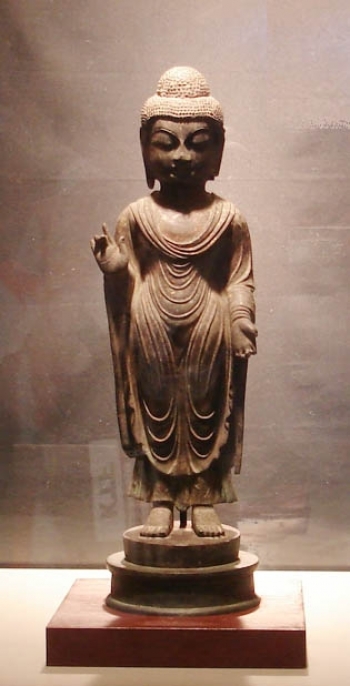
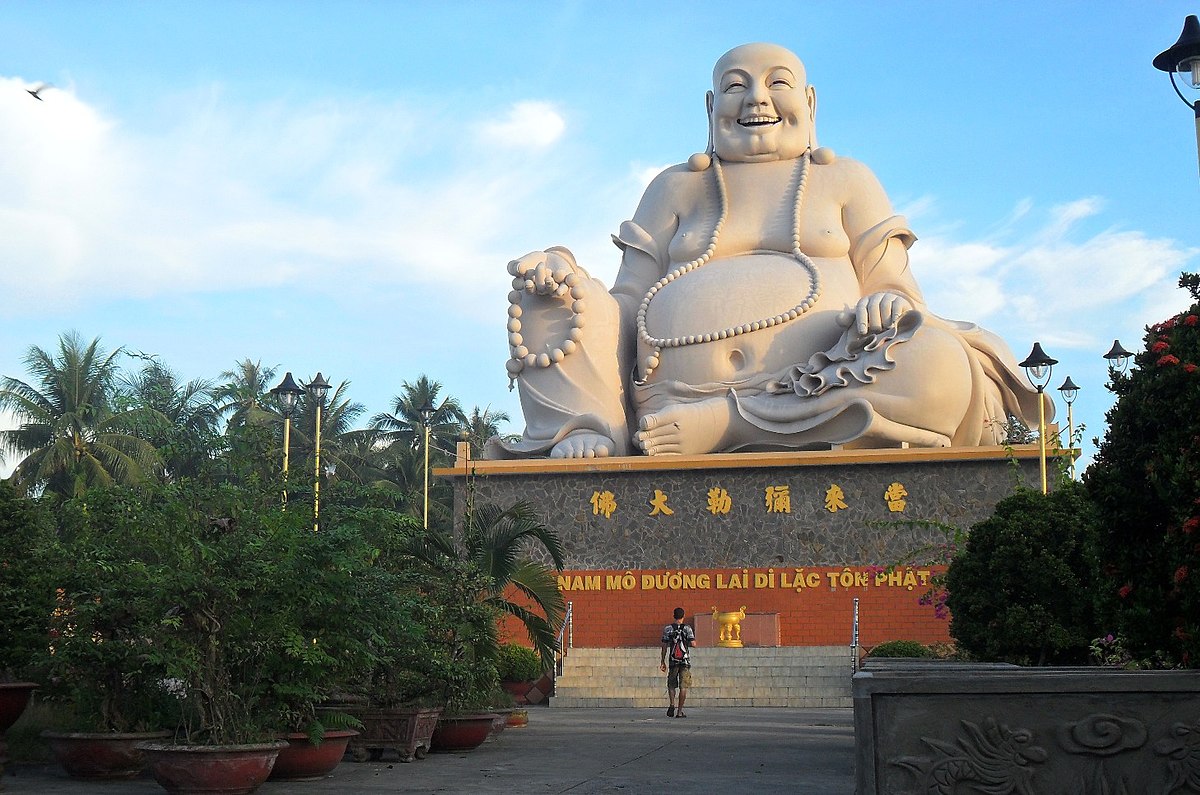
I usely see the the Buddha with more meat around around restaurants while the boney Buddha is surrounded by quotes. Is there a reason for this or is it just a coincidence?
P.S Idk if this is the right subbreddit
Similar to "what race was Jesus," Buddha has different versions depending on what country you're in or what time period. Also, while there is one, original Buddha, there are also many other Buddhas, people who have achieved enlightenment and become immortalized in statue form.
In Japan, there are examples of monks who would starve themselves in a self-mummification ritual and then be built into a statue. I saw an example of this at the Tokyo National Museum and I thought I had taken a picture of it but I can't find it, so I think it's in the "no photo" gallery. I believe it was this statue here, but I can't be 100% sure. Here is an image from Discover magazine of a similar statue that originated in China, with a brief story on the history of such practices.
I've got a few different photos of Japanese Buddhas to share. This Buddha is from 8^th century Nara Japan. Nara was based in the southwest of Honshu and their Buddhas share many common traits with Korean and Chinese examples. This multi-armed Buddha is from the 14^th century Nanbokucho period, also from the southwest region. You can compare these Buddhas to this one from Seokguram, Gyeongju Korea and notice that they share a lot of similarities - the almond shaped eyes with a tiny slit, the fairly narrow nose (although the Nara Buddha has a bit wider and flatter nose), the same hair style (even on the Nanbochuko Buddha, the little heads above the main one share the hair). This Korean statue from the 8th century Silla dynasty again shows similar features - almond eyes, hair, and a wide nose, ala Nara Buddha - and this Buddha statue from the 14^th century Goryeo dynasty shows a more Chinese influence - rounded face, different hairstyle. It should be noted that the Silla kingdom was based in Gyeongju, a stones throw from the southeast coast of Korea. Also, the Silla and Paekche kingdoms fought with the Paekche losing and many of the Paekche upper-class fled to Japan. Furthermore, China, Japan, and Korea all traded across the southern Korean coast with Korea frequently acting as an intermediary, so it is no surprise that the Buddhas are similar. Goryeo, on the other hand, encompassed all of modern South Korea and most of North Korea and they based their capital in the Seoul region. They had more contact with the Chinese at that point. These last two statues I mentioned were both stolen from Tsushima Island Japan a few years ago by Korean patriots/art thieves/opportunists and brought back to Korea. It's been claimed that Japan plundered them and a court recently ruled that the standing Buddha must be returned to Japan since no one in Korea was claiming it, but a temple in Seosan claimed the seated Buddha. Earlier this year the court ruled that that statue would stay in Korea, but it's been going through the legal system with a hearing before the Supreme Court just this March.
Here is a photo of the Buddha at Bongeunsa Temple in Seoul. I know I've got photos of this one, I've been here dozens of times but I just can't seem to find any. Here's a funny commercial regarding this statue and the origins of pizza. Anyway, note the large ears on this guy. Here is a Buddha statue at Seoraksan National Park - again, note the giant ears. This one also has his eyes slightly open, at least more-so than any of the others I've shown have had. This particular Buddha was built in the 90's, being finished in 1997. A statue at Beobjusa Temple in Chungcheongbuk-do South Korea is the tallest standing bronze Buddha in the world. Again, note his large ears. This statue was finished in 1989. At Donghwasa temple in Daegu, a 30 meter tall Buddha was finished in 1992 and his ears make Dumbo's look tiny. At Mangbolsa temple in Gyeongsangbuk-do, you can see two Buddhas with big ears. They also have the Buddha I think you're talking about.
This statue represents Siddhartha Gautama, the founder of Buddhism. It was said that he exercised and starved himself in an effort to overcome the minds desires and that when he finally sat down beneath a tree to meditate, he was so emaciated that this was what he looked like. These statues are supposed to show the dangers of being too extreme and to show that transformation is possible.
There are a couple of different chubby or laughing buddhas. Here is one from Jogye Temple in downtown Seoul. Then there's Budai who was not actually a Buddha, but the incarnation of Maitreya, a future Buddha.
So to sum up, there are many different Buddhas - there is the original Buddha who founded the religion and then anyone else who has achieved enlightenment. Depending on the time and place, each Buddha can be depicted differently. While I made a point of noting that Korean Buddhas have large ears, it should be pointed out many other countries Buddhas have them too. However, Korean Buddhas tend to have all around large ears whereas other versions tend to only have elongated lobes. You can also see the similarities between Buddhas in regions that share a common Buddhist history, i.e. China, Korea, and Japan. So to answer your main question, you're seeing two different Buddhas from specific points in their histories. Budai is only one form of Maitreya - he could look like this Chinese carved Budai or like this Korean made Maitreya
Hi, you may be interested in some earlier threads on this question. See this answer by /u/Notamacropus, and follow the links for more