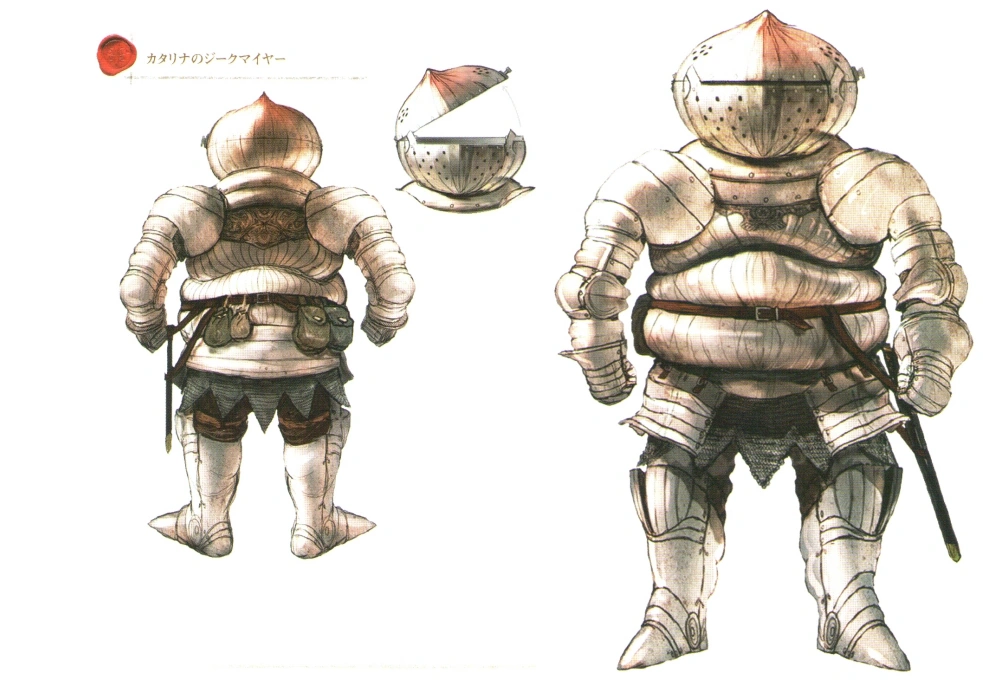
The armor is worn by the knights of Catarina. Most people assume when they see it that the wearer is simply obese, but according to the lore it is made with as few angles as possible to render it impenetrable to sword strikes. Would armor such as this have any practical use? Why or why not?
I'm not aware of any such armor. The ideal was almost always to make armor as form fitting as possible while still leaving room for a bit of padding underneath. The less material used, the lighter the armor will be; and the better fitted it is, the less the wearer will feel the weight. Plate armor is already very nearly impenetrable to sword strikes, which is why most attacks would be made either to the joints - which, regardless of how bulbous the armor is, remain vulnerable - or with the pommel, to stun. There is no purpose for this kind of armor other than aesthetics.
If possible, I'd like to go a different way with this a bit... "Would armor built around the girth of an obese man be usable". I think the answer to that is yes, assuming it isn't rigid metal.
In the picture you can see creases from where the leather belt is cinched tightly, indicating that the armor is not some for of solid plate, but more compressible material, possibly some sort of heavily padded armor that is painted to appear to be metal, you can still clearly see the vertically sewn seems as well.
The armor does appear to be form fitting as well, based on how it appears to be tightly hugging the body and his curves
The arms appear to be fairly standard armor, with large areas of overlapping protection on the shoulders, which could get in the way but also were not uncommon in armor: for example (sorry for stock photo, but real display; http://c8.alamy.com/comp/D406M0/coats-of-armor-on-display-at-the-royal-ontario-museum-D406M0.jpg )
The helmet, while silly looking, is also not that far from what was used - http://images.metmuseum.org/CRDImages/aa/web-large/29.158.36_007AA2015.jpg
So basically, if we can assume that his chest is covered in some sort of heavily padded armor, and not metal, which evidence in the pic does support, we can then match up the rest of the parts with real armor pieces that were used in the 1400 - 1600 range
Armor is already designed this way with as few angles as possible. Note the bulbous chest plates of full plate armor (both men's and women's).
From a materials perspective, the idea behind this design is to increase the radius of any curves on the surface to avoid pressure points. That way, in theory, no one segment of armor is weaker than the steel itself (no chinks or cracks where a swordsman can gain leverage) However classic armor designs already find the right balance for this and mobility/weight (humans are not shaped like snow men after all) and increasing the curvature any further actually weakens the plates themselves. With the design you posted, there is now a greater distance of un-reinforced steel plate between the joints, lowering it's ability to withstand deformation under sheer stress. While there will be fewer specific vulnerable points, the larger the plate the easier it is to pierce/dent. A larger plate resisting a blow has a longer moment arm which increases sheer forces and will make it more susceptable to deformation under the same amount of stress. Think of how little force it takes to pop a balloon if you aim a sharp point directly perpendicular to it's surface, where's I'd you change the angle a bit, the balloon isn't quite as easy to pop. With that kind of blow against this armor, a sword would pop through it like a balloon.
Tl;Dr this wouldn't add anything to classic design, and would actually weaken them. At some point the material limitations of the steel becomes the dominant factor regardless of how efficiently the shape of it distirbutes the forces of the blow.