Hey I'm resubmitting this after not getting any responses:
I'm sure there are many historians who believe that the bombs being dropped was unnecessary but I was wondering if there was an active historical debate from that side or popular works expressing that view.
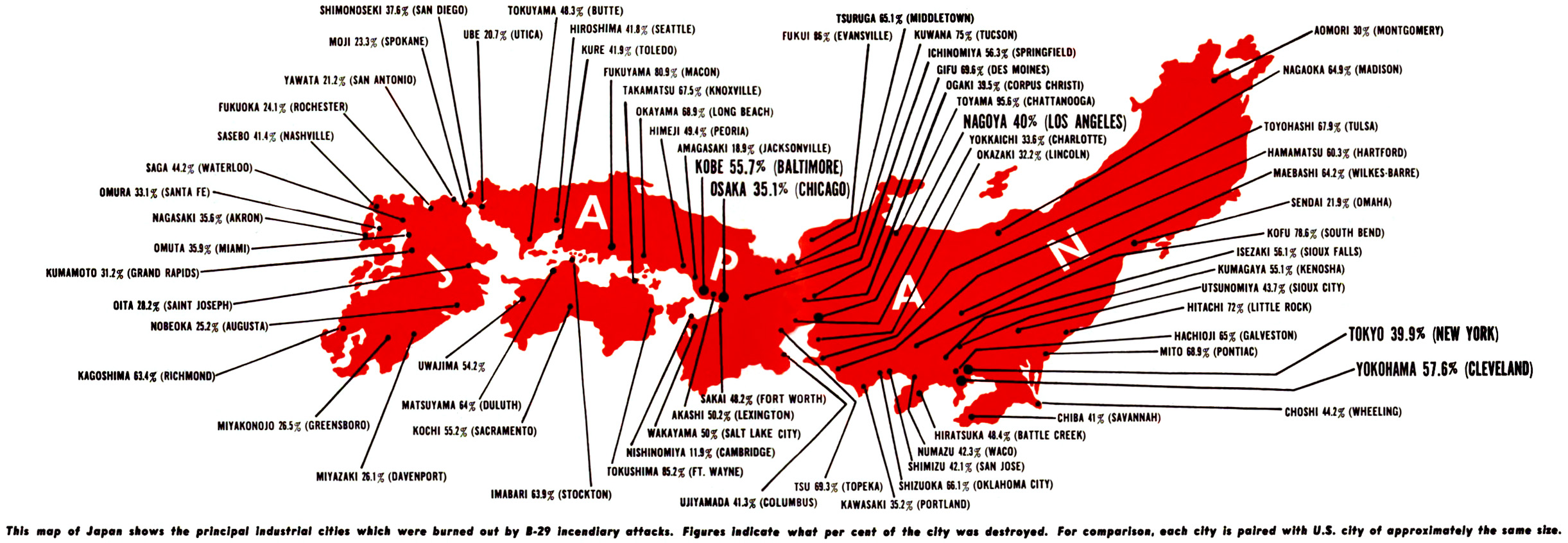
I don't know if how I feel is relevant here but I've always wondered how the atomic bombs being dropped can be critically justified considering the firebombing in Tokyo took more lives (and I'm assuming military infrastructure bombing could have continued for some time) and the US airforce had complete control of the Japanese mainland making a complete invasion of Japan that may have killed "millions of Americans" as the popular saying goes I think unnecessary-and there's the invasion of Manchuria by the Soviet Union that I think influenced Japanese officials to meet and discuss surrender as well.
I guess I'm wondering how people here feel about the '"mythology" around the dropping of the two bombs and the circumstances that led to them being dropped and if you know of historians /relevant historical movements who disagree that the bombs being dropped was justified,
Thanks!
Yes, there are plenty of people who have argued this since at least 1946.* It comes down to what you define as "necessary," but there are, and have been for decades, people who have argued, from various points of view, that the war with Japan would have ended soon anyway, that Japan was essentially defeated, and that a land invasion would not have been necessary to secure an adequate surrender. There are several different variations on this argument, such as the idea that the Soviet declaration of war by itself would have been a big enough "shock" to induce surrender. Another is that the US could have sought to lessen the "unconditional surrender" requirement to better meet Japanese cultural/political needs. Another is that the first bomb could have been "demonstrated" or used in such a way that would have made its power clear but had minimal casualties. Another is simply that only one bomb could have been used — there are many who believe that Hiroshima might have been justified and necessary, but that Nagasaki was simply excessive and unjustified, coming so close on the heels of Hiroshima.
There have been various motivations for people to make this argument. To just give an example, the US Strategic Bombing Survey in 1946 famously concluded:
Based on a detailed investigation of all the facts, and supported by the testimony of the surviving Japanese leaders involved, it is the Survey's opinion that certainly prior to 31 December 1945, and in all probability prior to 1 November 1945, Japan would have surrendered even if the atomic bombs had not been dropped, even if Russia had not entered the war, and even if no invasion had been planned or contemplated.
Now, why would the USSBS conclude such a thing? In part because they resented that the work in conventional bombardment had been overshadowed by the atomic bomb. In their view, the atomic bombings were only a small, final part of a much bigger operation, one that destroyed Japan's ability and willingness to make war.
At about the same time, there was a separate line of thinking (pioneered in print by P.M.S. Blackett, a British physicist) that the bomb was unnecessary and used only to rattle the Soviets. This has been carried forward in time by "revisionist" (I hate the term) historians like Gar Alperovitz. I think most historians today think this is an overly simplistic way to look at the decisions that led to the bombing; the use of the bomb as a diplomatic tool was in the minds of a few statesmen (Byrnes and maybe Truman) at Potsdam, but there were so many other motivations for using it that this looks just like a "bonus" motivation.
And one can argue against that, as well. I think today most historians would agree with Tsuyoshi Hasegawa's sentiment that a combination of the bombing of Hiroshima and the Soviet declaration of war/invasion of Manchuria is what pushed the Japanese to their final agreement on surrender. That does not mean that you could remove one or both of those and not get the same result — that's very uncertain, a complicated counterfactual, and these two events are so entangled in time that it is hard to really imagine them being separated. But that the bombing and the Soviets played some role in the Japanese deliberations seems somewhat clear, though the question of which one to apportion the greater weight to is not. (This is in his Racing the Enemy, esp. the conclusion on counterfactuals; he puts more emphasis on the Soviet invasion, but does not claim that the bombs played no role.)
But there are certainly others, today from a more liberal bent, who think the atomic bombs were not only not necessary, but didn't end the war. Ward Wilson, in his Five Myths about Nuclear Weapons, argues that the Soviet invasion, full stop, is what did it. He argues that if the atomic bombs compelled surrender they would be the first and only aerial bombardment to have done such a thing — that the trope of "boots on the ground" being necessary to compel surrender was a real one (Russian boots, in this case). I don't find that argument entirely persuasive (the atomic bombings were, for a lot of reasons, unusual, and so if you were going to find an exception to that rule, maybe they'd be it), but it gives you an example of the kind of argumentation used in this sort of thing. For Wilson, his goal is pretty clear: he thinks "myths" like this (that the atomic bombs ended the war) contributed to wrong-thinking about nuclear weapons in general, and that once you dispense with the myths, you can dispense with the weapons.
Separately, it is just worth noting that the "other side" has its own political motivations for making its political claims as well during all of these times; politics goes both ways, it is not one side being "political" and the other side being "apolitical." A quick example is that the "millions of Americans" dead claim is surely exaggerated — even using Okinawa casualty rates, which would be a big assumption, you have a hard time getting above 100,000 dead (I wrote a recent comment about this here and here, the latter with a citation). Inflating the invasion casualties is one method of trying to argue for the bombing's necessity, even arguing that it was "humane." The actual casualties being discussed at the time were high in objective terms (tens of thousands), and surely were taken seriously at the time, but at least an order of magnitude, sometimes two, lower than these inflated postwar numbers. (And, of course, literally nobody who argues that the atomic bombs shouldn't have been used has ever argued that a land invasion was the preferred alternative; it is a false choice, the "two atomic bombs on two cities vs. a land invasion.")
* Indeed, criticism of the need to use the bomb in 1946 was acute enough that it spurred many of the participants in the bombing question (notably Truman, Stimson, Groves, and Conant) to actively pursue measures at "correcting the record," at making sure their position was presented strongly. This was the genesis of Stimson's famous Harper's article, "The Decision to Use the Atomic Bomb" (February 1947) which is the origin of what we today think of as the "orthodox" account of the bombing (e.g., there was a deliberation, it was bombing vs. invasion, Truman made the final call, and the bombs ended the war). It is a very slanted view of things, presented by people with huge stakes in the public perception. I bring it up only to indicate that the narrative one thinks of as "default" had to come from somewhere as well, and the context in which it emerged was not "apolitical" in the slightest (much the contrary). On the genesis of this article and its many elusions, the final parts of Alperovitz's The Decision to Use the Atomic Bomb are very good (even if many of Alperovitz's other interpretations on the bombing are quite debatable).
Not to discourage new answers, but there have been some excellent responses to similar questions in the past:
/u/Restricteddata gave us a fascinating response to "Did the US have to nuke Japan?"
/u/t-o-k-u-m-e-i provides a long answer about the "nuke vs soviets" debate here.
Prolific commenter deleted gives even more detail to the "Soviet vs nuke" discussion
I think it's worth clarifying your question somewhat. You are in fact asking three separate questions: 1) was the use of 2 nuclear bombs "justified"; 2) was the use of 2 nuclear bombs "necessary"; 3) how do historians feel about the " 'mythology''" around two bombs.
As a general rule, contemporary academic historians (or at least, historians producing contemporary academic work) refrain from making judgments about either the necessity or the justifiability of historical actions, because one very quickly ends up either importing external standards of judgment or making highly-speculative conjectures about individual and national psychology, military strategy, etc. The 'history of history' has proved that such speculations generally indicate more about those making them than their subjects, and so academic historians today generally confine themselves to trying to reconstruct causal chains on the basis of archival evidence, rather than evaluate either the moral legitimacy or strategy of past historical actors.
As a follow up question, I was reading The Fall of Japan: The Final Weeks of World War II In the Pacific by William Craig and found it absolutely fascinating to get more of a view of the Japanese reactions, but I've also heard that it isn't well sourced and he took liberties. Is that true? And are there some better books to read to gain insight on what was going on behind the scenes from the Japanese perspective in English that someone could recommend? Or is most of that scholarship going to be in Japanese and untranslated?
I love getting a glimpse into the internal politics involved in the military and Supreme War Council during the specific war, and most of the voluminous lay discussion involving the end of WW2 I have seen in English seems to completely ignore politics involved on the Japanese side in favor of discussions on the atomic bombings and Russia invading Manchuria. The work of Tougo and Yonai behind the scenes to bring the war to an end and the obstinacy of Umezu and Anami is absolutely fascinating to me, but I don't want to rely on more "fluffy" looks at their words and actions when bringing it up in discussions if it can be helped.