Let's say in 1920 I have a photograph as well as a hand drawing, both of which I want to have printed in a magazine. How are these transferred from one medium to another?
I wasn't educated at this subject in english, so it might be a little rough for me to translate all the terms, but I'll try.
There were a number of printing techniques available prior to computers. In regards to drawings, a technique called Woodcutting started seeing use in as early as 16th century, and consisted on carving an image on the surface of a block of wood, leaving the printing parts level with the surface while removing the non-printing parts. This means that artists had to carve the negative space of a block of wood. For printing, the surface was covered with ink by rolling over the surface with a brayer, which leaves ink upon the flat surface but not in the non-printing areas.
This means artists had to draw and carve the image afterwards. You could use multiple colors to print colored images. Even though this seems a little rough, results could be really astonishing, as you can see in this piece called Four Horsemen of the Apocalypse, made by Albrecht Dürer.
In 1796 lithography was invented, which advanced the quality of printing greatly. Now you could make drawings with better shadows. Wikipedia explains it best:
Lithography originally used an image drawn with oil, fat, or wax onto the surface of a smooth, level lithographic limestone plate. The stone was treated with a mixture of acid and gum arabic, etching the portions of the stone that were not protected by the grease-based image. When the stone was subsequently moistened, these etched areas retained water; an oil-based ink could then be applied and would be repelled by the water, sticking only to the original drawing. The ink would finally be transferred to a blank paper sheet, producing a printed page.
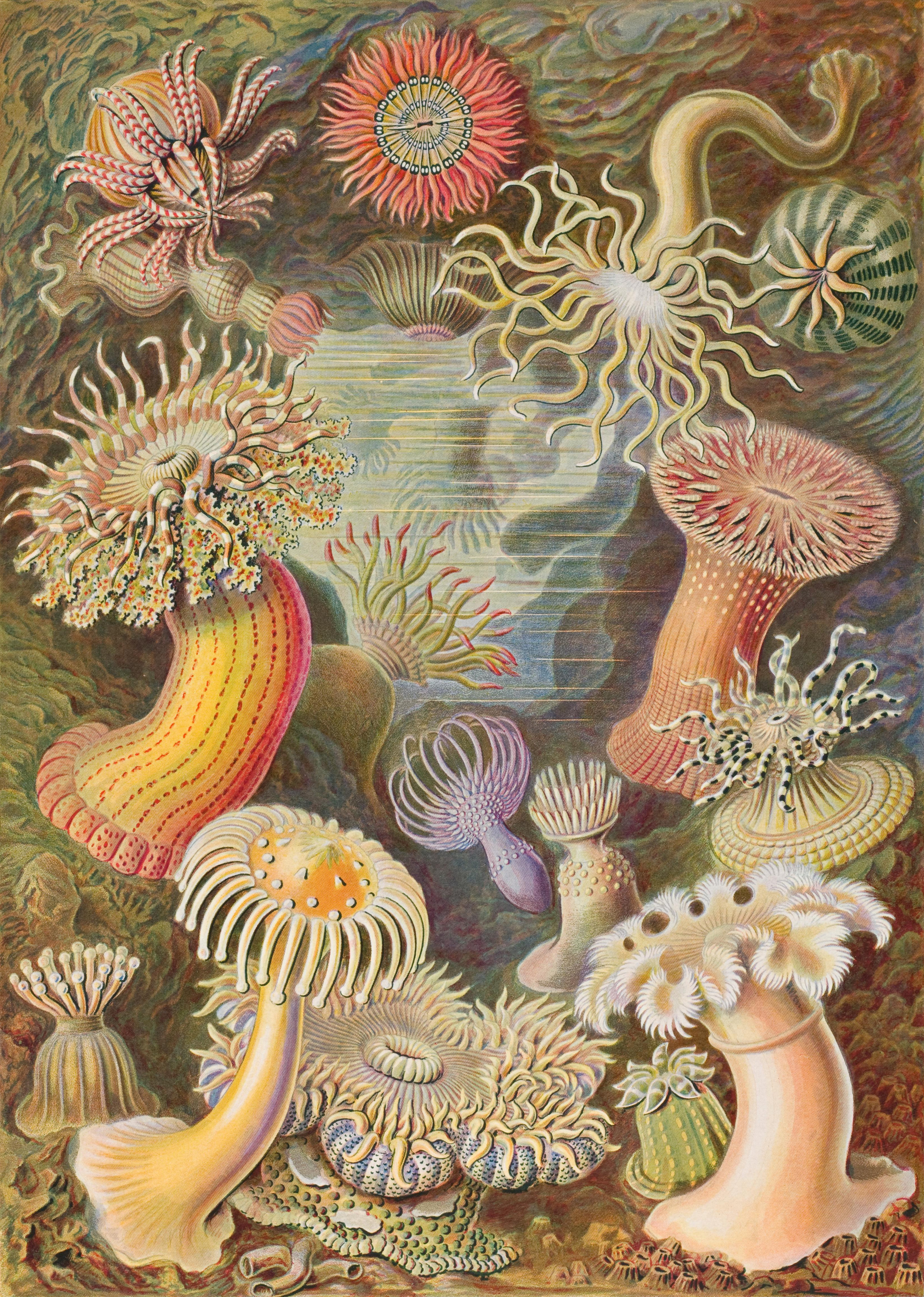
This picture, Artforms of Nature, by Ernst Haeckel, is a litograph. As you can see, quality was greatly improved, although the artist still had to make a matrix of it to print it.
In 1875, offset printing was invented in England, and was used with lithography. Once again, Wikipedia does a better job than me at explaining this process:
the inked image is transferred (or "offset") from a plate to a rubber blanket, then to the printing surface. When used in combination with the lithographic process, which is based on the repulsion of oil and water, the offset technique employs a flat (planographic) image carrier on which the image to be printed obtains ink from ink rollers, while the non-printing area attracts a water-based film (called "fountain solution"), keeping the non-printing areas ink-free.
This process was only applied on paper in 1904 (literally on paper, I mean. It wasn't used on paper before this). At this time, lithography was basically dead, and a new process called photoengraving was at its peak. Photoengraving was used to reproduce a wide variety of graphics such as lettering, line drawings and photographs. It consists of applying a photoresist to a metal surface and applying acid over it. It is then exposed to light - usually strong UV light - through a photographic, mechanically printed or manually created image. The photoresist is hardened where it receives sufficient exposure to light, and a solvent is used to wash away the soft parts. This means that, for photography, when you took the picture, the "film" was a metal surface. This metal surface was then used as the matrix, and printing was done through it.
This means that, for 1920, the drawings and photographs were most likely "scanned" through photoengraving, which in turn produced the matrix that was used for printing through the offset method. For earlier periods, artists had to make theses matrixes manually, either by carving wood or by lithography magic.
In the end, it all boils down to drawing on a paper and having a way to scan it to a surface that can be used as the matrix for printing. The matrix has to retain all the necessary details of the drawing, and the ink that goes into it has to retain its form on paper. People got very creative with different materials up to the point that they discovered that light itself could retain the details of the drawing. At that point, the artist was free of the printing nightmare.
If you're still interested in studying history of printing, Wikipedia is a really great source for this. The side menu articles all go into great details about all the different printing techniques that were developed throughout the history. Here's the link.