I recently saw a film that covered German brutality in WW2 called "Come and See". The film was good, but I felt it characterized the Germans as bloodthirsty monsters, while the Soviets were simply innocents fighting for the right to live. From what I read both nations committed atrocities upon each other. I then saw that the film was made in Russia in 1987. I know that any form of dissent was cracked down under leaders such as Stalin, but I'm curious if dissent was still banned late into the Soviet Union. Thank you for any answers
The 1985 Mosfilm Come and See directed by Elem Klimov actually was quite transgressive for a Soviet film about WWII and represented some of the new freedoms of Gorbachev's Glasnost reformism. While it might look like a piece f graphic agitprop, Klimov's film was a landmark departure in Soviet cinema's depictions of the war. A number of these departures from prior depictions of the war might not be readily visible in 2017, but were obvious to many contemporaneous Soviet audiences.
For one thing, the the last half of the film shows a good deal of Belorussian collaborators with the SS detachment. One of the collaborators is scene prominently during the nightmarish village attack wearing an ill-fitting helmet painted with a skull-and-crossbones and an interpreter who wears a German uniform and fulfills a vital role in the film's denouement. The issue of collaboration with the Germans was one that was a taboo in Soviet culture and society. The official state line was that collaboration was unforgivable and prosecutable , but the sheer numbers of Soviet citizens who ended up behind German lines was too large to call everyone suspect. Many of those who were prosecuted claimed as their defense they had no choice or used their positions in the occupation regime to aid the partisans. Among the Soviet populace, there was a marked tendency to divide collaboration into two hazy categories of forced and opportunistic collaboration with personal relations being drafted into collaboration while outsiders became willing partners to the German regime. Collaborators had little visible presence within Soviet culture outside of spy films where double-agents like the protagonist of Seventeen Moments of Spring used their proximity to the Germans to aid Soviet victory. Come and See not only showed collaborators willfully profiting from the Germans' dirty work, they also turn to the "I was forced to" defense once captured, suggesting that the forced/opportunistic binary was much more porous.
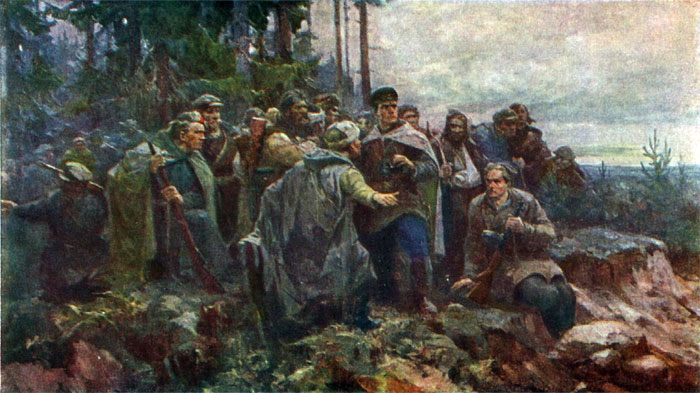
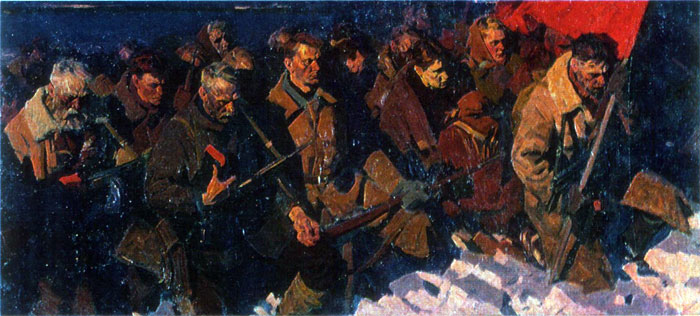
Come and See also takes a heterodox approach to its depictions of the partisans. Soviet arts and culture simultaneously valorized the partisans while eliminating any troubling politics or histories behind the partisan groups. Jewish bands like those run by the Bielski brothers were all but erased in Soviet commemorative culture as did various ethnic-separatist partisans such as Ukrainian or Polish groups. In place of the complex politics and dire living conditions of partisan life, Soviet arts tended to depict the partisans as square-jawed heroic types with broad shoulders. Paintings like In the Partisan Woods, Partisan Konstantin Zaslonov, or The Partisan Oath show a dynamic and heroic partisan movement, complete with Soviet insignia and professional appearances. Media that questioned this heroic narrative, such as Larisa Shepitko's 1977 film The Ascent had to run the gamut of official censorship and red tape. But Shepitko was atypical for Soviet filmmaking. Most Soviet films of the partisans hewed to conventional war movie cliches like the Duma o Kovpake trilogy that stressed heroism and a Manichean division between good and evil.
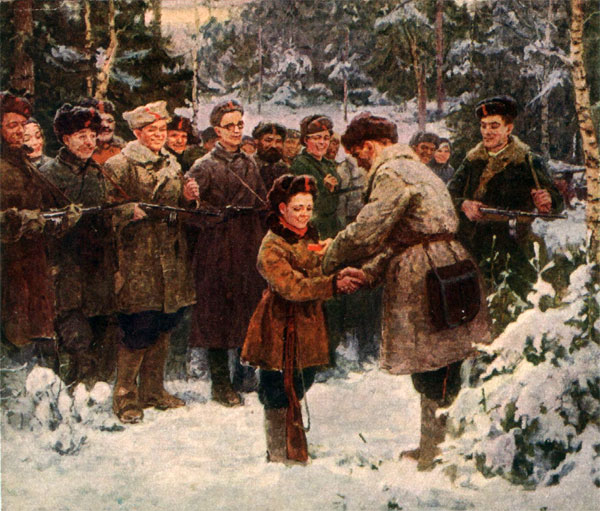
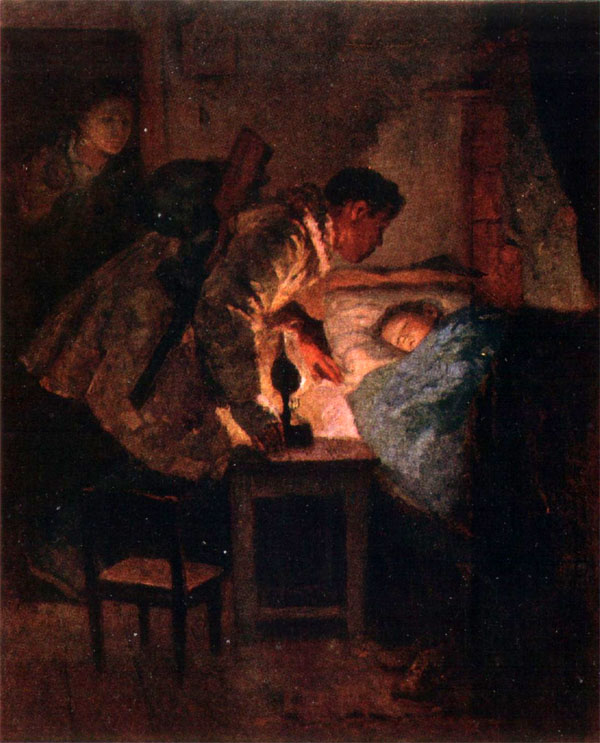
Klimov demythologizes the partisans in Come and See. In a aesthetic misfire for the film, when Come and See's protagonist Florya enters into the partisan camp and the picture takes a comedic tone. Through a long-tracking shot Florya tries and fails to join up with one of the sub-bands, who themselves are chaotically organized and seemingly incapable of getting their act together. While this scene is atonally out of place with the rest of the film, Klimov does present a less than heroic image of the partisans as a cohesive band of resistance. When Florya does meet up with a partisan, it is with a girl roughly his own age, Glasha. She not only is somewhat disconnected from events, but she also implies that she is in a sexual relationship with the partisan's commander, Kosach. While Kosach is not really seen until the film's final act, his actor, Liubomiras Laucevicius, was in his forties when he shot Come and See. Although Klimov never distinguishes whether Kosach's relationship with Glasha was real or a school-girl crush, this ambiguity undercuts the orthodox view of a partisan commander as an ideal masculine father to his unit. Media depictions of partisan children tended to hew to depicting them as heroic children getting rewarded from their adults, such as this painting, or as the reason the adults took to the woods to fight, as seen clearly in this painting showing a father bidding a sleeping child farewell. Come and See depicts in very graphic fashion the impact of the war on children. Glasha's odd personality clashes with her environment and later Florya sees a girl bearing a likeness to her who has been gang-raped by the Germans. Florya begins to resemble an old man by the end of the film as his hair turns white and the camera focuses on his thousand-yard stare.
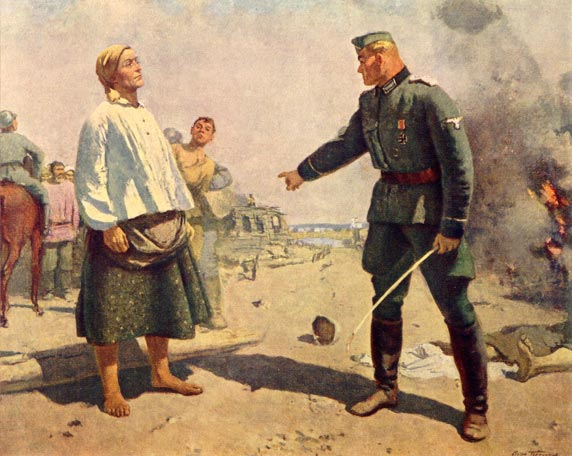
Florya's aging was in direct response to the horrors he experiences, and in this regard, Come and See was in very much a league of its own for its depictions of violence. The Soviet state did not cover up German atrocities, but its commemorative culture tended to hew away from graphic depictions of violence. The more common motifs for depicting German atrocities tended to emphasize resistance at the start and the experience of liberation. Sergei Gerasimov's famous 1943 painting A Partisan's Mother emphasizes defiance in the face of barbarism. Most Soviet and Eastern bloc monuments commemorating sites of German atrocities emphasized a liberation in which masculine Red Army soldiers would lead to a regeneration of these areas. Additionally, Come and See bucks the orthodox state explanation of these atrocities. The official line in the eastern bloc was that fascism's main rational for genocide was its ideological opposition to communism. Racism and antisemitism in Marxist-Leninist ideology was a form of opportunistic window dressing to encourage ordinary Germans to fight against communism. The climax of Come and See features the German unit captured by Klimov's group and while the German commander cowardly pleas for mercy, his subordinate does not and asserts what he did was right because inferior races are prone to Bolshevism and must be eliminated. This inverts the standard Soviet line about the rationale German atrocities in which anti-communism was central and racism was in service to this ideology.
Of course, Come and See could not go too far in its depiction of the partisan war. Klimov's capture of an entire German anti-partisan group was something partisan bands could not really accomplish and the fact that Klimov gave the German prisoners a chance to pea their case was very ahistorical given the savagery of the war in Belarus. Nonetheless, the film was not an example of Mosfilm propaganda and it presented a much dimmer view of the Great Patriotic War than other media in this genre. The SS brigade in the film is modeled after Otto Dirlewanger's unit, including its commander's pet monkey. The SS-Sturmbrigade Dirlewanger was a unit that was brutal even by the standards of the partisan war. More than a few German and Soviet audience members in 1985 attested to the accuracy of Come and See's violence and Belarus did lose a third of its prewar population due to the wars. Even with Come and See's minor flaws it is an apt testament to this grim experience.