What influence did he have militarily and what was his real significance?
Marlborough made his name fighting in the wars against Louis XIV. He saw three years service during the Nine Years' War (1688-1697), though usually he was subordinate to other allied army commanders. At the Battle of Walcourt the Allied commander Prince Waldek said of him:
"... despite his youth he displayed greater military capacity than do most generals after a long series of wars ... He is assuredly one of the most gallant men I know."
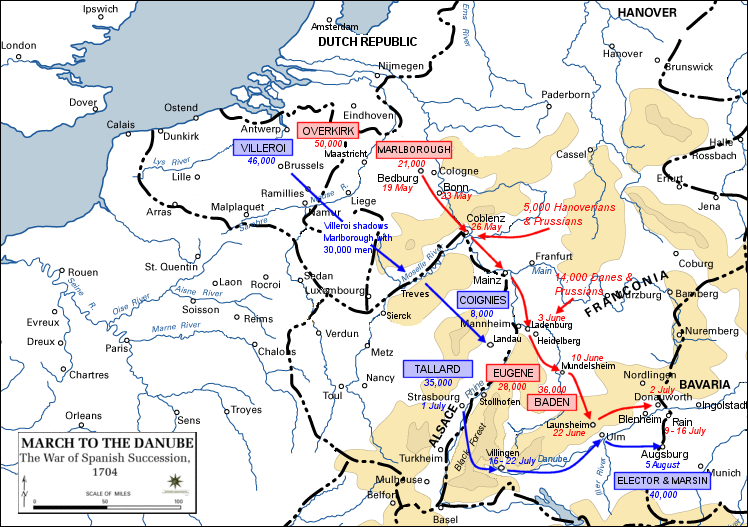
It was in the later War of the Spanish Succession (1702-1715) that Marlborough displayed his true military genius. This time acting as high commander of the allied army, in 1704 Marlborough waged the campaign that would put him in the history books. The enemy Franco-Bavarian army was threatening the allied Austrian capital of Vienna, so Marlborough planned to make a daring march from Cologne in northwest Germany to Bavaria, a distance of 250 miles. With 21,000 troops, and picking up a further 19,000 reinforcements on the way, Marlborough marched the entire distance in only five weeks.
A scarlet caterpillar, upon which all eyes were at once fixed, began to crawl steadfastly day by day across the map of Europe, dragging the whole war with it. – Winston Churchill.
In a time when most armies moved very slowly and methodically, with great long lines of supply wagons and limited logistical capabilities, Marlborough had basically achieved the impossible. This type of rapid, extremely mobile campaigning would not be seen again until Napoleon. In fact at the time this march would have been considered dangerous and foolhardy in the extreme: Marlborough left his right flank exposed to the shadowing French army the entire march, and his lines of communication back to his allied bases in the Low Countries could be easily cut at any time. His unexpected success then seemed to turn military strategy on its head, although it was not until an ambitious Corsican later perfected these concepts of maneuver and mobility and used them to conquer most of Europe that the traditional methods were finally proven obsolete.
Marlborough went on to fight several major battles where he emerged the victor: Blenheim, Ramilles, Oudenaarde, and Malplaquet. But from my various readings of military history it seems that it is his rapid marching on the Blenheim campaign that secured his legacy more than his performance as a general on the field of battle, effective as he indeed was in that role. Marlborough's 'March to the Danube' presaged a method of rapid mobility warfare that would not be seen again for a century.