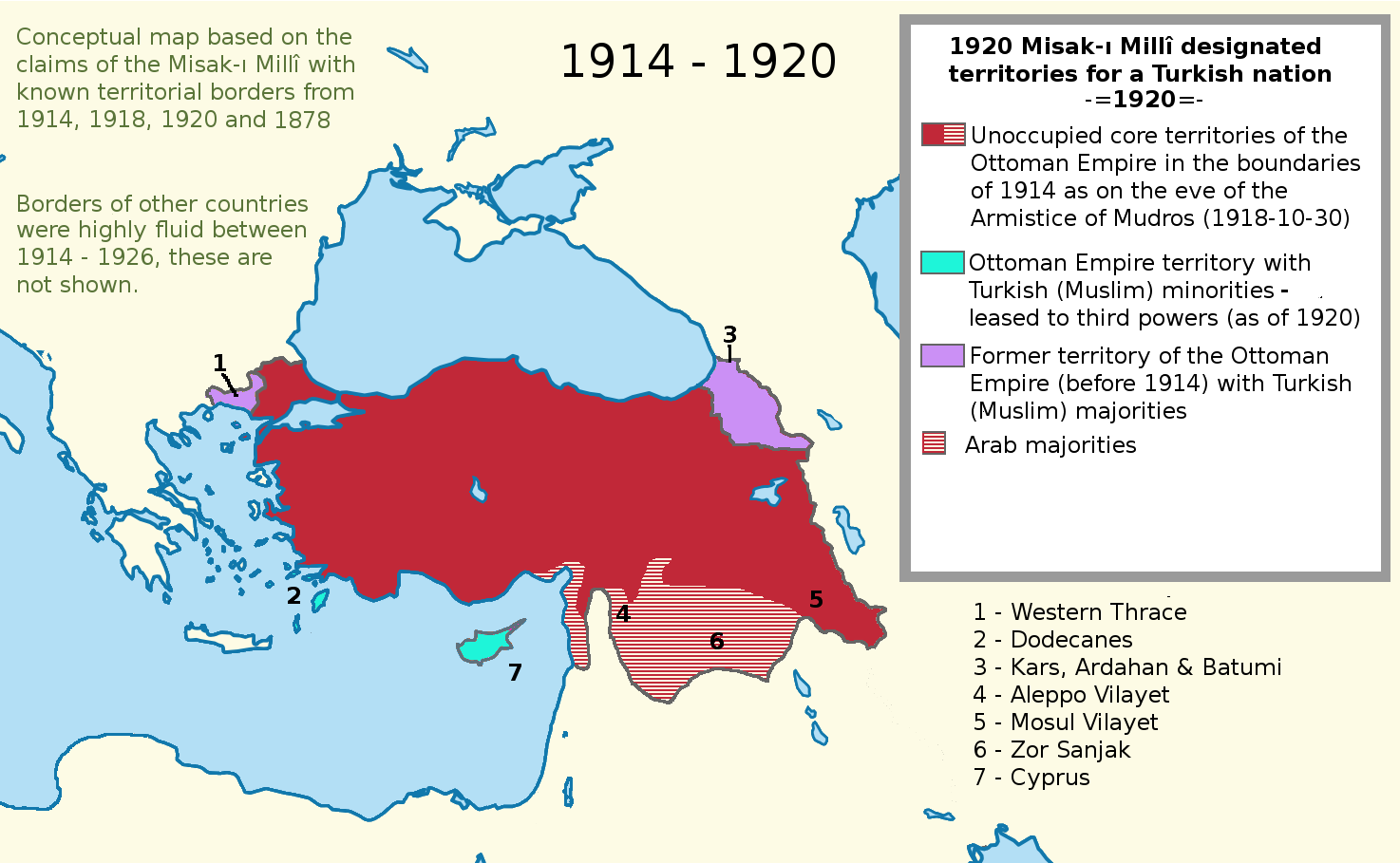
After the War of Independence Turkey claimed Mosul and Aleppo. But what is the reason? There are some Turkish minorities but the areas are mostly Arab and Kurdish.
Not a historian, but it's a fairly simple question so I'll chip in.
Just around the time Treaty of Sevres which would partition the Ottoman Empire was being negotiated, the Turkish national movement headed by Mustafa Kemal was busy organizing their new government and resistance.
From the new government that was being set up, first came the Amasya Protocol, declaring that the Istanbul government was unable to carry out its duties and that the independence of the motherland was in danger. The homeland was defined as the all the territory in Ottoman possession at the moment of the signing of the Armistice of Mudros. These calls were reiterated at the Erzurum and Sivas congresses and and the Sivas congress negotiations were held to bring the Anatolian government back into the fold. Progress was made, but were never ratified by Istanbul.
Nevertheless, fresh elections were held by the Istanbul government and many delegates from the Turkish national movement who controlled Anatolia were elected. Istanbul was attempting to absorb the Turkish national movement or at least trying to de-legitimize it but it didn't turn out that way. The Anatolian delegates (Mustafa Kemal never showed up in Istanbul, for obvious reasons) expeditiously dismissed members of the Istanbul government and elected their own such as Fevzi Çakmak as Minister of War.
Aware of the allies desire to partition the empire (Sevres would be signed 6 months from now), the parliament also passed the Misak-ı Millî (National Pact). It stated [paraphrased];
Occupied Arab majority regions should hold plebiscites to determine their future.
Plebiscites should be held in Kars, Ardahan and Batum to determine their future. (occupied by the Russians)
Repeat for western Thrace.
Istanbul's security is paramount and treaties concerning trade and communication relating to the straits will be honored.
The rights afforded to minorities by previous treaties shall be guaranteed and upheld on the condition that the neighboring countries do the same for muslims.
[Here's the kicker] Complete independence and sovereign rights is a fundamental condition to ensure our continued survival. All [foreign] restrictions on political, judicial and financial development are to be voided.
That last part is crucial to your question because it demands independence not for Turks or Kurds or Arabs or muslims but for the territory of the Ottoman Empire that was not occupied while the Armistice of Mudros was signed. This territory included Mosul and Aleppo. Here is the map on wikipedia. The British were understandably enraged and forced the sultan to shut down parliament.
Fast forward to the end of the Turkish War of Independence and it's time to sign a new peace treaty. The allies are busy with their holdings in the Levant and want a quick solution to the problem of Anatolia as their war-weary public have no stomach for more. The Turkish delegation never backs down on independence related issues mentioned in the Misak-ı Millî and the Treaty of Lausanne is signed and ratified.
The treaty leaves Mosul as an issue to be settled by the League of Nations, one of the few territorial concessions made by the Turkish government. The League of Nations commission awarded Mosul to Britain a few years later and Britain chose to quell Turkish anger over the issue by promising a portion of oil profits. The Frontier Treaty between Turkey, Iraq and Britain was signed and Turkey formally ceded the territory.
Sources:
History of the Ottoman Empire and Turkey - Shaw & Shaw
[Frontier Treaty](http://treaties.fco.gov.uk/docs/fullnames/pdf/1927/TS0018%20(1927)%20CMD-2912%201926%205%20JUN,%20ANGORA%3B%20TREATY%20BETWEEN%20UK%20&%20IRAQ%20&%20TURKEY%20REGARDING%20SETTLEMENT%20OF%20FRONTIER%20BETWEEN%20TURKEY%20&%20IRAQ.pdf)
Treaty of Lausanne
The ethnic composition of those areas changed over the time, and those areas in question had a large Turkish speaking population. The Turkish speaking were mainly Turcomans, whom had been native to the area since Turkic conquest of Mesopotamia. In fact some of the areas and cities had a majority of Turks. The areas were claimed by the republic of Turkey because until 1926. It was disputed between Great Britain and Turkey whether the province of Mosul should be a paet of Turkey or not. Great Britain insisted on keeping Mosul after the Lausanne Treaty was signed, becsuse of the newly discovered oil deposits. The issue were discussed in the League of Nations (predecessor of the UN), British officials claimed that Mosul province was a integral part of Iraq while the Turkish officials argued the areas was a part integral part of the Turkish heathlands. Turkey did have some internal problems in its Eastern Provinces, the Kurdish population in those provinces were revolting for some religious and nationalistic issues. This internal instability made it difficult for Turkey to press their claim, and the decision were in favor of the British claim. Great Britain would 10 % of the province's oil profits to Turkey in the following 25 years. It is discussed that the influence Great Britain had in the League of Nations, made the commission in charge of the conflict solving community be more in favor for British claims. But looking at the situation it is clear that Turkey did not have the diplomatic power to press the issue further, since it had internal problems in its neighboring provinces.
The Misak-ı millî was one of the manifestating factors of The National Movement and Turkish fight for self determination. Misak-ı millî means the National Oath, and it aimed to retake the Muslim/Turkish majority areas of the fallen Ottoman Empire. These areas were determined by Mustafa Kemal Atatürk in a legal proposal, and it were legalized in the Meclisi Mebusan(parliament) in 28. Of January 1920. Some of the areas were given up because of diplomatic reasons, for example Batum(Batumi, Georgia) were ceded to the Russians. This initiative ratified the national struggle and played a great factor for the cause fighting cause. Another disputed area was the Sanjak of Alexandretta, which was a part of French Mandate of Syria. That claimed were pressed in 1938, and eventually the Province of Hatay became a part of Turkey in 1939. Also areas like Gümülcine(Komintia, Greece) and Kırcaali(Kardzjali, Bulgaria) were given up, even though the Turks were a majority(and still is today).
Today most of the Turkmen population have either been Kurdified or Arabified, when Turkey gave up its claim the Turkish minorities were largely discriminated against. The Turkmen population today only compose a minority in the areas, which is the results of years of discrimination and oppression. Many Turkmens also choose to move to the Republic of Turkey and got integrated in the Turkish nation. The question of Mosul is still popular in Turkey, mainly in nationalistic/right wing circles that does not know the demographic situation today. In the recent years the rise of Neo-Ottomanism has caused some change in rhetoric regarding this claim, and some even talked about Turkey retaking these areas especially after destabilization of Iraq. But in general this is only in right wing circles, and not the policy of the state.
Sources:
Atarodi, Habibollah. Great Powers, Oil and the Kurds in Mosul:(Southern Kurdistan/Northern Iraq), 1910-1925. University Press of Amer, 2003.
Batuman, Bülent. "The shape of the nation: visual production of nationalism through maps in Turkey." Political Geography 29.4 (2010): 220-234.
Brown, Philip Marshall. "The Lausanne Treaty." American Journal of International Law (1927): 503-505.
Coşar, Nevin, and Sevtap Demirci. "The mosul question and the Turkish republic: Before and after the frontier treaty, 1926." Middle Eastern Studies42.1 (2006): 123-132.
Karakoç, Ercan. "Atatürk’ün Hatay Davası." Bilig Türk Dünyası Sosyal Bilimler Dergisi 50 (2009): 97-118.
Kerkuklu, Mofak Salman. Brief History of Iraqi Turkmen. Yıldız yayıncılık, 2004.
Sirkeci, Ibrahim. "Ethnic conflict, wars and international migration of Turkmen: evidence from Iraq." (2006).
Sirkeci, Ibrahim. "Turkmen in Iraq and International Migration of Turkmen." Ankara, Turkey: Global Strategy Institute(2005).
Wright, Quincy. "The Mosul Dispute." American Journal of International Law20.3 (1926): 453.
Uslu, Emrullah. "Ulusalcılık: The Neo‐nationalist Resurgence in Turkey." Turkish Studies 9.1 (2008): 73-97.
Taylor, Scott. Among the others: encounters with the forgotten Turkmen of Iraq. Esprit de Corps Books, 2004.