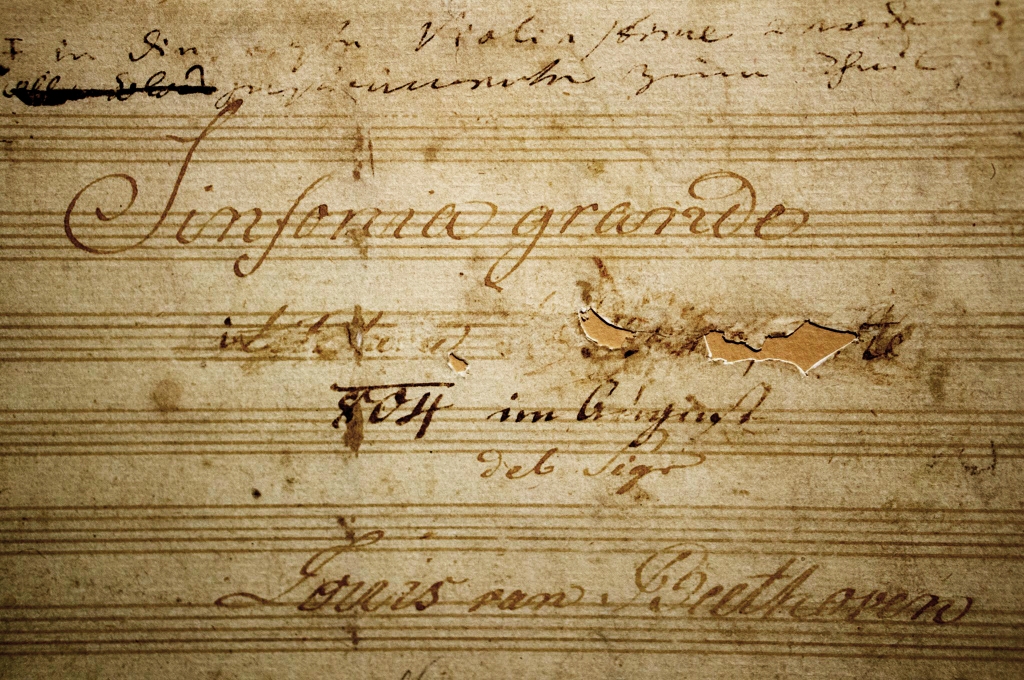
The idea that Napoleon was merely aping the pre-1789 political order was one of the many attacks on Napoleon made both by the Jacobin left and the emigre Bourbons. Beethoven reportedly claimed Napoleon was reaching for the imperial crown the Revolution left in the gutter and the composer scratched out the dedication to Napoleon in his Third Symphony. While there was some merit in these critiques about Napoleon's assumption of outsized executive power, they do miss some of the key aspects of Napoleonic rule and administration. Napoleon may have been Emperor, but he was acting very much in the spirit of a particular strain of French Revolutionary thought.
Napoleon's proclamation of himself as Emperor did alienate him from Jacobins and other social levelers and ideologues, it was not as a retrograde step from the Revolution as it might appear at first. The attitude of various Revolutionaries towards executive power was always very unclear, but there were voices throughout the Revolution that called for strong central order. The experience of the Terror made many within the Directory leery of pure democracy (Cabanis said democracy was "odious to all sensible and right-thinking men" and "kept all citizens in a constant state of agitation and anxiety") and seek an ordered solution to political power. Although subsequent Napoleonic propaganda would emphasize him as the natural and inevitable choice for the Brumaire coup, there were several other French generals various factions were courting for a coup. Emmanel Sieyès, one of the key plotters in Brumaire, would famously quip, "I need a sword," in other words, a man who could command the loyalty of one of the few powerful institutions that possessed a great deal of popular legitimacy within the Republic, the army. Bernadotte, a general and Minister of War, was the favorite of the Neo-Jacobin factions that wanted to reestablish the Revolution's leveling tendencies. Jean-Baptiste Jourdan toyed around with many different factions, but never made a firm commitment. Lazare Hoche, who enjoyed almost as much fame as Napoleon had unfortunately died of tuberculosis before Sieyès's initial soundings towards him could bear fruit. Jean Moreau, the youngest general in the army, refused to compromise himself with politics despite entreaties to do so.
Even still, the initial impulses of Sieyès was to have the Consulate be a divided form of power with the other two consuls acting as a check against one gaining supremacy. The problem was Napoleon appreciated the latent tendencies to authoritarianism within the Consulate's constitution, which he helped draft, far better than his fellow plotters. Napoleon's workaholic habits also made him ideally suited to quickly become the indispensable Consul in running the state. Napoleon, as a systemizer and organizer par excellance, naturally rigged these day to day business of the Consulate government to favor his own input. Being elected Consul for fife and then proclaimed Emperor were the logical next steps.
Napoleon's own elevation to Emperor carried with it several important facets that made quite different than his fellow imperial monarchs like Alexander I or Francis I. First off, Napoleon's title, Emperor of the French carried with it specific, secular connotations and that the title's legitimacy stemmed from the national principle. Second, although the Napoleonic regime borrowed many of the trappings of the ancien regime's monarchical style, Napoleon used tradition to sanctify the new regime, not symbolize the return of the old one. Napoleon consciously chose the pageantry of monarchy as a stratagem to curry popular support and feed the notion that the Empire enjoyed true popular sovereignty. Although Napoleon's plebiscites and Senate decrees supporting the Empire were often manufactured, they do show how deeply concerned Napoleon was over the perception he enjoyed popular support. The Napoleonic Code also outlined that the imperial order was sanctioned by law, not divine right or some abstract tradition derived from history. Napoleon may have been Emperor, but that was sanctioned both by plebiscite (albeit one he rigged) and upheld by law.
Napoleon's system of nobility shared a lot in common with the ancien regime's tables of ranks and shared many of the same hierarchies, there were several key differences between Napoleon's nobility and that of the Bourbons. One, in order for a noble title to be inherited, a noble had to prove they possessed a large income and an estate in real property. From the standpoint of 2017, this emphasis upon wealth seems decidedly anti-democratic, but basing an individual's political legitimacy upon property was a stance common among European liberal moderates in the nineteenth century. In this formulation, titles and elite status have to be earned by each generation and was a departure from the pre-Revolutionary conceptualization that noble status was permanent. Secondly, the Napoleon's nobility was to be a description of rank, not caste. Noble titles were to be a sign of what an individual had accomplished instead of their family or ancestors. Heritability of titles and their privileges was limited in the First Empire. Moreover, Napoleon's nobility was a service nobility; titles were earned through service to France and thus opened up elite status to the masses. The Légion d'honneur carried with it a title and lump sum of a reward, but a Legionnaire could not expect any exemption from taxation or other unique caste privileges that were common for the decorations and neo-chivalric orders of the French ancien regime.
In practice, this meant that Napoleon's nobility overwhelmingly favored the military (some 59 % of this nobility came from the armed forces), but there still was a degree of social mobility that was not present under the Bourbons. The apex of the nobility were the Princes and Dukes, and the Napoleonic Marshals, who were either a Duke or Princes, tended to come from relatively modest backgrounds. Ney was the son of a cooper and Augereau son of a domestic servant, and those who came from ancien regime noble stock like Davout or Berthier, were from the middling nobility. Napoleon would justify this new nobility as a meritocratic system and that his government had enabled opening up careers to talent and rewarded them accordingly. The new Napoleonic nobility was only about one seventh as large as the nobility in 1789, and in this measure was quite different than its predecessor.
The Revolutionary notion of popular sovereignty trumping the interests of the monarch came to be Napoleon's undoing in 1814. After observing the abortive Malet conspiracy of the previous year, Talleyrand noticed that the Imperial Senate did have the power to legally depose of Napoleon. Napoleon's penchant for constitutions to be "short and vague" proved to be a double-edged sword in the hands of a empowered opposition. Although the Senate had often been a servile rubber stamp for Napoleon's autocracy, it always posesed the legal potential to declare a new state. Talleyrand, still a Senator, convened the legislative body after he had sounded out like-minded conspirators in his salon, and declared a provisional government. They deposed Napoleon for his violations of the constitution and then the Senate invited Louis XVIII to take the now vacant French executive provided he accept the Senate's constitution. The Bourbon did so reluctantly and clashes between the monarchy and Chamber over the constitution would be the main hallmarks of French political life for the coming decades after 1814/15.
Although it is tempting to write off Napoleon as a self-serving reactionary, Napoleon really did implement and modify elements of Revolutionary government and political thought into the fabric of the First Empire. The ideal of an Enlightenment-inspired order and a rational and secular state administration had great currency during the Revolution and found fuller expression within the Empire. Even the Concordat with the Papacy fit within this search for order; French priests were to be servants of the secular state which in turn created a protracted struggle between church and the French state that continued throughout the nineteenth century. European left-wing politics in the nineteenth century would make much of Napoleon's alleged ending or betrayal of the Revolution after Brumaire, this breakage with the Revolutionary past was more apparent than real. The French Revolution was a multifaceted political animal and Napoleon was able to tap into certain elements of French political thought to justify his dictatorship. Yet, as his ignominious disposal in 1814 by the Senate and his appeals to the Revolutionary liberalism in the Hundred Days show, Napoleon could not operate above the various political ideals and concepts the Revolution unleashed in 1789 despite his pretenses of being a figure above politics.
Sources
Bergeron, Louis. France Under Napoleon. Princeton, N.J.: Princeton University Press, 1990.
Broers, Michael. Napoleon. Volume 1, Soldier of Destiny. London: Faber and Faber, 2015.
Dwyer, Philip G. Napoleon: The Path to Power, 1769-1799. New Haven: Yale University Press, 2007.
_. Citizen Emperor: Napoleon in Power. New Haven: Yale University Press, 2015.
Woloch, Isser. Napoleon and His Collaborators: The Making of a Dictatorship. New York: London : W.W. Norton, 2002.