After watching a lot of movies I believed that you could pierce chain mail with a sword, but recently I learned that it is very difficult and that cuts/slashes were basically pointless against it.
This got me thinking, why were swords so prevalent when chain mail was commonly used? Especially when the opponent has a helmet, it seems pretty ineffective to use a sword, isn't the only possible places to attack basically just their legs and their hands? Why didn't these swordsmen use axes or something? An axe to the chest will be effective regardless if it cuts through the chain mail or not.
What do swords have that axes and other blunt weapons don't that makes them so attractive?
Okay, so, basically the problem you're having is, you're assuming that a medieval warrior had the choice between exclusively using either a sword or some other weapon. That's not really the case. The sword, along with the ax, the mace, and the lance (and sometimes others) were all viable weapons, and a professional soldier could expect to have at least two to choose from - usually, a sword and something else.
Battle axes of the kind depicted in the Bayeux tapestry were excellent anti-armor weapons, but not because they were "blunt." That's a video game misnomer. A fighting ax concentrates a tremendous amount of force on a long, thin edge. It penetrates mail by splitting the rings open, not by crushing the man inside it.
The sword has several advantages going for it on a battlefield, even one populated by mailed warriors. It's light and easy to carry, making it an excellent backup weapon. It's an agile, maneuverable weapon, it can be used effectively with a shield, and it's more useful in a close fight than a lance or an ax. It can deliver devastating injuries to a poorly armored person, and though it won't shear through mail, a stout enough blow could very well break a collarbone or an elbow or a knee.
So a couple things need to be said off the bat. First, we're dealing with a HUGE timeline- mail was the primary defense for a great number of cultures spanning well over 1000 years (from the Roman lorica hamata which came from earlier European civilizations, to the shirts worn under plate). This makes the subject far too broad to give detailed answers for all cultures (and necessarily there will be counter-examples to the general descriptions). I'm most familiar with medieval martial manuals so that's what I'll use.
Second, we need to understand what role the sword usually filled: it was a sidearm (for most cultures). This means that the primary weapon for fighting men was something else- usually a lance, spear (or some other polearm), or bow. These weapons are longer, better suited for defeating armor (usually) and make better fighting tools than a sword alone. We do see swords being used as primary weapons when combined with large shields but this changes their use significantly. Being a sidearm means that the standards for judging a sword are different than the standards for judging other primary weapons not the least of which is that it needs to be easily worn on the body. Swords are extremely easily worn on the body, moreso than axes or blunt weapons.
So why did swords remain in use into the era of plate? Swords have significant advantages- 1) they are usually nimbler than the alternatives, with the point of balance for axes and blunt weapons necessarily being near the tip of the weapon. 2) they are effective against unarmored opponents, blunt weapons are not especially 3) they tend to be longer for the weight- this goes back to the handling point but weapon length is a really big deal. Because of the handling characteristics, a sword can be made significantly longer than many axes or maces while remaining useable in one hand. 4) they can find gaps in armor- this is the big one. Blunt weapons and some axes require defeating armor while swords can avoid it. We see this through the development of plate- swords used to thrust into armpits, groins, throats and faces. If you have a weapon that can get through armor without having to break it that's usually better than relying on breaking the armor.
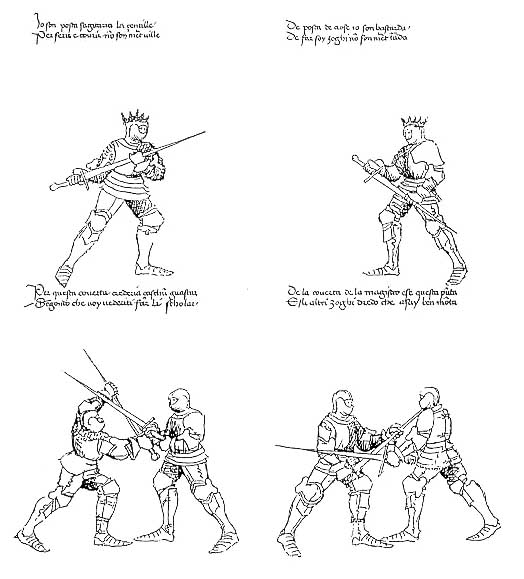
There are no surviving manuscripts from the era in which mail was the primary mode of defense (I.33 is the closest but focuses on unarmored sword and buckler). However many of the techniques used would apply to armored fighting for instance we see a focus on thrusting and attacks to the face. Furthermore, techniques used to defeat later armors (see Fiore's longsword for instance) would still be effective- grappling, shooting for gaps, the use of daggers etc.
The tldr? Swords have significant advantages in handling, wearability, and versatility- making them a valuable sidearm.
Edit, adding a couple museum pieces to illustrate differences.
The Mamluks famously used single handed axes. Here are a couple examples:
Compare to this rather standard arming sword
While the sword is missing some furniture (the biological materials) it's significantly lighter for the length- a full pound less than the smaller axe
Edit 2-
How could I forget hand protection! Tends to suck on axes and maces, but is better on most swords.
Follow up, kind of. Is the OP's idea that chain mail was extremely prevalent accurate? I have been lead to believe that armor made of metal was the domain of the rich, not the common soldier.