Today:
Saturday Reading and Research will focus on exactly that: the history you have been reading this week and the research you've been working on. It's also the prime thread for requesting books on a particular subject. As with all our weekly features, this thread will be lightly moderated.
So, encountered a recent biography of Stalin that revealed all about his addiction to ragtime piano? Delved into a horrendous piece of presentist and sexist psycho-evolutionary mumbo-jumbo and want to tell us about how bad it was? Need help finding the right book to give the historian in your family? Then this is the thread for you!
Here is a neat blog post by some well known Maya scholars on the use of bamboo by the Maya.
https://decipherment.wordpress.com/2017/07/12/bamboo-a-neglected-maya-material/
I know what you're thinking. "Isn't bamboo Asiatic?" The answer is no, not all bamboo. There is bamboo in the Americas.
In fact, at the site of Los Guachimontones where I am currently doing lab work, we have tons of material called bajareque. This material is essentially partially fired clay that once covered the ceremonial buildings. While the outside surface was made smooth, the inside surface retains the impression of the material it once covered. On many of these pieces we have impressions of bamboo from the perishable structures that once sat on top of the more durable clay and stone structures.
Unfortunately I don't have any pictures of the bajareque with impressions of bamboo. What I do have is a picture of a piece with an impression of the grasses that were once used to roof the structures.
Surface - http://i.imgur.com/chsMxcU.jpg
Impression - http://i.imgur.com/Kzfadqr.jpg
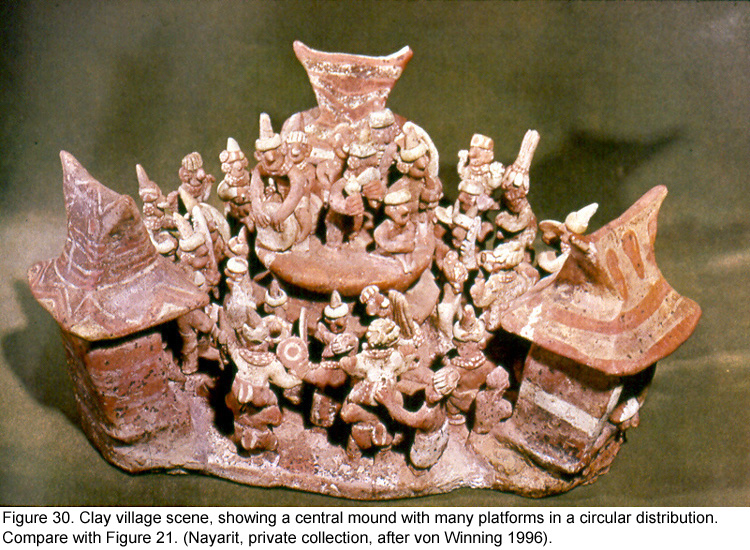
Apparently they applied clay not only to the walls of the perishable structures, but the roofs as well. This makes some sense given that the architectural models depicting simplified ceremonial structures or models of houses have roofs that are smooth and decorated, not made out of grasses.
Model - http://www.famsi.org/research/williams/images/Fig30.jpg
This week I've been researching Roman votive offerings, in particular anatomical ex-votos. They are models of body parts - feet, hands, arms, internal organs and even hair - left at temples. Scholars tend to think of them as either request or thanksgiving offerings for healing, probably of the body part represented. In the last 5-10 years there have been some exciting new ideas and theories used to think about them, culminating in this book published last year:
The reason I'm looking into them is that I think these new theories can also be applied to the curse tablets I usually study. The ideas I'm particularly interested in are thinking about these rituals from an embodied perspective - what did it actually feel like to practice them, and how did people understand them as parts of their lived experience?
I've been enjoying reading the Judge Dee series by Van Gulik. How accurate is the Tang dynasty world he describes in the books ?
I'm currently researching the erasure of indigenous actors in Garcilaso de la Vega, El Inca's General History of Peru with regards to location.
Besides Garcilaso's works, I'm currently reading Noble David and Alexandra Parma Cook's People of the Volcano: Andean Counterpoint in the Colca Valley of Peru and Gonzalo Lamana's Domination Without Dominance: Inca-Spanish Encounters in Early Colonial Peru, both of which are very enlightening. I'm generally interested in the connection between literature and history, so the Lamana (a literary scholar) is particularly interesting.
I'm wondering if anyone is aware of any biographies on "El demonio de los Andes," Francisco de Carvajal. A cursory Google search didn't turn up anything.
I actually have a few book requests today. :)
One of the most surprising things I learned when I first discovered r/AskHistorians back in January was that nationalism didn't really exist until the French Revolution. Can you recommend some books that deal with the absence of nationalism in pre-French Revolution Europe and how it affected their culture?
What are some good books about the Persian Empire(s), Chandragupta and his conquests, the Tamil Kings, and the Gokturks?
Thanks in advance!
I have a few 400-600 page books on medieval history that I read in part by borrowing them from my library, and I am thinking of buying kindle copies. They are relatively inexpensive in that format. My concern is that I am already having problems managing data, with a growing collection of journal articles in PDF format and my own notes on anything non-electronic organized in Evernote. Searching in Evernote is fast and easy, PDF not so much but I am still eventually finding things, and now I would add kindle files to the mix.
Is there some trick to managing academic reading data in a mix of different formats?
I am continually researching the history of the pikes peak area 1850-1900. Most of the history I have found has not been widely published. A particular book is 'The growth and decline of Chinese communities in the Rocky Mountain region' by Rose Hum Lee is of particular interest to me. I havnt been able to locate a copy as world cat says all are in university libraries. If any one can get a scanned pdf of it from their library it would be greatly appreciated and would be compensated. Any way the research this week has led me to find two photographs I was unaware of by william henry jackson. And he is now the leading candidate as primary artist for a historic painting that was later tampered with. Twice. Anyone that may have done research in this area should now the weird history i am talking about. And if anyone is interested i would be happy to share it with others.
Looking for resources on 17th century American colonial architecture. I'm curious when and where homes made the transition from one room cottages to multi-room multi-story homes.
Started the real gruntwork on my senior thesis today.
Looking into the development of a lot of the postwar WW2 mythology that's somehow "common knowledge" and examining how that came to be, using American armor as the primary case study.
Reading AARs is a lot of fun.