Also, approx how many people were killed in WWI because of this? Planes would of had to been shot down without the pilot dying, only to die hitting the ground.
Parachutes only became standard equipment for pilots of aircraft during the 1920s and 1930s. There were a number of reasons for this that ranged from technology, doctrine, to internal pilot cultures that ensured that the adaptation of the parachute would be a protracted process.
One of the peculiarities of WWI resistance to the adaptation of the parachute is the idea that parachutes would encourage pilots to be timid and abandon their aircraft prematurely. A number of commanders felt that an aggressive spirit was essential wither for the defense or the offense. A pilot with a safety parachute might abandon the fight when they should be winning it. As cold as this might sound in 2017, it is worth noting that the air battles over the Western and Italian fronts were incredibly toughly-fought affairs. Which side possessed air superiority over the front often see-sawed greatly with the introduction of new aircraft and tactics. This made the air commanders particularly sensitive to anything that could give an enemy an advantage.
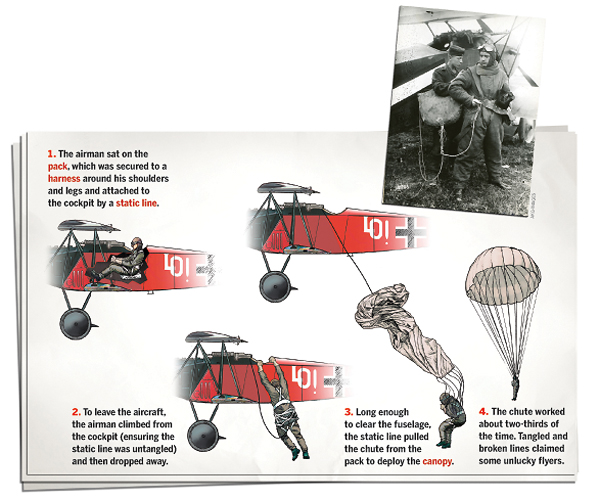
The reluctance to adapting the parachute also was buttressed by the poor designs of the existing parachutes in the war. The harnesses and ripcords often had to rely upon the body's own weight to activate the chute. Balloon or airship crews received parachutes on observation duty not only because it was expected they would be routinely shot down, but because the gondolas could easily incorporate the tethered straps and packs on the bottom of the craft. The small aircraft of the period had little room for such parachutes. When the Germans started equipping some of their aircraft with parachutes in 1918, they were connected to the side of the fuselage interior, as illustrated in this diagram.
In addition to the "will to fight" rationale, the resistance to parachutes stemmed from an unexpected source: the pilots themselves. Early parachutes were bulky and often the cockpits of WWI planes could not easily fit the existing parachute pack and the pilot. Some pilots also believed the weight penalty exceeded the value of escape, a factor that should not be discounted given the relatively low power of WWI engines and constant development of aircraft made pilots leery of sacrificing performance. Finally, it should be remembered that the most effective parachutes for most of the war relied upon the weight of the body to extend the parachute canopy, which was tethered to the gondola. Such a system was not readily applicable for heavier than air machines and the speeds at which they operated.
This is not to say that all pilots categorically rejected parachutes, many did indeed request them. However, there was a push against parachutes that did not always originate from the behind the lines. It was not until after the war that there was serious thought put into designing parachutes suitable for use in the small, cramped space of an aircraft. Leslie Irvin of New York was instrumental in coming up with designs and patents for parachutes and harnesses designed for freefall. Irvin's designs also found use in the barnstorming culture of aviation in the 1920s and 30s as daredevils baled out of aircraft. Militaries also began to use Irvin-stlye parachutes increasingly as the performances of aircraft increased so much that it became much less likely that he would survive nursing his aircraft into a controlled crash. Even with these developments, bailing out still remained a very dangerous process and more than a few pilots such as Hans-Joachim Marseille died while bailing out of their aircraft. Some aircraft like the P-38 were quite difficult to bail out of, as evidenced by this wartime training video. Parachutes may have increased a pilot's chances of survival, but they were no guarantee a pilot or aircrew would survive a bail out.
Sources
Cormack, Andrew, and Peter Cormack. British Air Forces. Oxford: Osprey Military, 2001.
Sweeting, C. G. United States Army Aviators' Equipment, 1917/1945. Jefferson: McFarland & Company, 2015.
To add to /u/kieslowskifan's solid answer, I'll point out that parachutes actually predate airplanes. It was possible to attain high altitudes through hot air balloons, of course. And the first parachute drop was performed in the 1780s. By the 1790s they had advanced to become fairly similar in design to modern ones in that they were made of folded silk, though they remained significantly less sophisticated and much more finicky to use until more modern times. For a long time parachutes were more of a novelty, or an entertainment, one of the earliest practical uses was during WWI when artillery observers in balloons kept them at hand for emergency escapes.
Most of the major advances in parachutes came about during the 1910s and between the World Wars. They became much less bulky and the design was generalized around the backpack + ripcord + pilot chute system that has become synonymous with parachutes since then. In the 1920s both parachutes and airplanes had advanced so far that many militaries were beginning to adopt the concept of dropping commando units behind enemy lines via airplane and parachute. From there the parachute advanced to become a dependable and useful tool.
As for how many pilots died in WWI through lack of parachutes, that's very difficult to know. Some air forces, like the Germans and later the French and British, equipped their airplanes with parachutes, some of which saved lives. But those parachute systems were also very unreliable so it's questionable whether one could say with any confidence that a parachute would have saved some pilot in an otherwise doomed airplane.