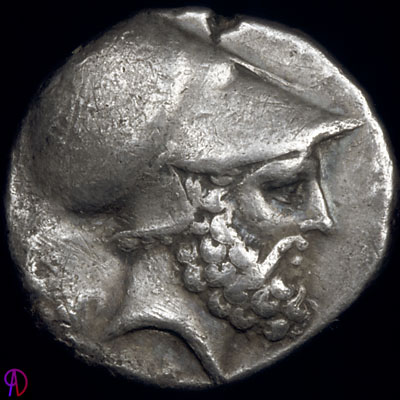
FYI, there's a response from /u/iphikrates here
Mostly so that you can see their faces. Greek art generally isn't meant to act like a photograph that captures a realistic moment in time, instead elements in the piece aid in identification. A helmet indicates some association with the military. This kind of object indicating something about the figure is very common. Naked young man holding a strigil - athlete, naked young man holding a shield - soldier, naked young man with a dog (or a hare-smacking stick) - hunter, etc. But why not just put it over their face and indicate their military status that way? Well, in your middle example, that's the city founder Leucippus, so you want to show his face and individual features and not just an anonymous soldier. For 1 and 3, there's an aesthetic/erotic element to Ares that would be spoiled by covering his face. Just imagine how different the effect would be if you covered him. You would lose the attractive features of the face and instead have something that would be, I think, uncanny and intimidating to the viewer while that is not the effect the artist was striving for.
There's also a certain element of possible realism in the gesture. For example, in this piece showing Achilles and Ajax playing some games on their down time, the helmet on Achilles head indicates that we're seeing a moment of rest between battles. This interpretation is encouraged by the fact that our heroes are holding their weapons and are in armor and that the rest of their gear is in grabbing distance. It's definitely a visual trope to show the helmet up as a sign of the soldier taking a break and it seems quite plausible that the trope grew out of real life habits of soldiers pushing their helmet up to take a quick break. This is particularly fitting in the third (actually Roman) example. Part of the popularity of the image of Venus and Mars was the metaphor of love ending war, illustrated by Venus taking Mar's panoply off.