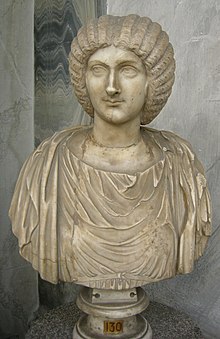
I was going through images of Roman sculptures today and the very elaborate Flavian hairstyle caught my eye. The nodus which precedes it is far less elaborate and later busts (this one is from 180-200 CE) also do not have such intense styling.
Do any Roman historians know what led to such elaborate hairstyles for such a brief period of time?
I'll try to outline some progression between hairstyles of Roman portraiture to ultimately argue that while styles changed, there wasn't really a decline in complexity or artistic skill in these portraits. Some important points to note though in examining stone portraiture would be the types of women being depicted. Obviously, these women would have been some of the richest in the empire and many of the portraits I'll use will be of those in the imperial family since they were more widely distributed and these women were some of the few that were given portraiture. As a result, while these hairstyles do represent trends in the upper class, they certainly don't for the lower classes and even the everyday wealthy Roman.
Before the Flavian Period (Julio-Claudian)
The Julio-Claudian period is probably the earliest you can start with since primarily women from the imperial family were often the only ones able to have art made of them. They were also one of the most widely created an distributed sources of female portrayals in Roman art. So we start with Augustus's wife Livia and this portrait alone is enough to show some of the messages that artists were trying to send. The youthful appearance of Livia is completely uncharacteristic of her since she was likely past 50 at the time this was commissioned. Comparisons have even been made that compare her to depictions of Roman deities, and this is a common trend within imperial portraiture. The hairstyle as well is not entirely a simple one, and some skill was required to sculpt the folds in her hair.
Continuing into the reign of Tiberius (40 years prior to the beginning of the Flavian period) you have Agrippina the Elder, a member of the imperial family. One can see the growing complexity in Roman hairstyles for women (Not so much for men at this time) especially with innovations in drilling which would become commonplace for creating intricate hairstyles (Like the portrait of the Flavian woman you linked). So while I would say the Flavian period had some of the most extravagant hairstyles during the imperial period, earlier portraiture was not a simple as the portrait you linked to of preceding art.
The Flavian Period
Now we reach the period your question focuses on. Fortunately, the bust you linked is one of the more definitive examples of Flavian portraiture so there aren't really any other examples I need to link to. And this bust merely continues the trends of increasing complexity within hair through the increased drilling that was used with the earlier portrait of Agrippina the Elder. Interesting fact though, it is very plausible that the Flavian woman's hair is actually a hair piece, which may explain why it is so extremely elaborate.
After the Flavian Period (Nerva-Antonine and Severan Dynasties)
I want to begin by stating that complexity in hair didn't necessarily decline. Portraiture of men for instance from the mid 2nd century onward became just as complex in hair as these portraits of women. This is the case with emperors like Marcus Aurelius or Caracalla (I can link more if requested).
However, you are right in saying later hairstyles for women, while complex, were not as extravagant as the Flavian woman bust. That being said, the extreme complexity was not the only defining trait of the styles. Height of hair was also extremely important, and supposedly Flavian styles meant to show tallness from the front and a sharp downward slope of hair towards the back. Elements of this are still present following the Flavians with the portrait of Trajan's wife Plotina. Later on, hairstyles returned to having the front much lower and natural. Examples off the top of my head include Hadrian's wife Sabina, Antoninus Pius's wife Faustina the Elder, and Marcus Aurelius's wife Faustina the Younger. So why are these new portraits much less flamboyant in hairstyles?
One could argue that the end of the Pax Romana is mirrored by this decline of decadence and callback to more conservative styles. However the mass instability marked with the decline began during the later years of the Nerva-Antonine dynasty and the beginning of the Severans, far after we see changes from the Flavian hairstyles. This argument though, does explain certain portrait characteristics in later imperial art which I can elaborate on if anyone wants to know.
The best explanation though, is just that styles change. Just because the the Flavian woman's hair does appear to be more flashy than later portraits, does not mean that it was more complex or required more skill than other busts. I earlier linked Faustina the Younger's portrait and I think hers is the best example of this, her hair is certainly not as extravagant, but it's not overly conservative, represents new trends, and still required incredible skill with sculpting and drilling.
Also, to represent later styles you linked to what I think is a portrait of Julia Domna (Wife of Septimius Severus). And again the artistic skill required to depict the individual curls in her hair were also incredible. In fact, I'd argue the artistic complexity in the portrait as whole is greater than that of the Flavian woman with the increased emotion shown with Julia Domna through her facial expression and carved eyes. Furthermore, the overall style of her lowered hair is also quite complex as it was a type of wig that she pioneered as a style for Roman women in the Severan Dynasty
Sources:
Fred S. Kleiner, A History of Roman Art: Enhanced Edition
Shelden Nodelman, How to Read a Roman Portrait
Peter Stewart, Roman Art
Edit: Clarification, drilling is meant to refer to the sculpting practice which made depictions of these complex hairstyles possible only in the realm of stone portraiture