First, an undergrad major in history is different than pursuing a PhD in history. Outside of preprofessional programs like engineering or nursing or similar, undergrad degrees don't matter as much as you want them to in terms of early career.
Second, concerning a history PhD (which is really the only time academic job market questions come into play). Honestly? I think now is a better time to be starting one than 5-10 years ago. This is not because the academic job market is improving. It's not. By most experiences, it's getting worse. There was one job in medieval Spanish lit last year, and it went unfilled. This is a real job listing.
However, very, very, VERY slowly and painfully, departments are actually starting to realize this. And what I mean is, grad students know this--we see colleagues bouncing around from postdoc to VAP to postdoc--and we are putting pressure on our schools or just saying eff it and making our own guidance for alternate careers. A lot of people end up in uni administration, which is probably making the other problems worse. But there is definitely more of an emphasis on how to gain and market skills--with resume-friendly experience--that will help looking for jobs beyond academia.
That's not to say this is the right choice for everyone. It could potentially set you years behind your birth-year cohort in terms of promotions at work, in terms of building up a retirement portfolio. If you finish undergrad in debt or have to take on additional debt to do a terminal MA before a PhD, I think the cost-benefit equation changes a little--and yes, I am worried that we'll end up back in the place where a PhD is the "gentleman's privilege" offered only to people who can pay out of pocket for undergrad or get really, really, super crazy lucky.
There are also the non-economic factors. Grad school is hard. It's hard academically, but it's also hard emotionally. It's probably a toss-up whether academia attracts people who are already messed up or messes up the people it attracts. But last year when they released a study to the effect of 50% of PhD students admit to mental health issues, I posted on Facebook "...and 50% of PhD students are liars"--and no one disagreed. It's also a very, very, very narrow social/intellectual world you're signing yourself up for. Make no mistake, the grad students and academics here on reddit are for the most part NOT doing a good thing in the eyes of our professors, because it's not helpful towards an academic career. Academics write for other academics and hang out with other academics and live for other academics. (My non-reddit hobbies are very un-academia, which makes this part SO CLEAR). Now, academics are in general pretty cool people, certainly in history. This isn't a bad thing/dealbreaker, but it is a thing and you should know it. A career (including temporary grad student career) like academia is life absorbing, so your work (school) colleagues are also the people you'll get along with and be with in most cases. I'm not saying this is true for everyone (hi!), but it's true for most people.
So you can see from the above that I've given up on the job market, I think academia is broken and works hard to break its people, and most of my friends and social life are outside that rareified world. Would I still start my PhD, knowing what I know now?
Oh hell yes. The Middle Ages are awesome and I am just in love with them and knowing about them and trying to understand them and failing to and trying a new way and then telling other people just how freaking awesome they are.
Yes, because I went into international business after double majoring in politics and history, and it has been very useful for making connections. Granted, I do use my historical knowledge in a somewhat unorthodox fashion. I currently work as an analyst of sorts for Chinese executives, and I was hired in part because I had studied Chinese history extensively. To them, it showed I had a respect for their own culture and history.
I've found the Chinese are rather fond of talking about their lengthy history. Nearly every single Chinese person has a degree of knowledge and pride in their history, which is something of a nice cultural characteristic. Additionally, whenever my bosses make decisions they have a habit of drawing upon the old adage - "Those who do not know history's mistakes are doomed to repeat them".
I really enjoyed /u/sunaginstgold’s response. Given the cost of undergraduate education I believe it is important to recognize a few factors before beginning your first year of studies:
You are not necessarily committing yourself to be a historian by beginning a major field of history. History majors go on to do plenty of things, just like those who major in other fields. I would recommend reading a few pieces to get an idea of the value of majoring in history: [AHA on a History Major 1998](https://www.historians.org/about-aha-and-membership/aha-history-and-archives/archives/why-study-history-(1998); Historians on Being a Historian; AHA Decline in History Majors 2016
You must also realize, however, that beginning a major in history means you will probably be behind in other coursework should you decide to change majors. The reality is that in choosing to major in history you are naturally choosing not to major in something else and this comes with consequences. Although not entirely impossible, I imagine the number of history majors who ace the MCATs and get accepted to top tier medical programs are few and far between. But do not despair! There are a good number of history majors who excel on the LSATs and attended prestigious law programs. Long story short: being a history major doesn’t necessarily “condemn you” to life as an academic historian. You must also realize that in choosing a history major you may at least partially shut other doors. It's the nature of choice.
For those who do want to become an academic historian: I’d also like to add that so often we talk about this “choosing a major” topic as if students have no agency. To a large extent, you determine your own fate. If you expect majoring in history to get you accepted to the graduate program of your dreams, you are in fact dreaming. As an undergraduate, get involved in ways that can enhance your career. Volunteer at local schools, read voraciously from a variety of sources, practice becoming a succinct writer, submit opinion pieces, look into undergraduate conferences, and dialogue with your professors. The more you do in “the field of history,” whatever that is, the more you’ll know whether it is the path for you or not while also building a resume. Take it from someone who has been through a BA and MA and is currently writing a dissertation and looking toward the job market, what you do when you don’t have to will determine what you become when you don’t have the choice. I’d echo the sentiments of /u/sunaginstgold on both the economic and emotional tolls of a career in academic history. I would also add, however, if you truly love the discipline, enjoy writing and reading, and can excel in a teaching position, with a ton of effort, you can excel and I’ve seen it in many colleagues.
Cheers to all historians out there in academia and beyond. Your contributions make a much larger impact than you might realize.
Sure, but I'd probably go out of my way to pair it with something that would make it more readily sellable. I did a lot of ad hoc coding work as an undergrad; these days I'd probably try to get a CS minor (or some even more exotic field like Data Science) to pair with it. History by itself is a fine major (whether you go into academia or not) on its own, but paired with something slightly more technical it becomes a really strong "pitch." History is a major that teaches you how to read and write and research and think synthetically and critically... and it's a lot of fun, too. So yeah, I'd still major in History as an undergrad, even History of Science and Technology specifically. (In my actual field of study, my primary field was Science and Technology, and my minor fields were US history and German history. I'd probably do Russian instead of German the second time around; I don't use the German stuff very much. But who knew we'd be into Cold War 2.0 so quickly?)
The real question is whether I'd go into academia (or at least grad school) if I were doing it today. And that's a tough question. I graduated with a BA in history in 2002; the economy wasn't great but it wasn't abysmal. Most importantly, I graduated without any debt, because I went to a good state school that was at the time still pretty cheap for residents, and my parents were able to refinance their mortgage and pay for it on their middle-class salaries. (In retrospect, they had saved an amusingly tiny amount for my and my sister's college fund... $8,000 total. Different world, obviously...) Since then, the price in real dollars of the same state school system has gone up by a significant factor (three or four times), and the ability to refinance your mortgages on a whim seems to have gone away with the economic crash (or at least been constrained). Which means I probably would be graduating with significant debts to work through, which means I wouldn't have probably thought that starting a PhD in History of Science would be a good economic idea, because (unlike a lot of my grad school contemporaries) I don't have a trust fund or any other kind of independent wealth.
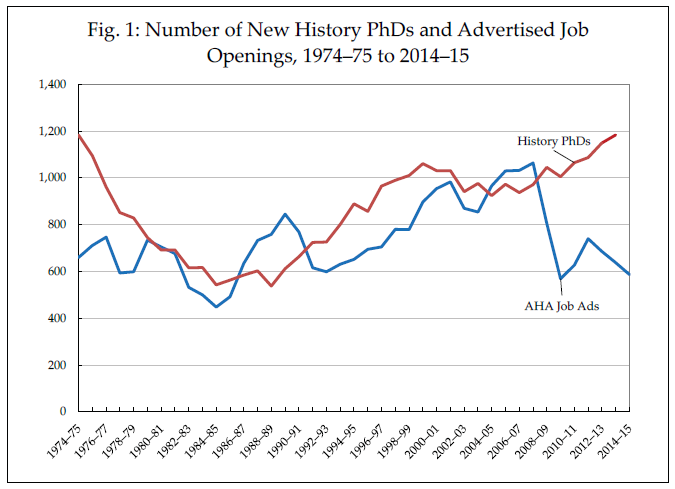
And the job market for historians has completely crashed — consider this graph. I started my PhD in 2004... a pretty good year! And indeed, it felt like everyone who got a decent PhD got a job without question. But I graduated in 2010 — and check out the data then. Quite a different situation. Being good and from a good school stopped being sufficient — it became only necessary. Luck essentially determined whether I got an academic job, which is a scary thing to consider. As it was, it took 4 years of postdocs and hustling to make something that worked out... I'm happy with where I am, now, but yeah, there were some nail-biting times in there, some real questions about long-term financial stability.
So would I still get a PhD in history if I were graduating today? I doubt it. This is a different world, though. It is remarkable how fast it changed, and how important these bigger structural questions (economic stability, funding for state schools, the housing market, etc.) shaped these sorts of matters. Which is a nice historical point, really, about the importance of context, and why we can't see these kinds of seemingly "intellectual" decisions as being divorced from it in any way. It also tells you a lot about how economic realities change the makeup of the discipline — there are still plenty of grad schools in history programs. One wonders what will come of them. Will the academy be primarily for people who don't fear economic failure, e.g., people with trust funds?
i have my master's in humanities with an emphasis in history. u dergrad was philosophy/theology. the job market sucks and i had to go back to school and not work to finish my master's.
i'm applying to a job now that has been unfilled for two years at least and doubt i'll get it, tho i have teaching experience. i've been unemployed 3 years now mostly, tho part time jobs teaching here and there in high school.
i didn't pursue my master's for the job market. i started pursuing bc my previous job said they would pay more, but then laid me off.
but for me... education has always been an end in itself. i studied what i wanted despite people saying "what can you do with a philosophy degree? with a humanities degree?" my goal has always been to teach..
but i love academia. i love learning. i spend all my free time painting and learning more about history, especially the time periods i'm most interested in. i've become proficient in areas of history because of this and my desire to teach that has just become stronger.
i'm a boring person to talk to bc i want to talk about academic shit, or historic time periods, or whatever i'm studying right now. i don't know when i'll find work. i'm not qualified to do much other than teach, really.
and i keep thinking maybe i should just pursue a phd now. but writing a thesis took me a year... 6 months of research, 6 months of writing and research. i had a thesis that got me great praise from my department. and i'm super proud of that. i had a paper published by my university. super super proud of that.
but my family kinda thinks i'm a loser. and i'm starting to believe them.
i'm going to show up in person today after applying online and try to see those hiring. i have little hope. but all i want is to teach this shit to kids in school today. bc i believe i have something to offer.
but would i do it again? i don't really see anything else i could have done differently or would have done differently re: academic pursuits. i love learning and love knowledge... it's my fucking drug.... and i'm addicted. history is fascinating and i keep digging deeper and deeper into it bc it feeds this addiction to knowing and to learning.
i'm an academic. it's just the type of person i am. some people want to make money, i'd like money so i could do more and travel to these places i love learning about, but money is so much lower on the list. i just want to know more. it's kinda all i care about. to the frustration of my parents. tho my dad understands bc he has this academic side too and has spent his life in pursuit of these sorts of things himself.
it isn't profitable. and i can't say i care. i just want more knowledge. and a job passing the knowledge forward to others and making kids care about ancient egypt as much as i do.
there's nothing else i would study. i would have only studied harder and more in depth.
the job market sucks. but that doesn't stop me from learning more for the day someone hires me to teach it.
I was a dual major in chem and history, so I probably still would major. That said, as /u/sunagainstgold has so vitally noted, grad study in history is not the same thing as undergrad, and the academic market is utter crap (I think Rebecca was actually a little rosy in her language relative to that Acura). I recall listings in NJ asking for PhDs to teach a college's intro classes for $900 a course in 2008 so this insanity is not going away soon. Knowing what I know now, I'm not sure whether I'd have gone on past BA when I did nearly two decades ago. Today I almost certainly would not. The methods and initiative necessary to follow leads and learn structures of knowledge to find information, not to mention the ability to write about them, were part of my history major; I could have used them elsewhere to good effect. Some of my grad cohort in fact did, and became paralegals in Chicago and NYC.
Ultimately I elected to go to graduate school for history because I felt I could always come back, become a lab monkey, and probably die of boredom titrating something endlessly. I had to make sure there was a plan B at all times, but in the end (and with a sobering amount of luck) it did work out to such a degree that I await the moment when I wake up from the coma / dream / Matrix / etc. I am an exception, however--even though my field is less crowded ("appallingly bad" instead of "froth-inducing awfulness that makes the lottery look like a sure thing") it's entirely owing to stupid strokes of luck that I survived that gantlet. [edit: in light of /u/restricteddata 's comment, I should note that I was on the market a year before, right when the bottom fell out of the economy in the middle of the interviewing season. It was chaos and very ugly with canceled searches and retracted hires, but honestly not as bad as the next two years were.] Some of my junior colleagues also express this feeling--even those who went to Ivy League grad schools--and we're doing more active professionalization outside of education and the academy at both undergrad and grad levels to encourage people to see the breadth and portability of what they are learning and grab opportunities.
So the TL,DR is "Major? In my case, yes; I'd still encourage it. Grad school? No way, what was I thinking?"
I would, because for me those choices (studying for a PhD and taking undergraduate and postgraduate degrees in History) were about so much more than getting good job prospects. For me, taking History and studying for a PhD was more of a lifestyle choice - it was what I wanted to do and it offered me the flexibility, freedom and travel opportunities in a career which I wanted from the outset.
Of course, the road hasn't always been easy and I've taken numerous jobs whilst studying and inbetween degrees in order to live and pay rent. But also, I'd say that having an undergraduate degree in History gave me lots of different skills, and a very independent attitude towards work and study, which helped me go on to succeed in a range of different jobs. I suppose what I've taken most from studying History is versatility.
Of course, if I could go back and change things now, there are certain things I'd do differently. I'd spend more time in my 1st and 2nd years at university getting involved in societies, taking positions of responsibility and writing more. Basically, I'd do a lot more work to build up my skills and CV in advance of leaving university and being thrown into the job market so I was able to differentiate myself from other candidates.
But I can't say that I'm unhappy with the choices I have made. Yes, the job market in academia is tough, but there are opportunities out there and, for me personally, the extra hard work it requires to get into a steady position is worth the sacrifice, particularly when you count in the flexibility and freedom of the work once you get it.
You can ask in r/AskAcademia
Can anyone offer a UK perspective on this? I only ever really see people talk about the US academic job market
Maybe I'd still major in it for my bachelor's but I wouldn't go for my Masters again. And I'd pick a better minor than political science. May e Geography.