I'm referring to the Celtic people of Britain who lived there during the Roman period, as well as right before and after.
By typical dress, I mean what was worn by the common people (not the Roman elite).
So the first sources to look at are the Classical written sources, but they have a few problems - they were written by Greek and Roman authors, not Celts, with specific agendas, so we don't know how reliable they are. Also there actually aren't a lot of Classical sources that directly discuss what the Britons wore.
We have this tidbit from Julius Caesar (De Bello Gallico 5.14):
Most of [the tribes] in the interior [of Britain] do not sow wheat, but live on milk and meat, clothing themselves in animal skins. But all the Britons dye their skin with woad, which gives them a blue colour and fearsome appearance in battle. They wear their hair long, but shave every part of their bodies aside from the head and upper lip.
I'd be very wary of trusting most of this, since he's basically making them out to be primitive savages - remember he wrote this to justify his invasion of Britain, which was costly and not particularly successful, to the Senate in Rome. And it involves the woad thing, which isn't really corroborated anywhere else.
Next up: Diodorus Siculus (ca. 60-30 BC), on the Gauls. Gaul is only just next door, and they probably shared quite a lot with the Britons - for a start, they'd all have been speaking some variation on P-Celtic.
The Gauls wear stunning clothing - shirts which have been dyed in various colours, and trousers which they call bracae. They also wear striped cloaks with a chequered pattern, thick in winter and thin in summer, fastened with a clasp.
This is probably reasonably accurate as far as it goes. Strabo's Geography 4.4.2 (ca. 64/65 BC - AD 21) echoes quite a lot of it:
They wear sagi, let their hair grow long, and wear tight trousers, and instead of normal tunics wear slit ones that have sleeves and extend as far down as the private parts and buttocks. The wool from which they wear the thick sagi (which they call lainaí) is coarse and shaggy [...]
You specifically asked about the Britons. Here's the classic description of Boudica from Dio Cassius' Roman History (62) (writing ca. AD 190-235):
[she] wore a large torc of twisted gold, and a tunic of many colours over which there was a thick cape fastened by a brooch.
The "many colours" thing that keeps cropping up is probably a reference to their use of stripes and checks in their weaving. Amazingly, we actually have one tiny piece of chequered fabric that survives: the so-called Falkirk tartan, from Falkirk in Scotland, that dates to the 3rd century AD.
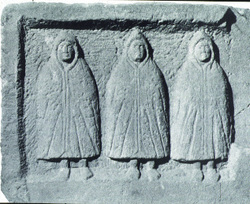
The only other specifically British item I can think of is the birrus britannicus, a type of cloak that became popular in the Roman Empire, presumably so-called because it originated in Britain. It may be related to the sagi mentioned above. Another interesting item that survives is the Orkney hood, ca. AD 250-615, similar in shape to the birrus though much shorter.
The authors consistently mention brooches or clasps (except for Caesar...), and the archaeological record is consistent with this. Brooches are among the most common metalwork finds at inhabited sites, suggesting that basically, that was how you did up your clothes.
Unfortunately, textiles don't survives well at all, and we don't have a lot of depictions of common people to go on, so it's quite a lot of guesswork.