So I'm having a hard time formulating this question properly, but basically what I'm trying to get at is why have indigenous people of the arctic never moved south? I realize most have traditional lifestyles which lend themselves to the environment and climate, but I mean more historically-why did more people not leave the relatively difficult lifestyle of the north and go south to farm or herd in better climates?
The short answer is that many did. The Americas, after all, were populated by three major waves of Arctic peoples prior to the arrival of Europeans. The earliest wave most likely traveled along the Pacific coast around or before 20,000 years ago. By 18,500 years ago, they had essentially gone as far south as south goes, having reached southern Chile by that point.
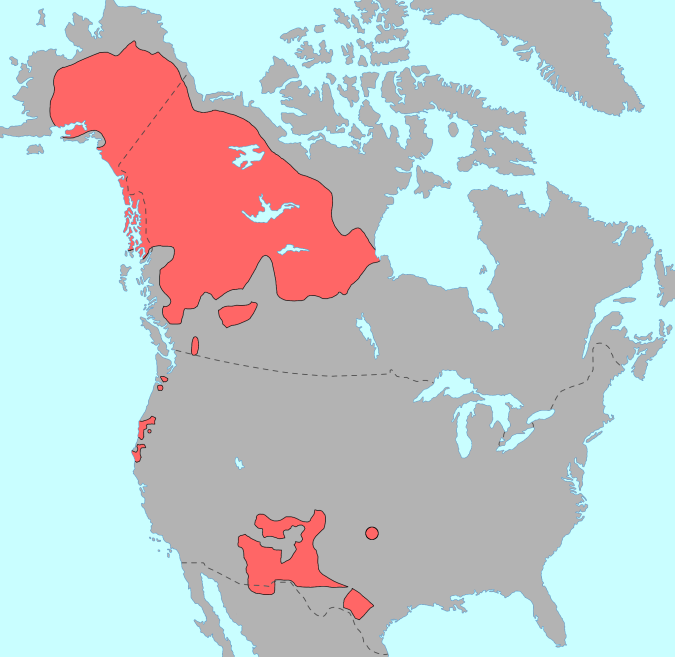
The second major wave of Arctic peoples to settle the Americas were the ancestors of the Na-Dene speaking peoples. As you can see on this map in recent history the traditional homelands of Na-Dene peoples has mostly been in the Alaskan interior and northwestern Canada. It's been theorized, based on linguistic and genetic information, that ancestors of the Na-Dene (and the Yenisians of Siberia) were the inhabitants of Beringia at the end of the Ice Age, splitting and pushing island as their ancient homeland flooded and the ice sheets withdrew from the continents. The exact timing of the when the ancestral Na-Dene populated northwestern North American is uncertain, but I favor the theory that they did so early, expanding into the territory opened up as the two major ice sheets in North American separated. However, it's important to remember that relatively modern distribution of languages is not an accurate guide to past distributions.
Case in point, you probably noticed that while most of the Na-Dene peoples are in the north, there's also a large population in the American Southwest. That's the Diné and the Indeh, or the Navajo and the Apache. They left the northwest Na-Dene homelands about 1,000 years ago, in a migration likely triggered by the catastrophic eruption of Mount Churchill in Alaska. The ancestors of the Diné migrated down the western side of the Rockies, while the ancestors of the Indeh came down the eastern side, both eventually reaching the Southwest about 600-700 years ago.
By the time the third major wave of Arctic peoples - the ancestors of the Inuit, Inupiat, Yupik and Aleut peoples - reached the Americas, the southern regions were already well populated. If you were part of that last wave of Arctic migrants, you basically had two choices. You could either be the best at surviving in the Arctic, or you could head south and intermingle with the people who were already there - people who might be to eager to share their land with you. Most seem to have choose the former - the Inuit and related people brought with them a suite of tools that let them excel at hunting sea mammals and allowed them to dominate the Arctic coast by accessing resources that other communities couldn't, or at least couldn't do as well. They absorbed some Na-Dene peoples into their own communities along the way - there's significant genetic admixture from Na-Dene communities, up to 50%, but less so the other way around, only 10%. That 10% possibly represents people from this wave of migration that did choose to go further south, they just didn't get too far before blending into the pre-established population. But, like I said, those folks to the south aren't always happy to have you show up if you're a northern looking to escape the cold. In the east, the 1700s, the Inuit had pushed as far south as Newfoundland and generally had a violent relationship with the local Beothuk (though some Inuit communities from Labrador and Beothuk bands in Newfoundland appear to have been on peaceful terms, trading and intermarrying). But, for the century or so that the Inuit were in Newfoundland, they came predominantly to hunt along the coast and trade. Perhaps if Newfoundland wasn't the so hotly contested by different societies (the Beothuk, the Mi'kmaq, the Inuit, and Europeans), they might have attempted to established a permanent presence at that time, but that's purely speculative.
So, to summarize, for the Americas:
2.Those that stayed in the north did so because they could exploit resources that others couldn't and people to the south weren't always receptive to sharing their land.
The first correction I have to make is that some did head south. The Manchus who ruled China during the Qing Dynasty for example are a Tungusic people, whose geographic distribution goes way north to the Tunguska river in Siberia. Now as far as I'm aware there's no definitive history of where they originated (it seemed like around the Amur river of what is formerly outer Manchuria) but it seems like a high degree of intermarriage between northern and southern Tungusic people and local people.
And even at the very least, the Manchus themselves (then called Jurchens) by the 12th century was established in modern day Liaoning & Jilin province (near North Korea), so they definitely moved south from the regions around the Amur river.
In fact China during the Qing Dynasty even had a small border war with the Russian Empire over the Amur river basin as Russian settlers and colonists came into conflict with the people around the region (like the northern Tungusic Evenk people) who swore fealty to the much larger southern Tungusic Manchus.
heading somewhere depends on whether you can defeat the other people that are already there. the north american people moved around quite a bit pre-conquest.