I'm specifically interested in entities with some sort of overarching government structure spanning a large (relative) area (or large population; bonus points for both) and/or multiple peoples, as well as both how that government worked and why it was able to hold together a large polity where others had failed.
I've always heard of the Iroquois Confederacy as the go-to answer for this, so I'm interested in some other possible answers.
(Also, a vaguely related side-question that I didn't think merited its own thread: were Native Americans anywhere pre-Columbus known to use marriage as a political tool to secure alliances or goodwill?)
Your mention of the Rio Grande makes me think you may be aware of the Pueblo cultures of the American southwest (if not, check that link out!), but no mention has been made of the Mississippian culture -- I think you're in for a treat!
You may or may not know them as 'the mound builders', but that's a very large umbrella term that can apply to numerous cultures in the Eastern Woodlands and IMO also kind of downplays their importance, and at the same time unfairly mystifies them.
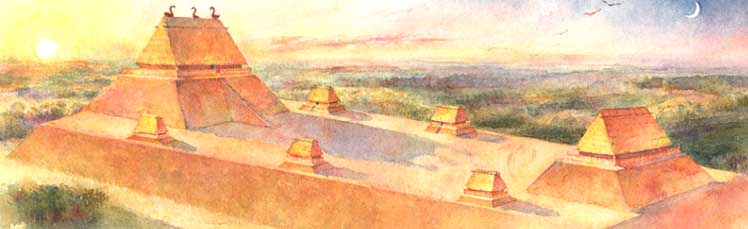
Before Columbus, and even around 200 years after, there were thriving sedentary agricultural polities spread throughout much of the eastern U.S, and especially the river valleys. We call them 'the Mississippians' because of their prevalence throughout the watershed. The members of this culturally interconnected group are known for their intensive agriculture, stratified social classes, a complex system of hereditary government and lastly the 'mounds' -- earthen platforms of various shapes, sizes and purposes, some built up of various layers of earth and substrate for structural stability, and many expanded on from previous mounds. The largest of these, and the largest Eastern Woodlands polity we know of, is Cahokia, which is right next to modern St. Louis and once held around 20,000 people -- our most conservative estimate, though you'll often hear estimates as high as 40,000 or higher.
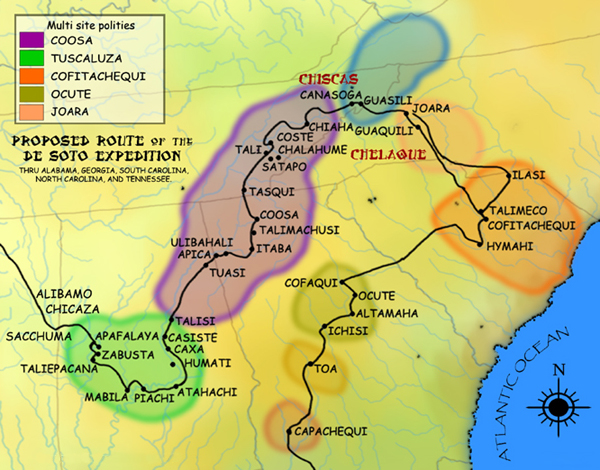
We know through Hernando de Soto's 1539 expedition to the eastern U.S that not only was the Mississippian culture alive and well, but that some of them formed large territories controlled by powerful paramounts using sophisticated political hierarchies, like the chiefdoms of Coosa or Cofitachequi. While we can't say for certain if Cahokia would have exercised this level of control, it does seem likely and archaeologists like Patricia O'Brien^1 and Julie Holt^2 propose a state level of governance termed the 'Ramey State'. For now, we're not sure. What we do know is while Cahokia existed, a large trade network spanning nearly the entire Mississippi watershed was thriving. After Cahokia declined (probably due to a flood), the networks fractured into more local systems.
But large Mississippian polities existed well past Cahokia up until the 1600s when most Eastern Woodlands society collapsed in response to European incursion. (The Natchez, a Mississippian people, still controlled a sizable amount of modern Louisiana until 1730.)
It's technically not 'north' of the Rio Grande, but the Calusa^3 are a notable people of southwest Florida. They had a stratified class system, an absolute, hereditary ruling family, political hierarchy, a professional military leadership, massive shell mounds with equally massive buildings on top, an absolutely amazing artistic tradition, a series of large canals dug right into the swampy mangrove terrain to facilitate navigation, and controlled much of the southwest portion of modern Florida from their island capital, Mound Key, which featured its own canals -- but none of that is what really makes them unique. They accomplished all of those things while growing little to no crops themselves; essentially living a 'hunter-gatherer' lifestyle, as the subsistence strategy is called! They were able to thrive thanks to the sheer abundance of sea life on Florida's west coast, which allowed for a complex sedentary culture to support itself. On land and sea, they were able to give the Spanish a run for their money on several occasions, which is partly why we don't know as many details about their culture as we could have. From what we do know, though, I'm honestly not sure why they aren't considered some kind of archaic state instead of just 'chiefdom'.
I say 'little to no crops' as there is evidence for them growing squash in small gardens, along with chili peppers and papayas -- these two plants are totally unknown in the Eastern Woodlands.^4
I understand it might fall out of your definition of an 'overarching government structure', but confederacies were very common political constructions in North America; especially at the eve of European colonization as the need to band together was emphasized. As you mentioned, the Haudenosaunee government was probably one of the most intricate, almost resembling a centralized form of government. One of my favorites is the Anishinaabe Three Fires Confederacy, which ceremonially, culturally and politically groups the Ojibwe, Ottawa and Potawatomi peoples. This confederacy held off both other native confederacies (like the Iroquois) and European powers (before being defeated by the United States), and apparently the Ojibwe's birchbark genealogies can trace the CTF back to 796, which is...a good long while ago.^5
To answer your question about marriages, it seems to have been relatively common among the complex chiefdoms of the U.S. During De Soto's exploration of North America, he had been trying to garner peace betwwen the rival chiefdoms of Casqui and Pacaha (near modern Memphis, TN) by arranging a feast. They both tried to one-up each other by offering women to De Soto as wives. As Casqui offered his daughter, Pacaha responded by offering "a wife of his", his sister, and "another principal Indian woman".^6
This was also done by the Calusa, of whom the paramount Calus 'offered' one of his sisters to Pedro Menéndez, who was so very politely coerced to do so during a party meant to convey Spanish allegiance. This was meant purely as an attempt to form an alliance between Spain and the Calusa, for the sole purpose of using Spanish military power to dissuade his captain-general (or other members of the nobility), who would have been the rightful king if not for some tricky business done by Calus' father, from trying any funny business^7. Though military might certainly played a part in Calusa conquest, marriage was also important in securing and maintaining territory. By making separate polities 'kin', they are more likely to cooperate and much less likely to rebel against them. Calus would have had a wife from each village to cement that kinship, and this form of tribute would be repeated upon the appointing of a new paramount. ^8
Sources:
The Haudenosaunee are a go-to answer for this mainly due to their territorial gains in the Beaver Wars of the mid-to-late 1600s. Prior to that and prior to Columbus, the Haudenosaunee territory was predominantly the area of New York between the Hudson and Genesee Rivers. Not nearly as big as impressive as they'd be at their peak in 1701, but still sizable compared to most of their neighbors in 1491. Population-wise, they probably had somewhere in the range of 20,000 people, bound together by the Gayanashagowa - the Great Law of Peace. This is the oral constitution of the Haudenosaunee, and the best known precolonial political work from the Americas. I have an older post on the Haudenosaunee government that you may be interested in, though I wish I had more information to include about the Clan Mother Council at Gaustauyea.
The nearby Neutral Confederacy was located in southern Ontario. We don't know much about them now, but they were visited by a few missionaries in the first half of the 1600s. Based on their descriptions the Neutral Confederacy may have had a population of up to 40,000 before being conquered and absorbed into the Haudenosaunee. Unlike the Haudenosaunee, the Neutral Confederacy might not have been a partnership of equal partners - the name "confederacy" may not even be accurate here. One ethnic group within the confederacy, the Chonnonton, seem to have held considerably more sway than the others, and their leader Tsouharissen (possibly his title rather than his name) is described as a singular "king" rather than one of many council-chiefs as the Haudenosaunee have.
Turning our attention south, I should point out Coosa and Apalachee. I'll be brief here since I discuss both in greater detail in the linked post. In terms of territory, Coosa is the largest confirmed precolonial polity north of America, stretching about 400 miles along the southern Appalachians, and with a population of at least 50,000. It dissolved sometime after European contact in the mid-1500s, and became one of the Four Mother Towns of the Creek Confederacy. Apalachee was a much smaller polity, territory-wise; essentially, it's just a 30-mile radius circle around modern day Tallahassee. But two different Spanish reports from the early 1600s put the population of its capital at 30,000, though its possibly they were really taking about the Apalachee region as a whole rather than just the capital. If not though, that bumps the estimated population up to about 60,000.
I talk about about how the Apalachee government worked in this post, along side other notable Florida polities - the Timucua and the Calusa. The Timucua were very populous prior to the arrival of Europeans, with a low-end estimated population of 200,000 in northern Florida and southern Georgia, but they were never unified into a single polity that we know of. At the time of European contact they were divided into three major alliances of smaller communities. The Calusa were unified and had conquered the southern half of Florida, including the Keys, by the time Europeans arrived. The estimated population for the Calusa proper is about 10,000, or 70,000 if you include all their subjects.
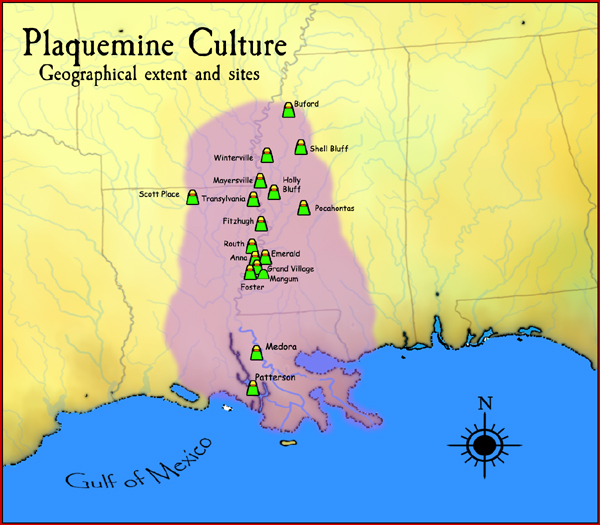
Another notable contender that we unfortunately know all too little about is Quigualtam, a polity that existed along the southern Mississippi River at the time of European contact. You can read about Quilgualtam's fleet of war canoes here. From the encounter De Soto and his men have with Quigualtam's war canoes indicate that its leader was about to coordinate a military operations along as sizable stretch of the Mississippi (roughly equivalent to length of the state of Mississippi today). Coincidentally, this corresponds roughly to the what archaeologists know as the Plaquemine Culture, a late Prehistoric subset of Mississippian cultures that Quigualtam was certainly part of. Possibly, Quigualtam actually unified the whole, or at least a sizable chunk, of the Plaquemine culture. The oral histories of the Natchez - the last remnant of the old Plaquemine culture - were written down by the French history du Pratz in the early 1700s. They also point to a more or less unified Plaquemine, led by a single Great Sun (as the Natchez leader was called) and 80 subsidiary Suns, ruling over some 200,000 people, prior to the collapse of Plaquemine society in the latter half of the 1500s into the 1600s. But a unified Plaquemine is hypothetical, and confirming it with a few scant historical records and archaeology will be difficult.
a vaguely related side-question that I didn't think merited its own thread: were Native Americans anywhere pre-Columbus known to use marriage as a political tool to secure alliances or goodwill?
Definitely. The link where I discuss the Calusa mentions that the certepe took wives from each of his tributary peoples. There's a pretty famous example in the founding history of the Aztecs too which you might want to ask our Mesoamerican specialists about. I don't want to spoil that story by telling it ineptly. Going way back, archaeologically, we know that the Havanna Hopewell in Illinois and the Scioto Hopewell in Ohio were intermarrying on a regular basis some 2000-1500 years ago.
Immediately north of the Rio Grande people were mostly semi-nomadic, hunter gatherer types. Further north we have people like the Whichita, which lived in small villages ranging from North Texas to Kansas. Along the Texas Louisiana line there was the Caddo confederacy along the Sabine River. They were known as an agricultural society living in villages with local governments in place. The Atakapans also lived around the same area, ranging from Louisiana along the Sabine River, all the way to the Trinity River in Texas.