If you really want to gather as much info as you can, you should check out some of the dozens of excellent books on this subject, including Mary Beard's Pompeii: The Life of a Roman Town (link), Aldrete's Daily Life in the Roman City: Rome, Pompeii, and Ostia (link), or Carcopino's Daily Life in Ancient Rome: The People and the City at the Height of the Empire (link). As you can see, there is a lot of material on many aspects of life in Pompeii in the first century--way too much to cover here. I can provide some outlining to get your started on your questions, however.
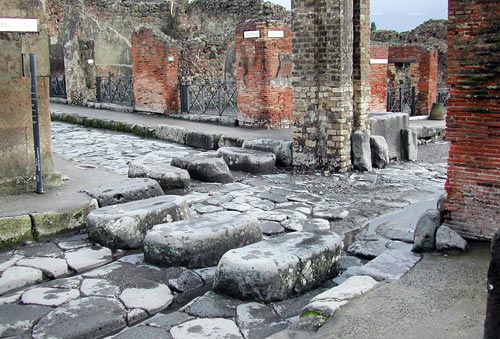
Pompeii was a typical town of its type (veteran colony), and had all the amenities we expect from such a place. It was neither large nor small for a veteran colony, but about in the middle, having about 12,000 inhabitants (a third of them slaves) and about twice that many in the immediate surrounds (villas, farms, etc). Most of the "big" buildings were constructed or embellished in the decades after the town became a colony after the Social War, or during the early Empire under Augustus and Tiberius: an aqueduct, a theater, an amphitheater, a recital hall, public baths, temples, markets, etc. There was a large forum, of typical Roman design, with a capitolium temple at its head, a temple of Apollo, a public meeting hall, flanked with colonnaded wings connecting basilica and markets for meat and vegetables, and adjoining a modest bath complex. The streets were roughly orthogonal, with a few kinks and sharp turns belying very ancient foundations, nicely paved but grimy enough to warrant the famous stepping stones.
As far as its importance to the Empire: not very, unfortunately. It was a hub of local commerce in Campania, but one of several, and obviously not indispensable. The city had sided against the Romans in the Social War, and even at the end still wore vestiges of its non-Roman past. Pompeii shared the arena with a neighboring town, Noceria, and had in recent times engaged in a full on riot against the Nocerians over, apparently, a sports disagreement, to the general annoyance of the Emperor back in Rome. In other words: yes, the city was "on the map" at Rome, and big enough to deserve consideration, but not big or important enough to warrant resurrection after the event. In a few decades, the town was apparently almost completely forgotten. Pompeii had been the crossroads of a few important Roman roads, particularly the route moving north and south along the coast between Capua/Neapolis/Stabiae, but this road was completely obliterated in the eruption anyway and when it was rebuilt, it simply traveled over the moonscape terrain which had once been Pompeii. A road leading east to Noceria might have continued to function and might have linked up with the region again after the dust settled, but I can't find any good information on that.
I really encourage you to take a look at one or all of the books I linked above. They are very accessible and stuffed full of good information on the daily goings-ons of the Roman world in the first century.