Natural causes? War? Lead poisoning? What was the typical life expectancy?
I want to preface this by saying that this post might not be the exact answer you are looking for, but I make no apologies for that. As u/commiespaceinvader so evocatively put it in this recent post, we cannot forget that what we are dealing with here are "human beings who lived lives, felt pain and joy and happiness and sadness." Your curiosity into mortality in the Roman world is great, and I hope you will continue to be interested in this topic, but please try to stay connected to your humanity. These are not mere statistics on a spreadsheet, but real lives lived by humans in circumstances worse than almost anything experienced in the modern world.
Right, on to answering your question. Around half of people born in the Roman world died before their fifth birthday. Yes, you did read that correctly, and I'll say it again. Around half of people born in the Roman world died before their fifth birthday, and perhaps even worse, a third of newborns would have been dead before they reached the age of 1. Infant mortality ripped through all levels of Roman society, from the poorest, most destitute plebeian to the wealthy senatorial families. According to Plutarch (Life of Tiberius Gracchus 1.2), Cornelia Africana, daughter of Scipio Africanus, had 12 children, only three of whom survived to adulthood. That's nine dead children in one of the richest families in Rome, with access to the best diet and medical care available at the time. Lack of sanitation, epidemic and endemic disease, and regular food shortages fell disproportionately on the young, making the first 5-10 years of life the most dangerous. Now, in the modern world, even the worst countries in the world have infant mortality rates below 200 per 1000 live births (see the WHO 2015 report here). Statistical analysis is very, very hard to do for the Roman world, but I've seen estimates as high as 470 per 1000 live births (Frier in the reading list below). Just let that statistic sink in for a moment. If that estimate is even close to being correct, infant mortality would have outstripped warfare, slavery and everything else by orders of magnitude greater than I can get my head around. The devastating rate of mortality among under 5's in the Roman world could have pushed life expectancy at birth as low as 25. Going by WHO data again, in 2015 in Sierra Leone life expectancy at birth was 50 - the lowest in the world but still double the figure for the Roman period.
This level of infant mortality had serious effects on Roman society. Just to maintain the population, the average woman needed to produce 5 children. Women were recruited into this early - marriage was legal from age 12, and gravestones from places like North Africa (where we have lots of surviving epigraphy) show that over half of women were married before age 23. The emperor Augustus put in place a series of stringent marriage laws to punish unmarried men and women and to reward large families. The religious system focused incessantly on fertility - of the land, of animals, and of human beings. Romans were well aware of the likelihood that their babies would die soon after they were born - according to Plutarch they didn't even give them names until they were 8 or 9 days old. Parents went to any lengths they could to protect their children from disease and death, into practices that we might consider crazy superstition, as demonstrated by this passage from Pliny the Elder:
“The large indented horns of the scarab beetle, attached to the bodies of infants, have all the virtues of an amulet. In the head of the boa; there is a small stone, they say, which the serpent spits out, when it is in fear of death: if the reptile is taken by surprise, and the head cut off, and this stone extracted, it will aid dentition to a marvellous degree, attached to the neck of infants. The brains, too, of the same serpent are recommended to be attached to the body for a similar purpose, as also the small stone or bone that is found in the back of the slug.”
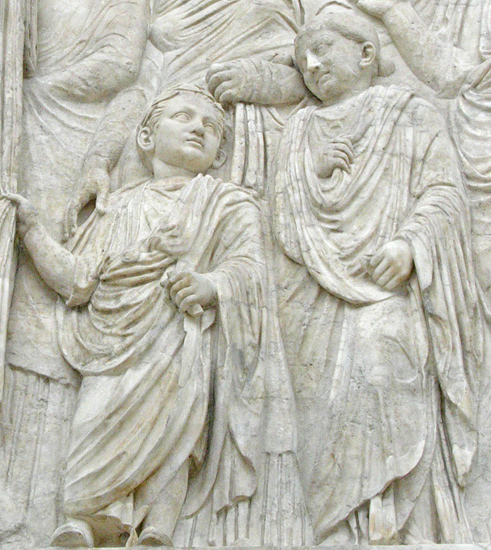
All citizen boys wore a bulla - a round amulet, made of either gold or leather (see this image of one of the boys on the Ara Pacis). This marked out their citizen status, but was also believed to protect them from harm.
Some historians have argued that these levels of infant mortality must have numbed the Romans, making them cold and unfeeling towards their children. Certainly, children were not always treated as we would expect in the modern world - child labour was expected, and some unwanted infants were exposed (i.e. left outside to either die or be taken by a slave trader). However, I would argue that the epigraphy gives us a very different picture. There are countless gravestones for children - to be expected with so many dying - and lots of them are heart-wrenching in what they say. Take this example, now in the Ashmolean Museum. The inscription lists how long the boy lived, even to the exact number of hours - how can we say he wasn't cared for? This case is even more interesting, in that the epitaph was set up by the boys owner, not his parent. Infant death, even of slave children, seems to have had an emotional effect on the whole household. There are a few more collected and translated here, if you have the stomach to read them.
So there you have it. The average Roman did not die in war or from lead poisoning. They died as babies: dirty, diseased or malnourished and in the arms of their desperate, grieving parents, who did not understand why this kept happening to them.
Sources and suggested reading:
Brown, P. (1988) The Body and Society: Men, Women and Sexual Renunciation in Early Christianity.
Frier, B. (1982) Roman life Expectancy: Ulpian’s Evidence. Harvard Studies in Classical Philology 86: 213-51
Harlow, M and Laurence, R. (eds.). (2010). A Cultural History of Childhood and Family in Antiquity. Oxford: Berg
Rawson, B. (2003). Children and Childhood in Roman Italy. Oxford: Oxford University Press
Edit: formatting.