https://upload.wikimedia.org/wikipedia/commons/8/8e/Wanli-Emperor.jpg https://en.wikipedia.org/wiki/Emperor_Wu_of_Jin#/media/File:Jin_Wu_Di.jpg
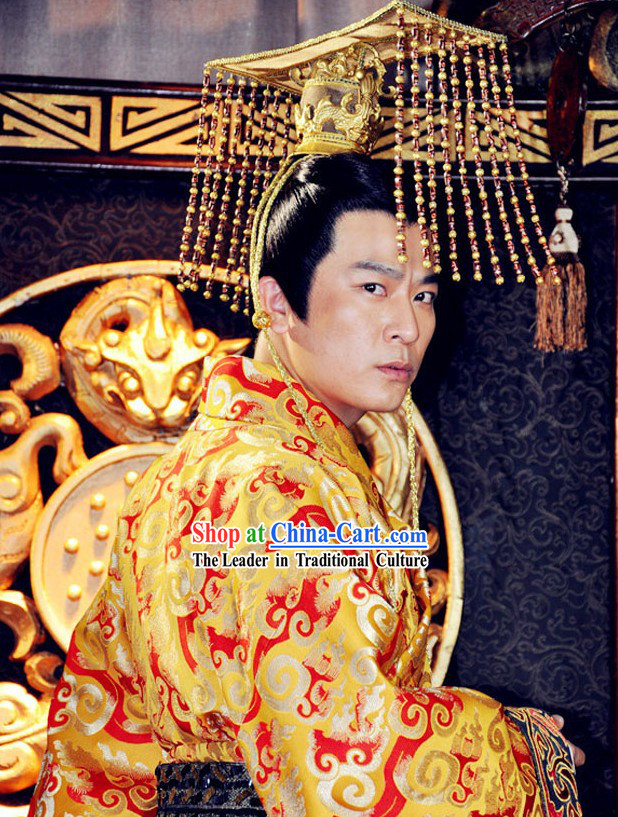
It seems to be around for a while, and I've noticed it in media portrayals of Imperial China. It seems now to be a stock image of what emperors wear: http://www.gettyimages.com/detail/photo/chinese-emperor-royalty-free-image/86170451 http://china-cart.com/bookpic/20125/2012522112412.jpg
So, what is with the beads? Why did they last so long, and how come not every emperor seems to have used that style? Was it specific to the Han Chinese? (It does not look like the Qing used it)
This specific headgear is called a mianguan (冕冠) (diagram), and was reserved for the most important ceremonial occasions. They're first attested in the 3rd century BC and were used all the way through to the end of the Ming dynasty -- as you point out, they finally fell out of use in the Qing.
In earlier periods, the mianguan was used by many officials, with their ranks being differentiated by the number of bead strings -- in the Han dynasty, the emperor would use 12, princes were allowed 9, high officers 7, low officers 5, and other scholars 3. The full set of 12 corresponds here to the 12 divisions of heaven.
Later on, the mianguan itself came to be restricted to the emperor himself, and an increasingly narrow set of ceremonial occasions; by the Ming dynasty it was used only on the emperor's coronation (Ming dynasty example), hence why it appears less frequently in later periods.
The position of the beads in front of the emperor's eyes served a couple of purposes. Hector (see below) notes, citing Gao Chunming: "These 'crowns with suspended tassels' (mian guan chui liu) were worn on ceremonial occasions to screen illustrious faces from direct frontal view, shielding the wearers’ eyes and facial expressions. While they provided wearers a separate semiprivate space, the tassels also served as mnemonic devices, reminding wearers to focus their eyes forward in a dignifed manner."
Additionally, a bead would hang next to each ear, with a similar function of reminding the emperor to listen carefully to each side.
Very little info on the topic is available in English, but there's a decent, if brief, discussion in Valerie Hector's 2013 article "Chinese Bead Curtains, Past and Present".