Okay, let's try again. I'm not searching for examples and the question doesn't involve the history of the American continent.
I repeat: I'm basically trying to understand how could the New World have been discovered without Columbus, but since alternate history questions aren't allowed...
... I'd like to know what "Old World stuff" was going on around the American continent in that second half of the 15th century, before Columbus expedition. Which were the nearest Old World presences?
I answered similar question already here
Relevant excerpt:
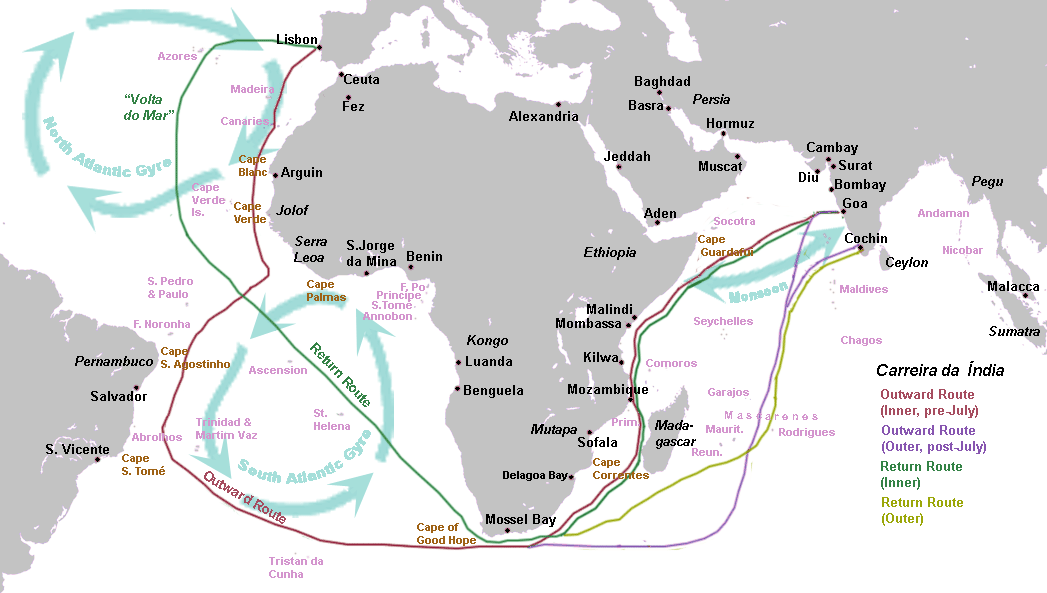
Now to the last question of what would happen if Columbus failed. While this is a what-if question, which means not suited for this sub, I can tell you that Brazil was discovered independently by the Portuguese in 1500. They stumbled upon it by following the best wind sail routes to go around the Cape of Good Hope. And the wind patterns and currents in that part of the oceans, make someone reaching Brazil almost a unavoidable occurrence if sailed regularly.
So even if Columbus' trip was a fluke of good luck, even if it had failed or he never returned, the Portuguese would have without doubt stumble upon Brazil on their way to India, as it actually happened in 1500 by Cabral's fleet.
Basically, Portuguese were doing a whole lot of sailing down to and around Africa, on their own and much before Columbus with reaching India in mind, and while we can't overrule the fact that Columbus finding something in the West might have emboldened them to in their journey travel more west then they would, the fact is just following the optimal path set by wind and current patterns would lead the expeditions to India to the coast of Brazil
Also for your question:
... I'd like to know what "Old World stuff" was going on around the American continent in that second half of the 15th century, before Columbus expedition. Which were the nearest Old World presences?
in addition to the answer above I will also add another story i touched on in another previous answer of mine, about Portugeuse attempts to sail directly West:
Some time after Columbus approached Portuguese king with his proposal and was rejected on the basis that his scientific reasoning is unsound (and an additional possible reason that his demand for financing and to be viceroy of the newly discovered region too much for Joao II to stomach), Joao II in 1486 gave permission to two of his subjects Fernao Dulmo together with Joao Afonso do Estreito to, on their own financing, go west and search for islands (mythical islands of Antilles and Islands of 7 citadels), and for thiy they will be rewarded standard discoverer rights (donatoria) which were substantial but much less then what columbus asked for. The expedition was in early stages of planning, set for March 1487, but then nothing more was heard about it, most probably it being abandoned or attempted and ended in failure.
Again this way of action was possibly encouraged by Columbus' proposal, but it does show there were other lines of reasoning why one would sail west (not to reach Asia but to reach islands thought to be there) floating around the exploration-minded Portuguese court, and possibly one would sooner or later decide and succeed in reaching Americas by this line of thought