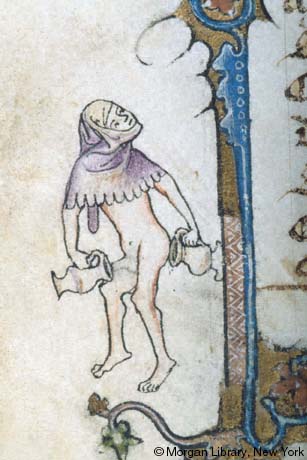
We've all seen the crazy illustrations that adorn some medieval manuscripts, but how were these regarded by the peers of the illustrators themselves? Were there like rules on what you could and could not draw? Or any testimonials of readers getting angry at particularly scandalous drawings?
Edit: autocorrect munged my title... were not we're
That particular butthole comes from the British Library MS Additional 49622, also known as the Gorleston Psalter (book of Psalms). It’s an early fourteenth-century book written in England, so I’ll keep the answer focused there.
Manuscripts in the middle ages were usually done on commission. For example, we have proof of a psalter being commissioned at a monastery in fourteenth-century Brittany in exchange for a specific amount of money, partly paid up front and partly paid on completion, including money for wine for the scribes, all to be done within a certain amount of time. In the earlier middle ages, scribal work was done entirely by monks or nuns in monastic scriptoriums (and that’s the case with this psalter), and in the later middle ages, secular scribal workshops in cities start cropping up. But in both periods, marginal illustrations worked more or less the same way: you paid for a certain number of illustrations before the actual writing began. You can notice signs of planning when you look at the manuscripts, because the scribe would plan text space before the illustrations went in, most of the time. For example, you’ll see an illustration that covers the tops of some of the letters in the line below it. Since they were planned, major illustrations were fairly specific to whatever the adjacent text was. With marginalia, the illuminators seem to have had more artistic freedom, because it tends to interact with the text a bit more, and you don’t see expensive ink and goldleaf used in it nearly as much. For example, here’s one example of fairly elaborate marginalia of a man pulling a block of text into place. The scribe seems to have planned the page badly (or wanted to look like he had), so the doodle-man is using a lasso to try to pull the text back into place. I use the example to point out that marginalia wasn’t quite as in-depth as obviously planned illustrations, but they could still be detailed and creative. Reading a medieval manuscript is much more of an interactive experience than the plain-text printed books we’re used to—they were expected to be almost like icons that you meditate on as much as read, and their readers were often only partially literate anyway, so visual aids to make things more interesting were common. It’s also worth keeping in mind that these things were very expensive to commission, and to some degree, a visually distinct manuscript was like a status symbol (we call these “display copies,” like the Duke of Gloucester’s book now known as Rylands English MS 1). The Gorleston Psalter is definitely one of these—if you look through the digitized manuscript in the link I posted above, you can see that the thing is lousy with illuminations and goldleaf, there are relatively few lines per page in big, set script, and there are entire pages devoted to illuminations.
But your question was about guidelines and supervision. There were definitely senior scribes and illustrators who oversaw the work of junior scribes in England. For scribes, the most famous example is none other than Geoffrey Chaucer, who writes an angry poem to his scribe Adam:
So ofte adaye I mot thy werk renewe, It to correcte and eke to rubbe and scrape, And al is thorugh thy negligence and rape.
Here, Chaucer the poet is angry that Adam’s work copying Chaucer’s poetry isn’t up to Chaucer’s standards, and he’s berating the scribe over the fact that Chaucer supposedly has to go back and correct all the mistakes Adam makes. There’s plenty of debate over whether Chaucer is being sincere or friendly/joking here, but the point is that yes, scribes oversaw one another. But this example comes from the later fourteenth-century, and Adam would have been working in one of the London scribal workshops, which were grouped in the same physical area as the illustrators’ workshops, tanners and parchment-makers, etc. All stages of urban book production tended to be grouped together.
Earlier monasteries operated a little differently, but the later secular scribes looked back to monks as models for their work. Because work in a scriptorium was long and hard in a cold, dark room (as several monks scribble in the margins themselves), multiple monks or nuns might work on a single book, and we can tell where a more senior monk supervised others because his handwriting (or just “hand”) generally makes fewer mistakes than his colleagues and will make corrections over their work from time to time. In the psalter you linked, though, if you look through the pages you’ll see that it’s not an isolated case. Nearly every single page has some kind of bizarre figure in the margins, ranging from knights dueling snails to disembodied heads with chicken legs to…well, you get the idea. A lot of money went into this psalter—the doodles are deliberate. What purpose they serve is kind of an ongoing debate, since we don’t have a blunt explanation about them, but because this is a religious text, one suggestion I’ve seen is that they’re supposed to be distractions that tempt you to look away from the sacred text and waste your time quietly laughing at the buttholes. The “green man” faces you see in some cathedrals serve the same purpose. You’re supposed to temper your will and stay focused on what matters instead of getting distracted and indulging your curiosity. In the cases of more obviously demonic or devilish figures, it’s more obvious that these were artistic renditions imagined by monks that they (and presumably the readers) expected they could realistically be confronted with in hell.
As for corrections in illustrations, there seems to be a lot more care taken with them, since it’s a lot harder to correct an image than just scraping out part of a word in the text, so the only examples I know of are illustrations changed after the product was finished. One example is the poem [Th]e Wench [Th]at Loved a King about a king and a sex worker that has the entirety of the text rubbed out, including the image, but you can still see the imprint of two horizontal figures lying side by side and let your imagination fill in the gaps. (Edinburgh, National Library of Scotland, MS Advocates 19.2.1, fol. 256vb.)
Back to this particular butthole in the link, I’m not very familiar with the book, so I’d love for someone else to chime in, but I can give a semi-educated guess. But keeping in mind that doodles like that were usually expected to be related to the text in some way, my first thought was that it could be King Saul. In 1 Samuel 24 of the Bible, while the future King David is leading a rebellion against the sinful King Saul, there’s a famous scene where Saul goes to “relieve himself” in a cave where David’s army happens to be hiding out. David sneaks up on Saul while the latter is, uh, mid-act, and cuts off part of his big royal cloak, like the one you see in the marginalia there. Later that day, when the two armies are standing off, David holds up the scrap of cloth to let Saul know he could have killed them if he wanted, and the two come to a truce (spoiler: it doesn’t last). The story would have had a special appeal for medieval people who are all about the idea that subordinates shouldn’t kill the people God put in charge of them, and that paired with the fact that monks had a generally dirty sense of humor makes it sound like a possibility to me.
I’m away from the library right now, but I’ll edit in a few more specific references later today!
Sources and further reading for now: