(Admittedly, there is the probability that at least some of the actual pilgrims were there more to see the aurora. More significant is that our reports of the events come from educated authors in London and Paris, a better parellel to our early medieval Bishop of Tours.)
Tell me stories about humans' relationship with air and space!
Next week: Unifications and Unions
Famously, the Aurora Borealis were seen in Northern Virginia on the night of December 14, 1862, after Robert E. Lee's great victory at Fredericksburg, a stinging reverse for the Union; while US troops saw the heavens mourning, some Confederates reveled in the sky itself celebrating their victory with streamers of fire.
What's that up there in the skies of Japan? Is it a plane? Is it a bird? No, it's Saigō Takamori!
In 1877, during the Satsuma Rebellion (Seinan War), rebel leader Saigō Takamori literally ascended to the heavens, at least in the public imagination. The following is from Mark Ravina's biography of Saigō .
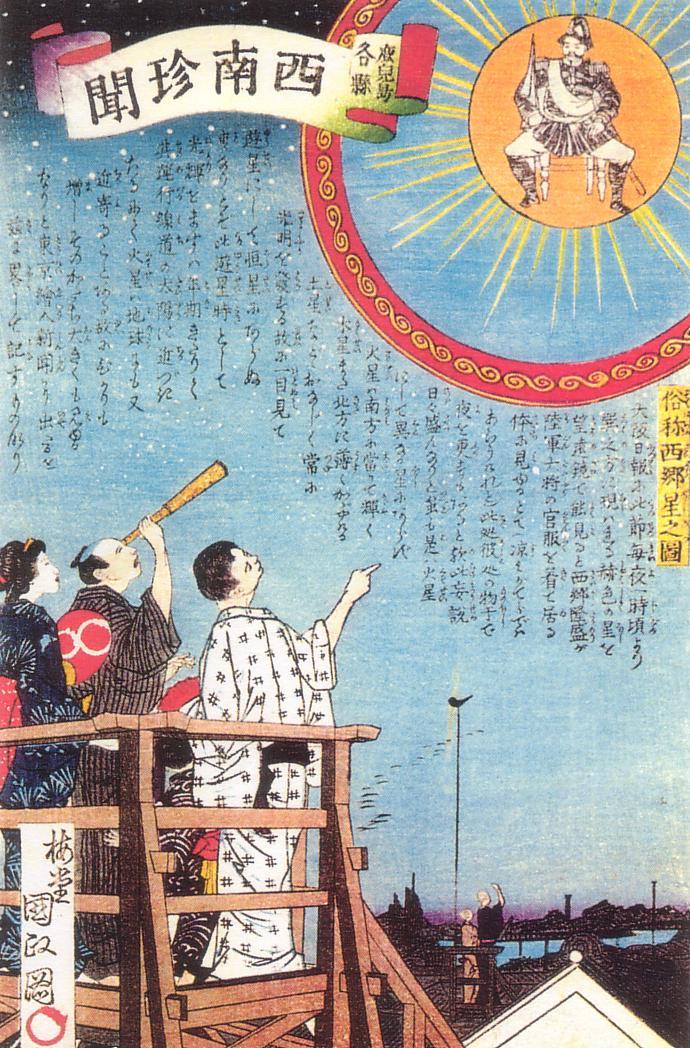
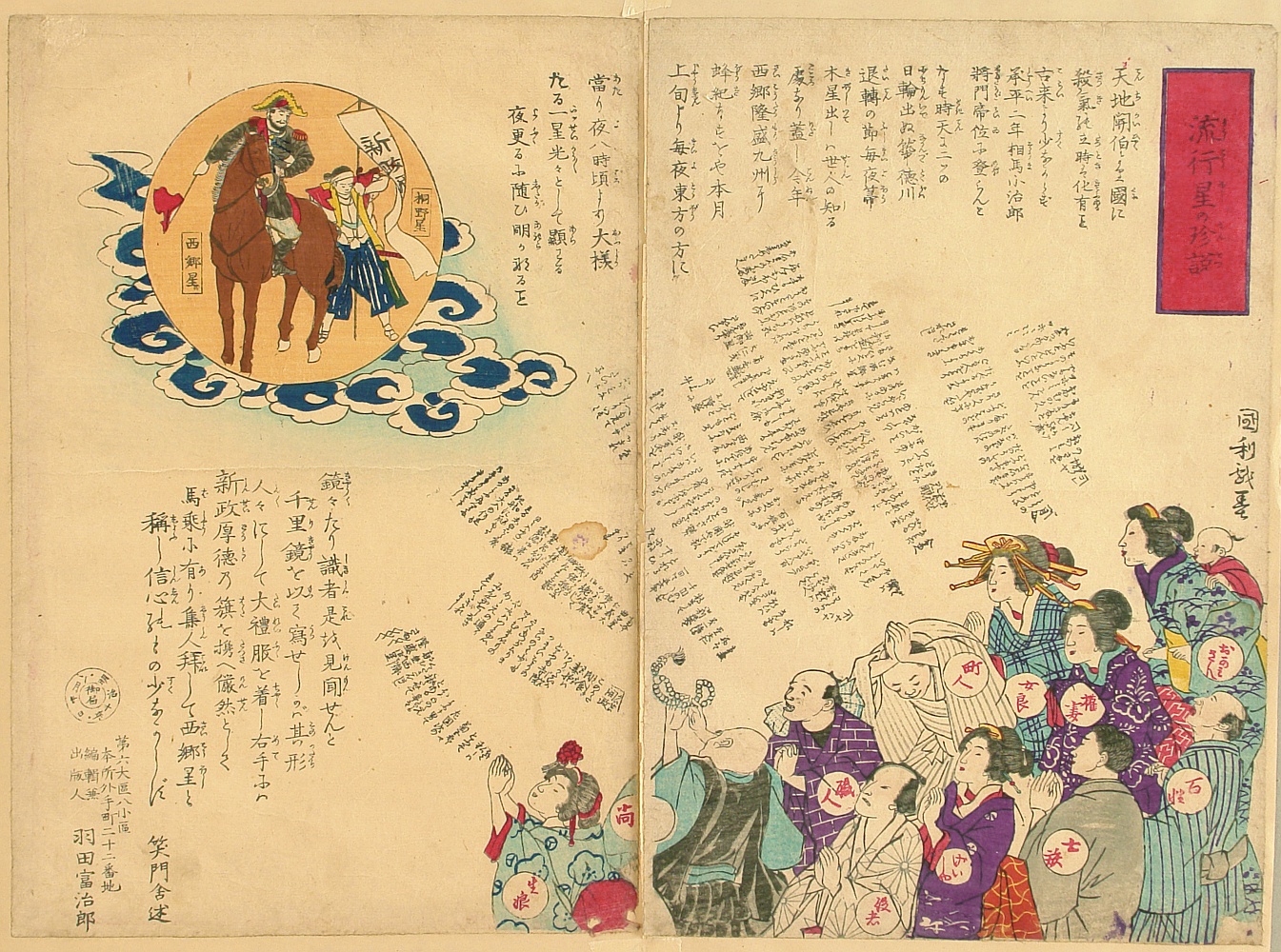
So powerful was Saigō's appeal that he was transformed into a demigod even before his death. Most Japanese newspapers dutifully reported the defeat of Saigō the “traitor” and celebrated the victory of the Japanese army. But Saigō's enormous popularity leaked through the constraints of government censorship. In the popular mind, Saigō's defeat was actually part of his ascent to the heavens. In Osaka, tales of Saigō’s ascent to the stars first appeared in August 1877, while Saigō was in eastern Kyūshū. In the early morning of August 2 a comet appeared in the southwestern sky. On August 3 the Ōsaka Nippō newspaper reported that when examined with a telescope, this “bright star” revealed a portrait of Saigō: healthy, fit, and in full imperial army uniform.This story swept through the city, and night after night people stood on their laundry-drying platforms to get a better look at the celestial hero. Woodblock prints soon appeared showing Saigō, ensconced in a star, looking down at Japan from the heavens.
Woodprint of exactly that by Baido Kunimasa, 1877
Saigō skywatching swept Japan, with the religiously-tinged craze spreading to Tokyo, and at least one roof collapsing under the watchers. The exact form of his apotheosis was debated. Comet or planet?
Saigō's ascent to the heavens was supported by other astronomical phenomena. In August and September 1877 the earth and Mars were in unusual proximity, and Mars glowed with exceptional brightness. On August 19 the Chōya shinbun reported that Saigō, burning with anger, had been transformed into the planet Mars.That same month the Japanese press reported that the American astronomer Asaph Hall had discovered a satellite around Mars. For Saigō loyalists this moon was none other than Saigō’s loyal companion Kirino, who had accompanied his friend into the heavens.
With the whole exploration thing in the 1400s the Portuguese naturally had a very close relationship with the stars, mapping the skies, making charts, developing navigation yadi-yadi-ya... you know the boring, useful stuff.
What is interesting is the strong, and by today's standard really unusual relationship between religion, science and what is now consider a pseudo science and superstitious hoax - astrology - but which seemed to be very popular especially among many of the scholars and "educated" of the time
So we have the instance of Azurara, the chronicler of the early exploratory voyages (well, glorified slave raids as Azurara describes) of Infante Henrique aka Henry the Navigator, and his writing on why exactly Henry decided to start his pursue of reaching Africa. After presenting a series of reasonable points, all based on various political, military, religious and economic motivations of the time and circumstances, the writer proudly adds his own observation on why he feels his patron Henry was predestined for success
But over and above these five reasons I have a sixth that would seem to be the root from which all the others proceeded: and this is the inclination of the heavenly wheels.
For, as I wrote not many days ago in a letter I sent to the Lord King, that although it be written that the wise man shall be Lord of the stars, and that the courses of the planets (according to the true estimate of the holy doctors) cannot cause the good man to stumble; yet it is manifest that they are bodies ordained in the secret counsels of our Lord God and run by a fixed measure, appointed to different ends, which are revealed to men by his grace, through whose influence bodies of the lower order are inclined to certain passions. And if it be a fact, speaking as a Catholic, that the contrary predestinations of the wheels of heaven can be avoided by natural judgment with the aid of a certain divine grace, much more does it stand to reason that those who are predestined to good fortune, by the help of this same grace, will not only follow their course but even add a far greater increase to themselves.
But here I wish to tell you how by the constraint of the influence of nature this glorious Prince was inclined to those actions of his. And that was because his ascendent was Aries, which is the house of Mars and exaltation of the sun, and his lord in the XIth house, in company of the sun. And because the said Mars was in Aquarius, which is the house of Saturn, and in the mansion of hope, it signified that this Lord should toil at high and mighty conquests, especially in seeking out things that were hidden from other men and secret, according to the nature of Saturn, in whose house he is. And the fact of his being accompanied by the sun, as I said, and the sun being in the house of Jupiter, signified that all his traffick and his conquests would be loyally carried out, according to the good pleasure of his king and lord
beyond telling us that the reason Europe discovered the world was because luckily Henry was an Aries, the passage i emphasized above shows a really interesting insight in how did the local scholar and intellectual manage to justify and merge all the conflicting theories and beliefs into a big mash of his predefined personal belief
Source: The Chronicle of the Discovery and Conquest of Guinea, Vol. I, Chapter VII by Gomes Eannes de Azurara
The Aurora Australis has typical tales of blood or fire in the sky being omens of the gods, but I do like this paticular tale from the Maori:
The Maori of Aotearoa/New Zealand saw aurorae (Tahunui-a-rangi) as the campfires of ancestors reflected in the sky. These ancestors sailed southward in their canoes and settled on a land of ice in the far south. The southern lights let people know they will one day return.
http://theconversation.com/fire-in-the-sky-the-southern-lights-in-indigenous-oral-traditions-39113
An eclipse of the Sun is a terrifying (and thrilling) event, as Americans can confirm.
Herodotus says that an eclipse interrupted a great battle between the Medes and the Libyans. Both armies were so terrified that they stopped fighting and agreed to a truce. The eclipse had been predicted by Thales, one of the pre-Socratic philosophers.
Scientists today think if this event happened, it was an annular solar eclipse that occurred on May 28, 585 BC and passed over Anatolia.
This is all according to Herodotus and is well before the Persian wars, so take it with a grain of salt.
The Irish monks who compiled the various annals that are among my principle primary sources were very attentive towards celestial and climactic oddities in the skies. Funnily enough, this is the first topic I ever wrote a full length research paper on in my undergrad :). While thumbing through a couple of annals, I noticed that besides important deaths, battles and wars, these texts often contained detailed descriptions (well, "detailed" for this genre of text) of odd cloud formations, stars that had been spotted at unexpected times of the day and of eclipses.
To give you an example, the Annals of Ulster records throughout the 760s terse notices of the passings of several kings and abbots as well as which kingdoms won which battles, before stating that in 765; "A horrible and wonderful sign was seen in the stars at night." Other texts like the Fragmentary Annals of Ireland describe events such as "Three shields were seen as if fighting in the sky, from east to west, like tossing waves, on the tranquil night of the Ascension of the Lord. The first was snowy, the second fiery, the third bloody...", while another entry common to many annals records the sighting of a star at the third, seventh, eighth etc. hour of the day
So why were Irish monks so interested in recording and interpreting celestial events? Because they believed that the world was gonna end at any moment, and they were recording portents of the apocalypse for posterity. That was just a reality of everyday life for most faithful Christians in the early middle ages. Many of these weird things reported by Irish annals are actually word-for-word copies of events portended in the Book of Revelation. For example, in 866 it is said that "Loch Lebinn turned into blood, so that it became clots of gore like lungs"; compare that to this passage from the Book of Revelation, 16:4: "Then the third angel poured out his bowl into the rivers and springs of water, and they turned to blood."
So the early medieval Irish monks who compiled these texts were recording bizarre events that were witnessed and interpreted them as signs of the apocalypse, which they sincerely believed might occur at any moment. By keeping track of the weird celestial and climactic things that people had reported, they could compare those oddities to the signs foretold in Revelation so that they would know if the apocalypse was really coming around the corner. A lot of these entries come from the viking age, which might have seen apocalyptic in itself for the Irish clergy!
Dunno if this is the right place to ask, but I'd like to see a post like this about borders, IE, how would a border crossing in your era along a major road function. Thanks!
The seventeenth-century Englishman is superstitious. I wrote on this forum recently about witchcraft, but the belief in magic is a more general phenomenon. The branch of magic pertaining to the heavenly spheres is astrology, and astrology is the reason that many of the early modern texts on the sky were written. In the seventeenth-century, you could be a believer astrology whether you were tucked away in rural England or ruling over the entire country. Henry VIII and Charles II are just two of the more famous kings to have taken astrological counsel. Many of the monarchs and aristocrats in Britain would have had an interest in their “nativities” being divined.
Astrology has a long existence before the seventeenth-century and it would be hard to identify a movement truly native to England. Many of the texts used in seventeenth-century astrology were translations of uncredited Ptolemaic and Arab texts. Otherwise, English texts borrowed significantly from them. Like in earlier times, astrology flourished in seventeenth-century England because, in the words of Keith Thomas, it constituted “man’s picture of the universe and its workings” (285). Its one great advantage over what was to prove eventually its successor - astronomy - was its explanatory power. To quote Thomas again, “the primary reason for the appeal of astrological explanation was… an intellectual one: its provision of a complete and comprehensive system of thoughts” (330).
Despite its significant borrowings from earlier texts, the field of astrology, especially in the latter half of the seventeenth-century, was surprisingly diverse. This is because it began to borrow from the field of natural science, which was experiencing an Enlightenment-era Moore’s law. By the end of the seventeenth-century, the precision of mathematics allowed the astrologer to pick out events and personalities from the future with a subtlety and discrimination impossible at the turn of the century. This relationship between developments in maths and developments in astrology was not the only such relationship. Another example of astrological sophistication being commensurate with that of other fields is in the relationship between medicine and astrology. Medical astrologers claimed that they could divine the consequences of maladies. The function of doctor and divine had long been combined in rural communities, where white-magic could be used to heal (see my post on witchcraft for slightly more on this). With the astrologer, however, one sees a codification of techniques and observations which has no parallel in the practice of white-magic medicine. Some astrological healers, such as Richard Napier, remain famous today.
Astrology’s explanations thus borrowed from the grounded empiricism of the natural sciences as the descriptive power of the latter increased, but advanced a predictive aspect that the natural sciences could not hope to replace.
What goes for Portugal in /u/terminus-trantor’s post – that is, the closeness of science and astrology – goes for England. In England, the two systems of thought are mutually supportive. From astrology to science, I note that Copernicus’ theories would have first reached many readers through Thomas Digges’ Prognostication, published towards the end of the sixteenth-century. This book was a kind of hodge-podge of astronomical speculation and astrological derivation. In the other direction, Brahe is amongst the authorities that Christopher Heydon, somewhat disingenuously I think, marshals to the defence of astrology in his A defence of judiciall astrologie.
The seventeenth-century also sees the rise of an independent scientific discourse. There are better people than I hanging around on this forum to tell the history of science – no doubt there is a history to tell. Some of the more eminent names include Jeremiah Horrocks, Richard Townley, and John Flamsteed, the last of which made the first known observation of Uranus. For a variety of reasons, much of the work of these men was not published until after their deaths. By the time their works were published, in the late seventeenth- and early eighteenth-centuries, they would have contributed to an entire field of de facto scientific discourse that had been going strong since the mid-1600s. In 1655, the Royal Society published the first copy of its Philosohpical Transactions. The first three articles therein were: “An Accompt [account] of the Improvement of Optick Glasses”, “A Spot in One of the Belts of Jupiter”, and “The Motion of the Late Comet Praedicted [sic]”.