Are there any examples left? Like poor quality maille/plate and weapons? How much cheaper/affordable would these things have been?
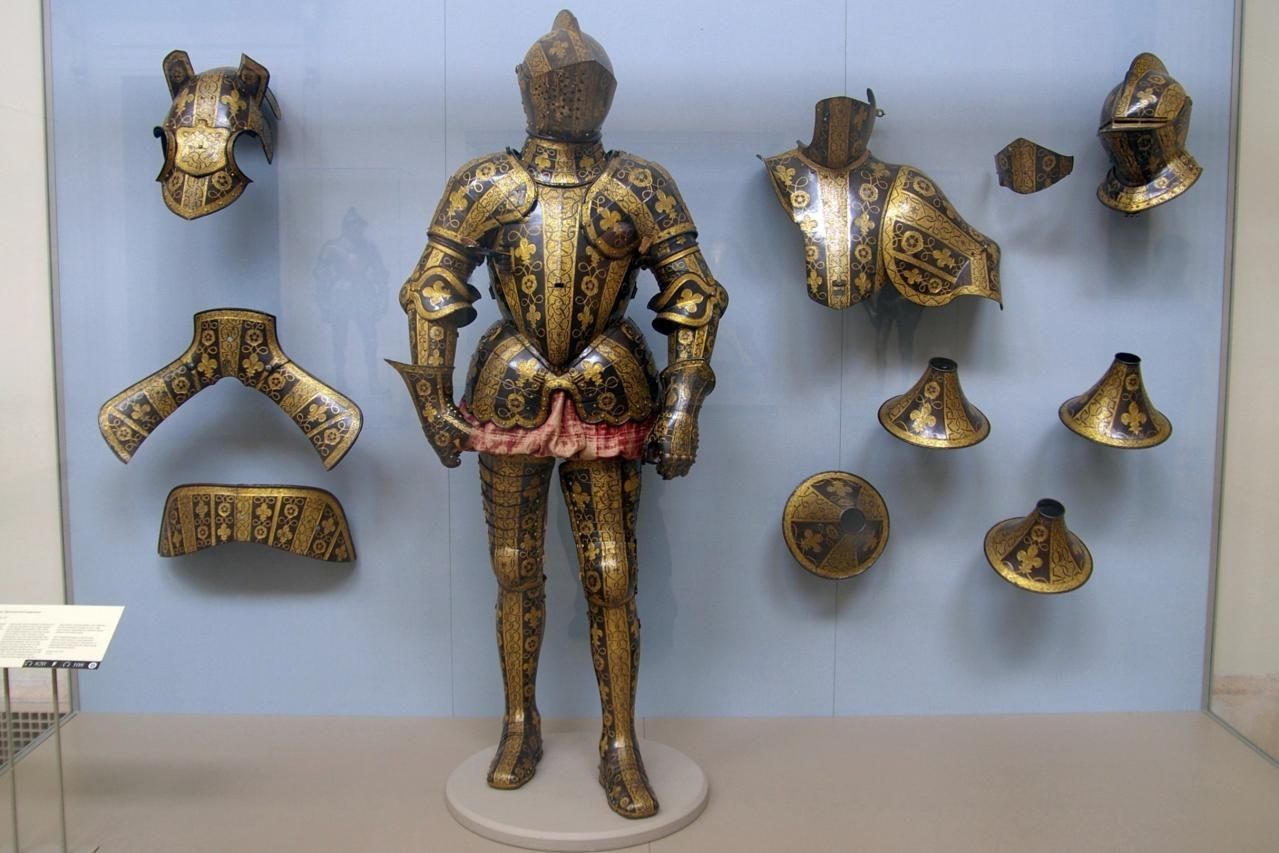
This all depends by what you mean by 'the good stuff.' Do you mean the armour of kings and the upper nobility? In the 16th century this meant gilt and decorated garnitures with 50 pieces of exchange that allowed you to assemble coordinated mix-and-match set of armour for all occasions. In the days prior to that, royal armour would mean gilding applied in various ways, unusually symmetrical, and etched, engraved and applied decoration. To get an idea of what this is like, I talk about the armour of dukes and kings here. The armour below this 'grade' would be the full armour of a lesser knight, esquire or untitled man-at-arms. Keep in mind, these are still wealthy and socially connected men - they just aren't among the wealthiest in the land. The 10% or 5%, not the 1%, to use modern terms. Functionally one of these armours would be nearly identical to the armour of a wealthier man. It might be older on average: while kings could commission a new harness for every campaign, your local esquire wouldn't necessarily do so. They may be somewhat less protective, though this is not guaranteed. In the 15th century The less expensive armours of less exalted soldiers might be less likely to be less likely to be heat treated. Armours without armourers marks were less likely to be heat treated than the (presumably more expensive) marked armours. But a surprising number of even infantryman's armours from 15th century Italy and Germany are heat treated, so the quality of the metal itself might be better than you'd think. I talk about the difficulty of determining armour quality here. One big difference, though, is that less expensive full armours would not likely not be custom made. Tobias Capwell looked at English funerary monuments (images of the deceased, erected in churches to remind people to pray for them) and various records, and finds that the armour worn by knights depicted in less expensive forms of monument (brasses and incised slabs - two dimensional monuments) are more 'foreign' than the armours depicted in the expensive alabaster full-relief funerary effigies. Looking at purchase records, it seems that the reason for this is that less wealthy men at arms were being equipped with mass-produced armour from Milan, while their titled superiors (the elite of the elite) were buying custom armours from English armourers. A custom armour would be much better fitting, which would make movement easier and more comfortable than an armour that was bought 'off the rack' in a general size and then customized in some minor way. Think of it as the difference between bespoke and off-the rack (but still tailored) clothing.
The difference in cost between the mid-grade 'off the rack' armour and the custom armour could be very large. Capwell quotes prices of 20 pounds or more for custom armour from London armourers, and I have seen prices as low as a bit over 3 pounds for armours mass-ordered from Milan (I have heard even lower prices, but I don't have solid documentation for these). The armours of kings could be even more expensive, costing many dozens of times the cost of a man-at-arms full armour.
But the average man at arms is still a member of the military elite. So if by 'not enough money for the good stuff' you mean 'not part of the military aristocracy' then that opens up the question of infantray armour. Keep in mind that infantryman in late medieval armies were often socially connected and came from some degree of money (at least in late medieval England); they were not the lowest wrung of medieval society by any means, and they were often equipped by their patrons, commanders, or cities, as well as providing their own equipment. Infantry armours change a lot over the middle ages. In general they are not complete, generally leaving the lower and face exposed, and possibly protecting only the torso and head; keep in mind that some soldiers would simply be unarmoured as well. Depending on the time and place infantry armour could be made of large plates, small plates riveted to a backing (brigandine), cloth or mail. It's such a diverse topic that I'll link you to a number of older answers to give you a taste of what it could be like in different times and places:
To give you a rough idea of cost, I mentioned above that a wealthy knight or lord's custom armour might cost 20 pounds sterling in 15th century England. An untitled man at arms' 'off the rack' Italian armour might cost 3 pounds. And the brigandine of an archer would cost 17 shillings, a bit under a pound sterling. In terms of an archers' wages, this corresponds to over a year's wages, four months' wages and a bit over a month's wages. I hope this gives you an idea of the cost scale.