Not really. There were some efforts by Hong Kong local elites. In the 1960's a few parties like the Democratic Self-Government Party of Hong Kong were founded with goals of democracy and self-governance. But involvement was limited to few liberal-minded elites, who didn't even agree among themselves. The party soon fractured into even less significant parties. As such, their efforts never developed into a social movement. Petitions to the UN to push for self-governance were quietly buried. The push to self-governance was ultimately too weak to shake the grasp of the colonial government and came to nothing.
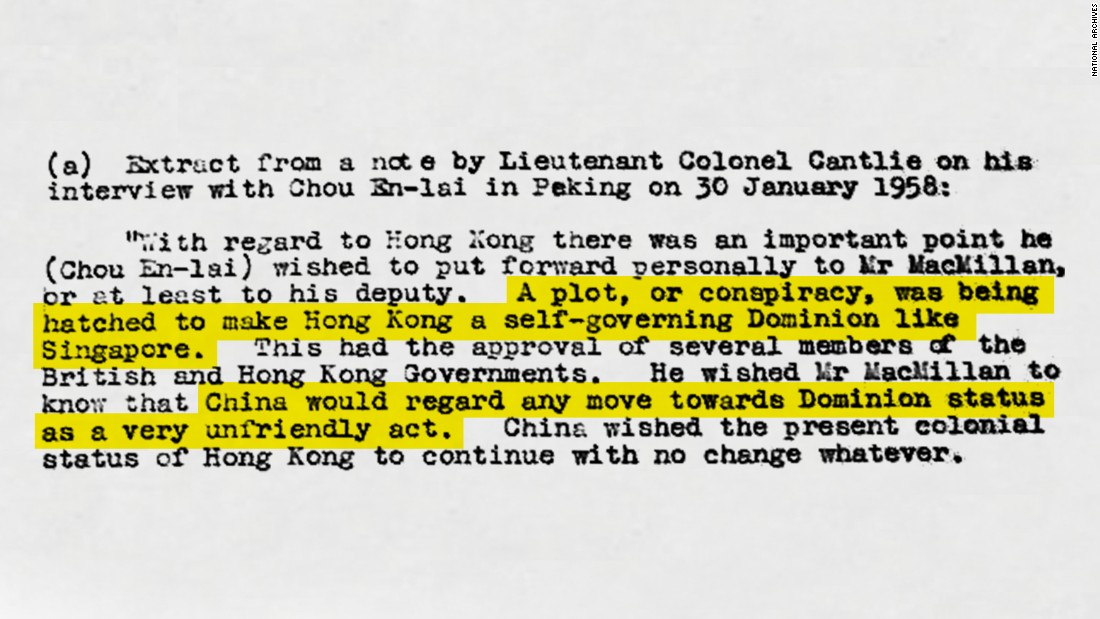
The greatest obstacle to self-governance of colonial Hong Kong was in fact China. The PRC government made clear early that independence was not an option. China always saw the treaties that ceded Hong Kong to Britain as unequal treaties, and wanted nothing less of recovering sovereignty over Hong Kong and Macau. In 1958, Zhou Enlai, Premier of China, stated that China would regard "any move towards Dominion status (like Singapore) as a very unfriendly act." In 1972 China pushed to have Hong Kong taken off the UN's list of Trust and Non-Self-Governing Territories, thus ending the potential involvement of the UN to grant Hong Kong eventual independence. There were British MPs that sympathized with Hong Kong's status, but they knew that Hong Kong's proximity to China would doom any push for independence. Britain was simply in no position to defend Hong Kong's interest if they crossed China's bottom line.
The negotiation really got going between the Britain and China in 1982, when British Prime Minister Margaret Thatcher visited China. During the secret negotiations, the British representatives floated the idea of continuing British governance after handing Hong Kong back to China. It was quickly turned down, as China saw no point in allowing British involvement past 1997. On the other hand, both sides saw the danger of losing confidence in Hong Kong if its future status remained unclear. Few people in Hong Kong trusted the Communist China to govern Hong Kong, and the risk of a massive exodus was high.
China wanted Hong Kong, but also wanted Hong Kong to remain prosperous. Britain was mostly concerned with its moral obligation towards her colony. The solution then, was to turn Hong Kong into a Special Administrative Region, granting it independence in most matters except for foreign affairs and national defence. That's the "One Country, Two Systems" that defined Hong Kong today. It achieved the goal of returning Hong Kong to China, while dispelling some of the worst fears about the handover. The Joint Declaration in 1984 largely ended the uncertainty about the future. Many in Hong Kong were not happy about being left out of the negotiation process, but from that point onward there were no meaningful efforts to push for full independence. Even after China's bloody suppression in 1989 scared the hell out of Hong Kong, no re-negotiation of Hong Kong's handover ever came back to the table.
So in short, the idea of "One Country, Two Systems" in the Hong Kong Special Administrative Region was not proposed to placate any call for independence. It was a pragmatic compromise to ensure Chinese sovereignty without severely undermining confidence in Hong Kong's future. China got what she wanted most. Britain could show the world that she tried to negotiate for large degree of autonomy for Hong Kong. Hong Kong populace largely remained wary of the handover throughout the 80's and 90's, but they had no voice in this matter and their only options were to stay or leave, and many did leave in the 90's.