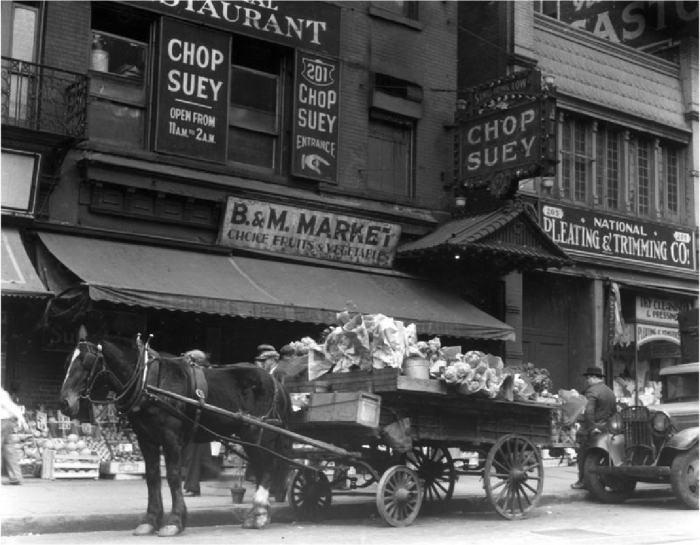
American Chinese food actually has a lot of influences beyond Toisan (or Taishan) and could be more properly encapsulated by looking at the 4 areas of Sze Yup (Toisan, Xinhui, Enping, and Kaiping), which refers to a specific region in Guangdong where many of the Cantonese speaking immigrants that originally came to America hail from.
For much of America's history, immigrants from this region as well as nearby Hong Kong made up the majority of the Chinese diaspora living in California, New York, New Jersey, Texas, etc. They came by the tens of thousands and settled in various Chinatowns, participated in the Gold Rush, worked on the infamous railroads, labored in sweatshops, built businesses, and faced much hardship along the way. By and large, these early Chinese immigrants were from the same towns and villages, all spoke Cantonese, and ate the same food.
Even as late as 1987, it seems that a whopping half of Chinese Americans still claimed Toisan heritage.
Thus, it seems natural that the regional cuisine has a major influence on the development of Chinese American cooking. It isn't that the location of Toisan itself is regarded as important but the fact that immigrants who came to America were largely from the Sze Yup area and restaurants that catered to these clientele wanted to give them comfort food that reminded them of home. The lack of proper ingredients that forced cooks to improvise in the beginning of Chinese immigrant history is what created the eclectic fusion of cuisines.
But it would be wrong to say that Toisan is the main origin of all Chinese American food. I should use this spot as a disclaimer that origins of dishes or food history in general can be extremely divisive since many people/places/institutions can and do argue about the 'true' origin or creator of foods, drinks, styles, and everything else. So unless the creation or origin of something is very clearly documented, much of it is derived from oral or cultural histories where accounts can be muddy if not totally at odds with each other. Keeping this fundamental uncertainty in mind, let us continue!
By the mid 1990s, much of Chinese-American food that modern Americans would be familiar with had already changed a great deal from the earlier days of what the earliest immigrants would have been serving in their restaurants. The reason for this is two fold. First is that cuisine is not static and of course availability of ingredients, cultural tastes, the audience, and trends change as time passes. Second, the Toisan/Cantonese majority for much of Chinese-American history was displaced by the massive influx of Chinese immigrants during the 1980s and 1990s.
An aprox. 400,000 Chinese American population of the 1970s nearly quadrupled in size by the opening of the 1990s.
Many of these Chinese immigrants hailed from other regions of China whereas before it had been dominated by Cantonese speakers from southern Guangdong and its neighbors but also increased the populations of those nearby neighbors of Hunan and Fujian. Noticeably, Hunan and Fujian tastes and cooking traditions have also had large effects on what we consider to be Chinese-American cuisine today.
For example, the modern iteration of 'orange chicken' or 'sesame chicken' are generally attributed to Hunan cooks/regional cuisine rather than Toisan or the other venerable regions of Sze Yup, though some have claimed that the Xinhui tradition of being known for using oranges as aromatics has had influence on the development of some variations.
Chop suey restaurants and the food they serve have similarly evolved over time and created endless variations and derivations. Chop suey in and of itself is not a dish that has a set list of ingredients or form of preparation but is a general style of preparation for whatever bits and pieces are lying around in the kitchen pantry. The name itself 雜碎 in Cantonese literally means "mixed pieces", with 碎 in particular having a bit of a connotation of leftovers or inconsequential things.
This belies the history of when Chinese immigrants simply combined whatever was on hand (even if it was simply cheap scraps that most people would ignore or throw away) to make something edible.
Parallels could also be drawn to the Korean dish of bibimbap, which literally means mixed rice and is also a dish that is seen as a combination of odds and ends pulled together to make food.
Chow mein is similar in that it literally means "fried noodles" and the variations that were created in America have differed a great deal from place to place (especially East Coast vs West Coast) over time. While there are 'staples' for different areas, ingredients, preparation, and modifications can all differ greatly.
Finally, with the broad acceptance of Chinese and Chinese-American cuisine, the line has been blurred a great deal as to what is simply Chinese cuisine and what is Chinese-American cuisine. This is because many Chinese Americans would return to their hometowns and either settle back down or visit on a regular basis. Some would bring back Chinese-American cooking derivations and these sometimes influenced mainland cuisine as well. But also because as newer iterations of dishes or cuisine are pushed out, it's becoming more and more difficult to say what is decisively Chinese or Chinese-American except by accepting various levels of arbitrary categorization.
I hope this has been a helpful primer! Let me know if you have any more specific questions and I'll try to point you in the right direction even if I can't personally help you!