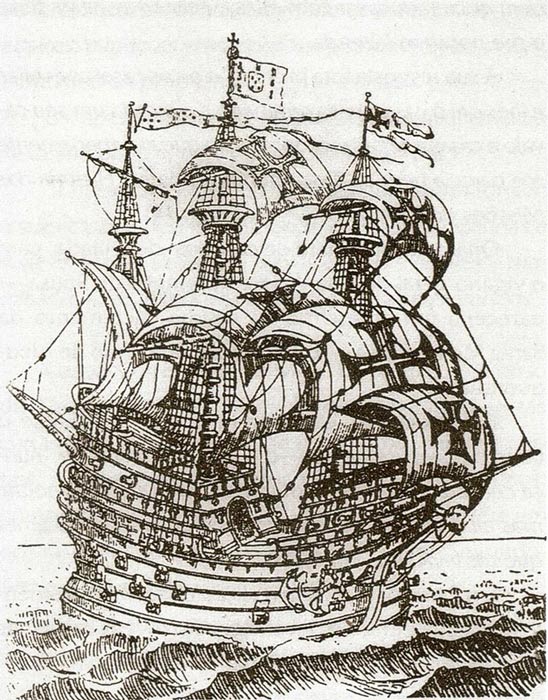
I've been finding conflicting sources on manpower needed to sail ships. The common theme seems to be that sources dealing with millitary history always report crews in the upper tens/lower hundreds (70-150 roughly), while accounts on merchant ships report way below that, sometimes even 15 men for a caravel.
What was the criteria upon which the captains decided the amount of crew they hired, if both 150 and 15 men are viable manpower on the same ship?
What else affected the minimum manpower? Did sail type changes, or rigging improvements make bigger reductions? How much impact did the invention of gaff rigging make? Could there have been caravels with front-aft sail plan and outfitted with either a lug or gaff mizzenmast?
Hi,
well the first thing I want to mention is that the caravel is not the same as Nau, size being one of the main differences (and not the only one) and different crew complements should not be strange.
While Nau is a term that literally just means ship (and which is why many contemporary textual documents just use Nau as blanket term for most ships creating much confusion), in the Age of Discovery it usually means specifically a type of ship that would be what was called a Carrack, which was (sometimes much) larger then caravel (more about this later).
As a second thing i want to give a disclaimer that we do not have a clear idea of the exact looks and specifications of any of the ships we are talking about in the 15th and first half of 16th century. We have some textual descriptions, some tiny paintings but no actual shipbuilding treatises or surviving examples to be able to be certain. Lists of ships we do have usually just give the various names of types, if we are lucky also the size or number of masts or crew number, but usually never all together to be able to piece together anything more substantial.
Finally it is important to know the size and looks of the ships being called the same type varied a lot from ship to ship in any one point of time, and additionally changed through the history.
That all being said let's look at what we do know about the ships.
The Portuguese caravel had through most of its existence pretty standard crew size of between 20 and 30, and the average size of 50-70 tonnes (there is some confusion about the way sizes were reported, sometimes it refers to amount of cargo a ship can take, sometimes about the displacement, tonnes is not the same as tons). It remained pretty much so throughout it's usage since the 1430s to the late 16th century, with the only change the switch to square sails on front masts instead of lateen sails for ocean travel, and the ever increasing artillery on it. The reason it didn't change much is because this size was considered perfect for the purpose of the ship. it was really fast and really maneuverable for a sailing ship, it was both large enough to withstand ocean and small enough to sail very near the shore and into some rivers. Of course the growing commerce meant the small size made it inadequate for shipping growing large quantities of people and goods, which is why the Nau was used and further developed
Tha Portuguese Nau experienced a shift to bigger sizes throughout the 16th century. Let's say the from typically around 100-200-300 tons size in the early stages of the 16th century to juggernauts of over 1000 tons towards the end. This doesn't mean that smaller Naus weren't used anymore on the contrary. But there was a push for larger and larger ships.
Smaller naus for instance wouldn't have such larger crews. For example the famous Columbus first expedition, the carrack Santa Maria was only slightly larger then the two caravels, and had 40 crew in contrast to approx. 25 each of the caravels.
Larger sizes warranted more sail area for the ship to move, meaning it was necessary to have larger sails and even more masts for additional sails.
Here are some contemporary illustrations we have of: a caravel, and a Nau. Modern reconstructive illustrations also show this in slightly more clear resolution: caravel vs nau. I am not really good in ship terminology, but there is a clear difference in number and size of masts and sails, the addition of the "top" sail and forward sail etc. All this meant more and more crew members.
Some other considerations for analyzing crew sizes include their purpose and voyage destination. Ships destined to be used for long voyages as Carreira da Índia, also had to account for losing a (large) part of the crew to storms, disease, scurvy, so you definitely had to have more then minimum crew. On the other hand a caravel running from Portugal to Madeira, a fairly routine journey, didn't have to have such considerations.
Additionally you must also examine if your sources count the number of soldiers on board as part of crew or not, as again royal ships, especially larger, had troops on board just in case and even more when expecting trouble. More and more artillery also meant bigger gun crews, also increasing the crew needed.
For additional info, you can ask additional questions or look at my AH user page for list of some similar questions I already answered and a list of sources you might want to read, which i now link here:
Cogs, Caravels and Galleons by Richard Unger. This book is probably the all-encompassing source with most detailed information, as well as illustrations and various other technical data
Galleons and galleys by John Guilmartin - less academic but informative and good introductory read
Spain's Men of the Sea: Daily Life on the Indies Fleets in the Sixteenth Century by Pérez-Mallaína - this is more about sailors then ships themselves.
The Portuguese Caravel and European Shipbuilding: Phases of Development and Diversity By Martin Malcolm Elbl - full free Google Book by author who wrote the relevant chapter in Cogs, Caravel and Galleons
The History and Development of Caravels - A Thesis by George Robert Schwarz - free PDF thesis going into more details explaining Caravels
A Portuguese East Indiaman from the 1502–1503 Fleet of Vasco da Gama off Al Hallaniyah Island by Mearns - full free article about the earliest Nau archeological wreck we have
Outfitting the Pepper Wreck by Filipe Castro - free PDF about late 16th century, early 17th century galleon (close to Nau)
Michael of Rhodes - a highly detailed website showing skills and processes of a 15th century Venetian Mediterranean sailor/officer/merchant, based on his manuscript. Demonstrates how exactly he navigated, sailed, progressed through ranks, and to top it all how he used mathematics with step by step explanation. Simply fascinating.
Foundations of the Portuguese Empire 1415-1580 (1977) by Diffie and Winius. General book about Portuguese discoveries and creating of their Empire