Today:
You know the drill: this is the thread for all your history-related outpourings that are not necessarily questions. Minor questions that you feel don't need or merit their own threads are welcome too. Discovered a great new book, documentary, article or blog? Has your Ph.D. application been successful? Have you made an archaeological discovery in your back yard? Did you find an anecdote about the Doge of Venice telling a joke to Michel Foucault? Tell us all about it.
As usual, moderation in this thread will be relatively non-existent -- jokes, anecdotes and light-hearted banter are welcome.
Two days ago, I successfully defended my MA thesis, the end of a six year history journey that began with a podcast, was nurtured by this very forum, and was made concrete by the steps I took to get me back to school.
I want to thank everyone, and especially this forum, for making it happen. Cheers to all of you for your help in listening to me rant and write all these years! Now, like a true history sucker, I'm off to the PhD.
cue Oliver Twist porridge scene
"Please sir, can I have another?"
I have come to Friday Funday to share some continuing observations on the demographics of the castrati! This is episode four, catch up on the series if you desire. I present these little write ups for two reasons: one, people ask about this stuff with some frequency and it’s useful to have it already written up and then just link to this, and also, even if you don’t give two figs about castrati, I think the approach here is very universal, and I hope someone finds it inspirational to how you can compellingly answer a difficult demographic question in history with a simple database and YEARS OF HARD LABOR.
And this time, we’re questioning the sticky issue of daily bread. Who paid money to castrati? To answer this question, in our database of castrati, I have tagged everyone with every way he was documented to have raised himself some income, musical or not, within a controlled set of categories, being a librarian and having a default setting of “subject index.” (Small asterisk of pedantry: I didn’t count money made from investments, which many castrati dabbled in, only labor based exchanges.) With subsets for location, because that is very LCSH so it feels natural to me, and I thought it would be useful for something else at some point.
Current castrati headcount: 1668
Top 20 jobs and how popular they are:
| Job (subset location for common jobs) | Number of castrati who had that job |
|---|---|
| Church singer - Italy | 750 |
| Opera singer - Italy - seria | 461 |
| Church singer - Italy - Vatican | 340 |
| Court singer - Italy | 150 |
| Church singer - Germany | 96 |
| Court singer - Germany | 80 |
| Opera singer - Germany | 70 |
| Composer | 62 |
| Opera singer - Portugal | 58 |
| Church singer - Austria | 54 |
| Religious order/Cleric/Priest | 50 |
| Opera singer - Italy - buffa | 45 |
| Opera singer - England | 41 |
| Choirmaster/Kapellmeister/Maestro di Cappella | 34 |
| Music teacher | 31 |
| Court singer - France | 23 |
| Church singer - France | 22 |
| Church singer - Spain | 21 |
| Concert singer | 18 |
| Instrument maker/Instrumentalist | 16 |
The somewhat astonishing thing is how dominant the Catholic Church is here. I mean, it’s always been reported in the literature to be dominant (usually authors saying it was the largest employer of castrati, and then promptly only talking about operatic castrati because why not), and yet, a full 45% of the castrati we have found and recorded earned money from the Italian Catholic Church, outside of the Vatican. Including the Vatican, it rises to 62%. (Don’t try to just add up the two tags up there, it won’t work, because there’s lots of castrati who worked in other Italian churches before or after they worked in the Vatican, so less than the sum.) Including all church work everywhere, it’s 71%. So nearly 3/4ths of castrati worked, at some point in their life for some span of time, in the church.
Moreover, it combines less with opera than you’d think: A full whopping 66% of castrati that we have documented, cannot be demonstrated to have ever set foot on a stage. That means there’s a sliver of just 14% of castrati who are known to have worked both opera and church in their lifetime. But, of all castrati who worked opera (570), 45% of them earned money in the church at some point in their life as well. Private court employment also seems something of a minority: 284, and of them, 134 also worked in church, as they were usually very linked (you work for the Duke of Mountmont, odds of you not having to work Sundays at his chapel are low.)
So, in conclusion, it turns out I have taken the better part of a year to really convince myself that something already reported in the literature... is probably true. But that’s like the first time that has happened working on this database so 👍 anyway.
But the enduring question is… How does this compare to intact men? Did a similar percentage of tenors or basses work in the church vs opera? The world may never know, because while I am perfectly content to rivet-count castrati for years, no way Jose on counting stupid tenors, that’s a bridge too far.
Any jobby things you want me to try to pop into the database and find out about castrati? Let me know!
(Another asterisk of extreme pedantry: “Vatican” employment tag includes workers of the Cappella Sistina (who sing at St. Peter’s Basilica when the pope is at home) and the Cappella Giulia (who sing there when he is not at home) but it does not include the Cappella Santa Maria Maggiore. They are kinda borderline there, because it’s a Papal basilica but also not in the Vatican, and I don’t totally remember why I decided that they did not count but I must have had a good reason at the time. These are the sorts of things you never think you’ll have to think about until you’re already like 839 men deep into subject tagging. There was a ton of overlap between Maggiore singers and the other two “proper” Vatican choirs anyway, so I’m not terribly concerned.)
Congratulations to this year's new history/allied field students--freshman-future majors, newly declared majors, new master's students, fresh PhD sacrificial victims! Have an amazing year!
Second episode of my podcast is out! It focuses on the practice of fashion history in a more general way, and the history of women's pockets. I think next time I will be talking about the history of mourning dress and related customs.
Months of volunteering, setting up exhibits, conducting interviews and an ungodly amount of cataloguing have ended with me getting a full time archival position. Its a great day and I wanted to share the good news!
It is more or less common knowledge that pre-unitary Italy lacked a well developed industrial network; and that therefore most of the "industrial" output involved the first phases of transformation of agricultural products.
What is surprising is the fact that some of these products - that you would expect to have a marginal role - actually took a major share of the various states' exports. For example, according to G. Candeloro's Storia dell'Italia moderna, in 1841 Tuscany's exports amounted to 39 millions lire; over 10 millions of those came from raw straw, woven straw and straw hats!
Which prompts me to ask: who was buying all that straw?
So close to finishing this MA dissertation! This summer has just been a blur of late-medieval scribes, book production, and affect, but I've been loving it--and it's September, which means keeping an eye on conference deadlines too. Oh, and money-work. And getting ready to move. And and and-
I actually wanted to make a main thread about this question, but maybe it's more appropriate here:
As historians studying history, how do you feel it's actively contributed to you as a human being and how you perceive the world and it's problems? Even regarding your morals, and logical + emotional thought? Do you think a lot of societal issues in present day would be fixed or a lot less rampant if they had a deep sense of study in history to broaden their perspective and understanding?
This is a question I posed in another sub, but thinking about it this one may also be applicable:
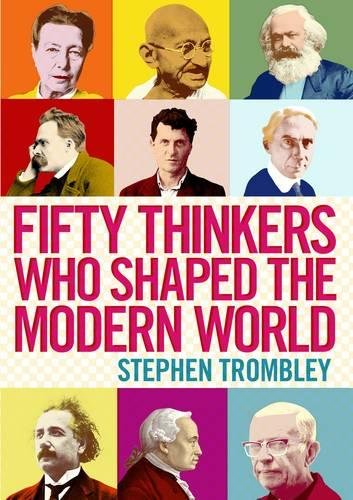
I bought a book for my niece, as a kind of survey of history of modern western thought, and she mentioned that she thought it was misleading that Gandhi was pictured on the cover, when he's not one of the "Fifty Thinkers" actually profiled. (He appears in the index but that's it.) She made the quite astute for her age (if that's not patronising) comment that this was probably because not many of the thinkers are very recognisable, and it got me to looking closer at the cover.
L-R, top to bottom, they are: de Beauvoir, Gandhi, Marx; Nietzsche, Wittgenstein, ???; Einstein, Kant, Sartre.
Who is ??? - right of the second row? It looks like it could be a youngish Bertrand Russell, or possibly AJ Ayer but I don't think the eyebrows are quite right. As an extreme longshot, does that picture leap out to anyone as obviously being a famous philosopher or thinker? The list of the 50 profiled can be found on the Amazon page, but it might not be one of those 50, given Gandhi.
Someone found a picture of Russell where it looks a bit more like him, but I'm still not entirely sure.
School started this week, this semester I'm doing a study abroad style program at the biggest maritime museum in the country, much of the course work is original research in science and history (with a chance of getting your work published too). In a few days I'll be sailing on the Brig USS Niagara, which will be a hell of an experience.
Hi /r/AskHistorians
I'm a big WWII buff and self-proclaimed hobbyist historian. I love doing research, reading books, watching documentaries and so on about WWII. However, I find that in real life this knowledge is almost useless. I'm 26, I have a bunch of friends and a steady job but quite frankly one of the things I enjoy most - not many people care about. I could spit out facts about WWII for days, and talk for hours about WWII related material - but no one wants to hear, or talk about this stuff at all. Sometimes I feel my hobby is rather pointless. Like, whats the point of learning all this stuff if I cant discuss or teach others about it? If though about teaching, but the pay isn't good enough, and i'd have to go back to college in order to get a proper degree.
I do have some friends that are interested in the topic- but more often than not my extensive knowledge trumps theirs so much that the conversations become one sided. That being said, I'd like to thank this sub for it's existence. It's one of the very few places I get to dish out some knowledge when a related question is asked every once in a while (if a flaired user doesn't beat me to the punch and write a dossier first)
So my question is, does anyone know another place where discussions on this topic are prevalent? Does anyone have any outlets to recommend, any other related hobbies I could get myself into to ease my frustrations?
side note - my specialty regarding this topic would be the Eastern Front, and more specifically the Wehrmacht. However, I've done so much reading that I could talk about any theater or side.
Thanks!
I asked this question about European fathers in the 19th century lamenting the lack of study or career options for their intelligent daughters. It got a bit of interest - 240 upvotes - but no replies.
I realise it's a borderline "example seeking" question. Is there a better way of asking the question or is the lack of responses more likely a result of no one with specialty seeing it at the time? Or did men generally not write about this stuff back then?
It's free for all so I hope I can post this in this thread.
I just want to say THANK YOU to the mods and contributors of this sub who bring their expertise to some of the most brilliant and random historical questions I would never dream of asking.
There is nothing I love more than seeing an interesting question on my front page with a series of [DELETED] comments below it because they didn't follow the community standards. This sub holds itself to the highest standard and I appreciate the thought provoking and well researched (and cited of course) responses.
So thank you again and keep history-ing on.
I was discussing with some other folks about good twitter/social media accounts to follow about politics, but it got me thinking.
I follow a few of my askhistorians friends on social media because they run their own blogs/twitter accounts etc. that share the latest in history writings, cool photos, book releases, historical perspective on current events, recent archaeological findings, etc. Of course there are other academics, institutions, and just cool folks that share their love of all things old on social media as well that I follow. What are some of your favorite social media accounts that share all things old and dusty?
I've been really getting into history podcasts lately, and I was wondering if people here had any recommendations? I'm currently listening to History of the Twentieth Century by Mark Painter, Tides of History by Patrick Wyman, Revolutions by Mike Duncan, and History of Byzantium.
What I would really be interested in is a podcast that focuses on economic, and social history as well as narrative history and / or one that covers a region outside of Europe and the US.
Is there any war, which you think the world would have been better off (whatever that means) had the lost side won it?
I'm not an expert in world history, but any war I can think of was won by good guys (except probably WWI where neither side was good nor bad): WWII, American Civil War, Greco-Persian War, etc. So do you think there was any war where "good guys" has lost?