I'm thinking both in terms of the hulls and sails of sailing ships hiding from other ships at night as well as modern warships running EMCON trying to avoid detection - does the standard gray color scheme work better to conceal ships than a black or patterned scheme would?
Who says the grey color scheme is not a form of camouflage? Given the different lighting conditions, the effects of haze, sea states, and various other factors, grey is a happy medium for most surface warships in that it reduces the visual signature better than other colors. Most merchant ships tend to avoid grey in lieu of high-visibility colors like red. Black camouflage is bad for daytime conditions and actually not all that effective at concealment at night.
This is not to say that navies have not tried out various forms of camouflage. Both World Wars saw various experiments in dazzle camouflage of geometric patterns to hide movements or break up outlines, such as USS Nebraska's 1818 1918 scheme. These schemes were interesting, but as /u/thefourthmaninaboat 's answer shows, they likely did not have all that much of an impact. Camouflaging large ships is both time-consuming and difficult to maintain. Some vessels that operate in littoral or riverine areas get camouflage or otherwise depart from the greys. The USS Freedom-class has received camouflage, but there has been some speculation that this camouflage is to cover up unsightly exhaust stains on the hull that showed up on the uniform grey (the rival Independence-class LCS do not have such a problem and have not received camouflage despite performing the same mission). But as a whole, extensive camouflage for modern peacetime navies is something not worth the expense and maintenance. It was of dubious utility in earlier conflicts in which visual sightings were an important part of fire-control and even less so in the modern battlefield with electronic tracking and sensors. Moreover, as the spate of recent USN collisions underscores, visual camouflage that is too effective or disruptive can be dangerous on the open-ocean. Dazzle camouflage's goal is to conceal a ship's movement and direction, not to hide the ship itself. This can be problematic in crowded shipping lanes during peacetime. Modern peacetime navies are partly about being seen (ie "showing the flag") and a uniform grey appearance is useful enough for existing military purposes and can be maintained much easier than more complex schemes.
Concealment can be quite difficult on ships. It's devilishly hard to get them to look simultaneously like water and sky. It's particularly difficult to find color combinations that work in bright sunlight and various states of dim light. It's also hard to find colors and patterns that work against surface ships, submarines, and airplanes.
The USN in WW2 tried a number of different "measures" (paint schemes). These were experimented with and changed throughout the war. And different ships had different paint jobs depending on location and threat assessment.
As an example you have measure 21. It was navy blue (N-5) low on the sides and deck blue (20-B) on the upper sides, deck, and superstructure. It was particularly effective against being spotted from the air... but made it terribly visible to any ships on the surface as it was high contrast vs the sky. It became a common site in the late war Pacific. Another late war scheme was measure 22. That had navy blue (N-5) up to the first deck and then haze grey (H-5) for the deck and superstructure. Measure 22 was far more popular in areas where submarines and surface ships were considered a bigger threat. It was heavily used in the Atlantic and for shore bombardment missions.
In addition to these standard camouflage patterns, the USN (and other navies) tried a variety of "dazzle" patterns like this (measure 12) designed to misdirect targeting information. If you can't hide your ship, and often you couldn't, you could at least make it hard to get a good read on its size, shape, speed, and direction. Here's another example using measure 32.
Ships that were intended to go close in to shore frequently got green paint schemes, with the green changing based on local expected vegetation, like this measure 31 scheme.
Now all of this is just highlighting a handful of camouflage patterns used by a single navy during a single war. But similar thoughts have gone into paint schemes for a long time. And that's not going into deceptive measures like painting a ship to look like a different ship, or from a different country.
does the standard gray color scheme work better to conceal ships than a black or patterned scheme would?
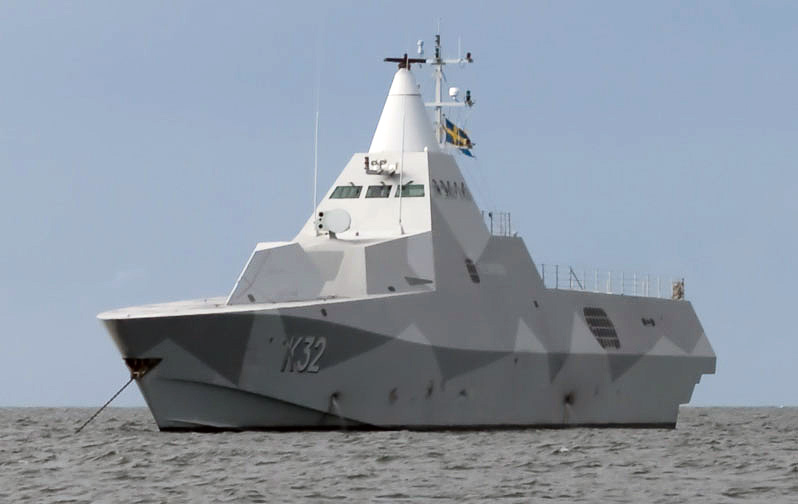
The standard "haze grey" and its variants are so popular for ships precisely because it tends to blend with the horizon so well. Various dazzle camos aren't as popular as they once were. Most navies worry more about radar and infrared than they do the human eye today. Which is why haze grey remains popular. It's effective, plus it's easy to maintain. And most ships are trying to look like just another piece of the horizon. But even modern ships will use modern variant of a dazzle paint job, like this, the Swedish HMS Helsingborg when it's considered appropriate.
More to be said here, but /u/thefourthmaninaboat's answer here should be of interest for you.