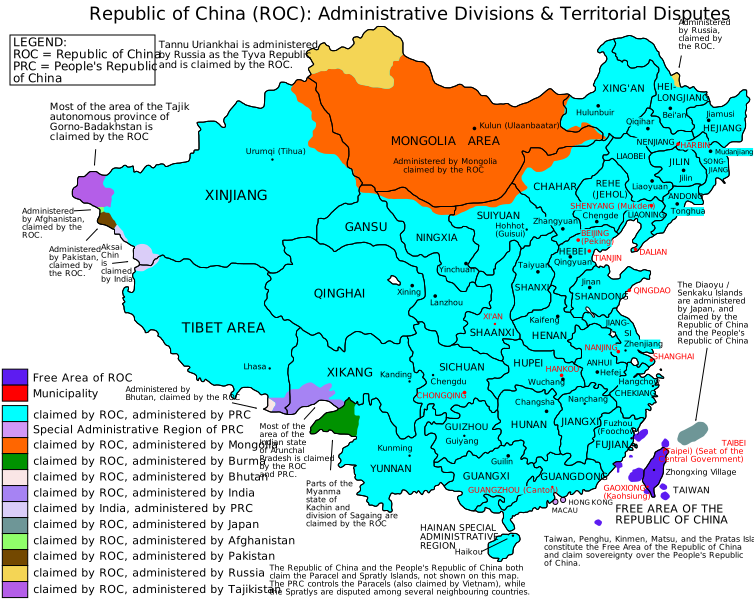
I remember reading that Tibet declared independence from China in 1913 and was reannexed in 1951 by Mao. I also read that the country was mostly feudal and retained most elements of medievalism before 1951. So how was the Chinese annexation of Tibet justified, and what does modern scholarship have to say about this justification? In addition, how did Tibetan society change because of it? How were these changes interpreted by the population, the Han Chinese and the foreign media/academic society?
Also, bonus question: How does the annexation of Tibet compare to the colonisation of Asia by the Europeans or the claiming of the so called terra nullius in America?
There are lots of questions here, and sensitive answers to them would be article-length or book-length. Tibet is difficult to discuss briefly because (a) the topic is very politicized, and (b) because commonly understood political forms and relations don't always precisely fit Tibetan societies (so terms such as "feudal" and "medievalism" can lead to misunderstanding rather than understanding).
To get you started: The justification for the invasion changed over time. The initial justification was to expel "imperialists." The idea that foreign imperialists were based in Tibet was not utterly without justification. The British had invaded Tibet in 1903, and during the first half of the 20th century there was a small but significant British presence in Lhasa. There were also rumored contacts between the Tibetan and Russian governments (let's wait for an expert to show up on that one).
However, following the invasion, the justification was made in two primary narratives: (1) that of Tibet "rejoining" the motherland and (2) that of "liberating" Tibetans from their oppressive government.
The first justification is based on the disputed claim that Tibet had become part of China ca. 1207, during the life of Sakya Pandita. The period of the 1720s is also pointed to here (when the Qing takes Lhasa, the capital of Tibet). Tibet being a "part" of China is disputed because the various Chinese/Mongol/Manchu invasions of Tibet did not seemed to "annex" Tibet to China; Tibetans also do not see themselves as being Chinese.
The second justification concerns the issue of whether one can be justified in invading their neighbor because that neighbor's government maintains a system of social inequality (just as one's own does). Tibet's traditional government is not a system that any of us would relish living under; contemporary history-minded Tibetans know this and complain bitterly in their own histories. Replacing that system of government via massive bloodshed and cultural destruction is an issue that is questioned by some.
These are interesting and complicated issues, and Tibetan history reads as a tragic soap opera. I have just pointed to a couple of names and dates to get you started.
For standard academic treatments of the issues you discuss, Melvyn Goldstein is one of the major authors. His "Snow Lion and the Dragon" is perhaps the shortest solid modern history. He also has massive (riveting) works that describe Tibet's modern fall in detail. Goldstein has also written about inequality, social mobility, and Tibet's traditional social system. Collected articles are here: http://case.edu/affil/tibet/CollectedArticles.htm
Tsering Shakya is also a notable historian in the field; his "Dragon in the Land of Snows" is a respected and engaging history.
The collected volume "Authenticating Tibet" (ed. Blondeau) also addresses many of your questions, in a short question-and-answer format, with pieces written by scholars in the field.
Feel free to ask more specific questions if you have them. All the responses here are getting erased; I am not a regular poster here, so I don't want to type more and have it erased....
This is an expanded version of my answer for a question that was previously posted on AskHistorians, but I believe this is also relevant here:
The Qing dynasty exerted influence over Tibet through ambans representing the Emperor in Beijing. The power of the ambans varied throughout the duration of the Qing, but had declined significantly by the end of the 19th century. In 1909, the Qing sought to reassert its control over Tibet by sending in Chinese troops. The 13th Dalai Lama fled to exile in India as the advancing Qing army entered Tibet. The Qing wanted to depose the 13th Dalai Lama, but realized that searching for a replacement would be difficult. Instead, they offered to return the Dalai Lama to Tibet as a subordinate figurehead with no political power.
But all of this became irrelevant with the Xinhai Revolution and the collapse of the Qing dynasty in 1911. The newly declared Republic of China (ROC), having overthrown their Manchu overlords, worked to re-envision China from an empire to a modern nation-state. One of core principles of the new Republic was to conceptualize the former empire as a multiethnic Chinese nation composed of "five races": Han, Manchu, Mongol, Muslim, and Tibetan. In modern China, this multiethnic nation is known as zhonghua minzhu. An early flag of the ROC represents each of these "races" with different colored stripes (the black stripe symbolizes the Tibetans). This idea of a united and harmonious multiethnic Chinese nation would be the primary motivating factor for future interventions in Tibet. As the last Emperor of China abdicated, he declared:
Let Yuan Shikai organize with full powers a provisional republican government, and confer with the Republican army as to methods of union, thus assuring peace to the people and tranquility to the Empire, and forming one Great Republic of China by the union as heretofore of the five peoples, namely, Manchus, Chinese, Mongols, Mohammedans, and Tibetans, together with their territory in its integrity.
Yuan Shikai, the Provisional President of the ROC, wanted to integrate Tibet into the Republic as one of five races "united in one family". He sent the following letter to the 13th Dalai Lama, who was still in exile:
Now that the Republic has been firmly established and the Five Races deeply united into one family, the Dalai Lama is naturally moved with a feeling of deep attachment to the mother country. Under the circumstances, his former errors should be overlooked, and his Title of Loyal and Submissive Vice-Regent, Great, Good, and Self-Existent Buddha is hereby restored to him, in the hope that he may prove a support to the Yellow Church and a help to the Republic.
The Dalai Lama responded by saying that he had no interest in returning to his role solely as a religious leader, and intended to obtain both political and spiritual authority over Tibet. When the Dalai Lama returned to Tibet, he issued a proclamation that essentially, but not formally, declared that Tibet was now independent from China.
On my arrival in India, I dispatched several telegrams to the Emperor; but his reply to my demands was delayed by corrupt officials at Peking. Meanwhile, the Manchu empire collapsed. The Tibetans were encouraged to expel the Chinese from central Tibet. I, too, returned safely to my rightful and sacred country, and I am now in the course of driving out the remnants of Chinese troops from DoKham in Eastern Tibet. Now, the Chinese intention of colonizing Tibet under the patron-priest relationship has faded like a rainbow in the sky.
Qing soldiers were expelled from Tibet. By 1913, the breakaway regions of Mongolia and Tibet mutually recognized their independence from China:
Mongolia and Tibet, having freed themselves from the dynasty of the Manchus and separated from China, have formed their own independent States, and, having in view that both States from time immemorial have professed one and the same religion, with a view to strengthening their historic and mutual friendship.
The ROC leadership did not recognize the independence of Tibet. The Republic was founded as a union of different races under a single nation. Letting Tibet go was tantamount to the disintegration of the Chinese nation. When the People's Republic of China (PRC) replaced the ROC in Mainland China (the ROC retreated to Taiwan), the PRC inherited the ROC's notion of a united Chinese nation, but recast the narrative into a Marxist framework. Like the ROC, the PRC sought to assimilate Tibet by redefining Tibetans as a Chinese minority ethnicity in multinational state composed of many ethnic groups. In an interview with Edgar Snow in 1936, Mao reiterated the ROC notion of China as a union of five races:
When the People's Revolution has been victorious in China, the Outer Mongolian republic will automatically become a part of the Chinese federation, at its own will. The Mohammedan and Tibetan peoples, likewise, will form autonomous republics attached to the China federation.
The PRC viewed the idea of "losing" Tibet as another symptom of a weakened China that had undergone a "century of humiliation" due to the interference of Western and Japanese colonial powers. From the PRC perspective, the decision to annex Tibet stemmed from a greater desire to expel foreign influences and restore the national dignity that had eroded during the end of the Qing dynasty and under the Nationalists. A 1954 report circulated among members of the Chinese Community Party discusses this idea:
Tibet and the motherland have had a close, inseparable relationship since a long time ago. Tibet is one part of the territory of our great motherland. However, after the Republican Revolution (1911), Tibet’s rulers, who were controlled and manipulated by imperialists, abandoned the motherland and went to rely on the imperialists. To a great extent, imperialists controlled Tibet, signed unfair treaties and gained great privilege in the spheres of politics, economics, and military. Also they took numerous pieces of territory from the border area of Tibet. Because of the development of the anti-imperialist struggle of the entire Chinese people and the existence of an anti-imperialist force within the Tibetan nationality (among them, including a part of the upperclass lamas and aristocrats), they failed to conquer the whole of Tibet. During this period of time, Tibet was semicolonial, and mainly took an independent attitude toward us.
The excerpts of primary sources come from Melvyn Goldstein's A History of Modern Tibet, 1913-1951, Sam Van Shaik's Tibet: A History, and other secondary sources.
As a related follow-up question, why didn't Communist China annex Mongolia, which was also part of the Qing state?
Ok, because my previous comments were removed because of the previous top comment's plagiarism, I'm going to try and concisely answer this question one more time.
There's basically three justifications that China used to annex Tibet: (1) Irredentism, (2) Nationalism, (3) Ideological.
1 Irredentism
I've discussed this before. The short version of the story is that the Qing Dynasty of China controlled Tibet through a complex series of events, starting possibly as early as 1652 (when the Fifth Dalai Lama Lobsang Gyatso visited the Shunzhi Emperor in Beijing^1) but more definitely and obviously in 1720 (when the Seventh Dalai Lama was brought into Lhasa at the head of a Manchu-Chinese army). Because the Himalayas, between British India and Qing China were both difficult to reach, map, and traverse, the border remained somewhat fluid and undefined (key word here being "somewhat"). After the simultaneous Chinese and Tibetan Revolutions in 1911, Britain wanted to solidify relationships in East Asia. Her goals were to (1) secure a favorable border for the India, (2) secure a favorable trade policy with China, and (3) keep Tibet within the British sphere, while allowing Chinese political borders as a defense against Russian influence (Van Schaik uses the term "Russophobia" to describe the attitudes of the British at the time).
In 1914, delegates from British India, Tibet, and China met in Simla, India to hammer out a treaty. You can read about it in detail in external sources (see below). But the tl;dr is that the Chinese came to Simla thinking it would be a cake-walk between them and the British, but the Tibetans came prepared with volumes of tax documents to show where their borders should be drawn. There was a significant problem over the wording of Chinese "sovreignty" vs. "suzerainty" in Tibet, with the latter being chosen because the Tibetans and British were on good terms throughout while the Chinese were simply demanding and trying to force their will onto the treaty. In the end, the Chinese delegation left without signing, while the British and Tibetans signed the Simla Treaty. There was a sheet stapled to the front of the document stating that Tibet and the Government of India agreed to uphold the treaty, even though the Chinese have walked out.
Fast forward a few years. China has enough of its own problems - enemies both internal and external - to bother with trying to secure its borders to the west. The breakdown of order that led to the Warlord Era, followed by the Communist Revolution and the Japanese Invasion pretty much put the Tibetan issue on indefinite hold. But the Republic of China, led by Chiang Kai-Shek still claimed all of Tibet, as well as the old Qing borders of China. (Note this map's different in borders between the Republic and the People's Republic.) The People's Republic, as a successor to the Republic (on the mainland at least) inherited those borders and now had to go about drawing new borders with her neighbors. To her north and west was easy, considering it was a Communist ally all the way through, but India was going to be a problem. And Tibet wasn't even considered since, by definition, Beijing didn't inherit the Simla Treaty from Taipei or even pretend to. But the Republic of India inherited Simla from the Government of India after her independence in 1947, which would cause problems leading to the 1962 Sino-Indian War.
But for all intents and purposes, both the Republic and People's Republic of China regarded Tibet as a piece of Chinese territory, and neither had ever signed a treaty otherwise.
2 Nationalism
The Qing Dynasty, China's last imperial house, was not ethnically Chinese. They were Manchu, previously known as the Jurchen, but changing their name in honor of the Buddhist Bodhisattva "Manjushri." After changing their name, adopting guns to their Mongol-style warfare, and being united under Nurhaci, the Manchu invaded Ming China, toppled it, and went about dominating east Asia. But it's important to remember that China was the biggest, and most important jewel in the Manchu Empire, but it was still a possession of the Manchu. The queue commonly associated with Chinese culture in the 19th Century, was actually an imposed symbol of colonialism to distinguish Manchu and Chinese. The Manchu were particularly notable for the heavy-handedness of their rule. So it doesn't come as a particular surprise that when the Revolution occurred in 1911, often the first act of rebellion for Chinese men was to cut off their queues and throw them at the feet of Manchu law enforcement.
When determining a flag, the architects of the Republic of China decided, somewhat arbitrarily, that the new China would represent "the five races under one union." Those five races were Han Chinese, Manchu, Mongol, Hui (Muslim), and Tibetan, represented by red, yellow, blue, white, and black, respectively. The five colored flag was flown from the revolution until 1928 when it was switched to the Koumintang Flag.^2
What the Chinese tend to ignore or forget is that there was a simultaneous Tibetan Revolution at the same time as the Chinese Revolution. And the only thing they really had in common was that they occurred at the same time as the Qing Dynasty was collapsing. The Tibetan Revolution was fed by resentment over the rule of the Ambans. The Ambans, as I wrote last time
The Ambans, not unlike ambassadors, had lots of legal immunity. Reading anything about them is like reading about some of the worst feudal landlords. They could pretty much act at will in Tibet with little fear of repurcussion. They could commandere property, take over whole villages and towns to enforce order or collect taxes, and execute people for offenses against the Qing. More than a few Ambans were murdered by Tibetans resentful of their rule. During one particular rebellion (I'd have to double check Van Schaik's Tibet: A History for the particulars) several hundred Tibetans were executed by "the slicing method" on the banks of the Yarlung River. Because of the memory of Qing/Amban cruelty, capital punishment was banished in Tibet during its brief period as an independent state (1912-1950).
And Tibet was well aware that, sure, they may have been represented as the bottom stripe on the Revolutionary Flag, they knew that Zhao Erfang, one of the last Ambans believed, again as I wrote before,
his and China's role in central Asia as "the British in Australia, the Americans in the Philippines, or the French in Madagascar." And in 1910, he launched an invasion of Kham, killing and executing Khampas at will with the intention to reorganize the area into an in-land Chinese colony, and to march all the way to Lhasa, planting Chinese colonies all along the way.
There's a reason the Tibetans call him "Butcher Zhao."
This led to the 13th Dalai Lama, acknowledging that the Republic of China believed it possessed all of Tibet, to issue a declaration of independence in 1913 (the year before the Simla Treaty) saying that the previous patron-priest relationship between China and Tibet had "faded like a rainbow in the sky."
The Chinese, all through the '20s, '30s, and '40s continued to think of Tibet as just another part of China, rebellious though it was. And most governments and maps around the world drew it as such. Britain acknowledged Tibet's status a suzerain to China until 2003, and India operated with special knowledge regarding Tibet's rights and responsibilities, and Tibetan historian Tsepon W. Shakabpa includes a large picture of his Tibetan-issue Passport that he used to travel the world with all of the stamps collected at western and Asian customs offices around the world, though they met Chinese resistance at almost every step of the way.^3
This image of a United Motherland was pushed by both the Nationalist and Communist Chinese from their inception all the way to the present day. In the 1980s, after Mao died, there was a significant effort made at walking back the stages of cruelty (IMO) and trying to harvest the socialist crop he'd sewed over the decades. Tibet was already under Communist control, but Taiwan still eluded her. So the goal was to try and entice the Dalai Lama and the exile Tibetan community back to Tibet with a grand tour of Tibet's "Socialist Transformation," and then hopefully Taiwan would realize there's nothing to be afraid of. Long story short, the whole situation backfired, with the Tibetan delegation realizing the extent of poverty in Tibet, the Tibetans themselves desperate for any news and contact with the outside world, and the Taiwanese reiterating simply that they had no interest in "socialist transformation."
Since 1989, during the botched compromise over the 11th Panchen Lama, Beijing has taken a hard stance against the Dalai Lama. Previously, they regarded him as a kind of "wayward son" who was too scared to take the full leap into Socialism (the Dalai Lama himself has, and still does, speak fondly of his time with Mao), but during the '90s their tactic switched into one stressing strict Chinese Nationalism (which Mao referred to repeatedly as "Han Chauvanism" which was supposed to be avoided) and constant denigration of the Dalai Lama, referring to him as a "splittist" and a "wolf in monk's robes."
Cont'd