Let's say links in a mail shirt are broken, or a war-hammer impales a hole through a helmet; could this kind of thing be repaired? Was it worth the effort?
The process of re-cycling and repairing armour can be quite different, so I will deal with these items separately.
First, yes, armour was repaired, though at what point damage was fixed and at what point it wasn't considered worthwhile isn't clear. Mail in particular is very easily repaired and modified - fixing broken links is quite easy, as is adding or subtracting links to tailor mail or change it to fit different uses. Multiple surviving mail shirts in collections show signs of later re-tailoring. Repairs are not always as obvious, but are still present. In fact, one of the first mail garments that survives has rows of butted links (that is, links closed without riveting) that may be a repair. In the 1360's the Tower of London maintained several people on staff to maintain, modify and repair mail garments - rolling them in barrels of sand to clean of rust, adding collars to make them more protective, and presumably fixing battle damage and wear and tear.
Plate armour is not as easily repaired as mail. One of the chief things that gives plate armour its strength is the homogeneity of the armour plates themselves - a breastplate that has been welded back together will not be as strong as one that is all in one piece. Nonetheless, plate armour was repaired. In the armours that survive in collections, there are multiple examples that show evidence of repair - though not too many. Alan Williams sees evidence of this in armours that may have been re-heated after being made, possibly indicating later repairs. These may be dents that needed to be hammered out rather than gashes, however.
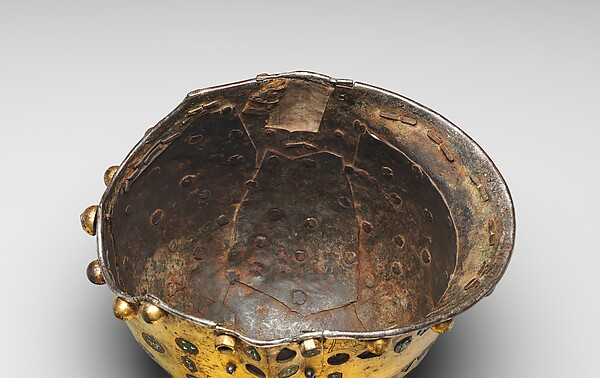
When you see a big patch in plate armour in a museum it is normally a 19th century restoration that is filling in a place where corrsion or other damage has made a hole. But sometimes these patches might be closer to the working life of the helmet. This parade sallet from Spain is an interesting case. Traditiionally it is thought to possibly be a moorish helmet from Granada, but others have argued that it is a parade helmet from Castille that uses Moorish motifs. One interesting possibility raised is that it was used in a combat game that had 'Moorish' and 'Christian' teams. The interior adds a wrinkle to this. When you look inside this sallet, you see patches - above these the helmet surface seems smooth and the decoration continues uninterrupted. This may be a restoration later in its life, but perhaps it was a working sallet patched and then decorated into a fantastical costume helmet for a tournament.
This gets us into recycling, which certainly happened. While most of the cost of armour was the labor that went into making it, steel itself was valuable enough that you wouldn't want to waste it. So how was it re-used? We have a few examples, and a few suggestions. First of all, mail armour might be cut up and made into other pieces of mail. For instance, mail shirts might have their sleeves and skirts removed in the 14th century so that these could serve as supplemental skirts and sleeves for people wearing plate armour. Plate armour might be cut up into small pieces. We know that the Jamestown settlers in the early 17th century cut up breastplates and turned them into 'jacks of plates' (fabric armours combining layers of fabric and plates of steel affixed to them). It is possible that some (many) brigandines ( latemedieval armours made of small plates rivetted to a backing) of the 15th century were made of cut-up pieces of plate armour. Another possibility is that the metal itself might be re-used to make armour. The armourers of Nuremberg used a material called 'half steel'. We do not know for sure what this is, but Alan Williams argues it might be the heterogenous, welded steel that some Nuremberg armours are made out of. This is the exact kind of steel that you would get if you hammered together, folded, welded etc. pieces of used plate armour. Finally, we have examples of plate armour that was no longer used as armour. There is the kettle hat turned kettle in the British Museum, and a sallet/kettle hat from the Hospitaller fortress of Rhodes that at some point seems to have been used as a kind of scoop or coal scuttle.
Sources:
-Alan Williams - the Knight and the Blast Furnace
-Thom Richardson - The medieval inventories of the Tower armouries 1320–1410
-Various Authors - The Art of Power: Royal Armour and Portraits from Imperial Spain